
SOURCE :- THE AGE NEWS
Washington: The US naval blockade of Iran that began on Monday (US time) has little precedent in recent decades, and the military has offered few details on how it might carry out the operation.
But previous operations in the Middle East may offer some clues to what the blockade could look like in practice. The Navy has a track record of monitoring the movements of merchant ships and taking them over, whether they want to be boarded or not.
What has the military said?
On Sunday, US President Donald Trump said he was ordering a blockade of Iran and the Strait of Hormuz, the narrow waterway separating the Persian Gulf and the Gulf of Oman that is a transit point for much of the world’s oil.
On Monday (US time), US Central Command, which oversees military operations in the Middle East, appeared to narrow the scope, saying it would prevent merchant ships from travelling to or from Iranian ports. An advisory issued to mariners in the region said details were “in development”.
Central Command said the blockade would be “enforced impartially against vessels of all nations” and would apply to Iranian ports on both sides of the strait.
When asked how the blockade would work in practice, Central Command pointed to a news release announcing the blockade, as well as an advisory issued by the United Kingdom Maritime Trade Operations organisation, which is administered by the British Royal Navy. Neither document says what would happen to merchant ships that try to run through the blockade.
How would the US monitor and intercept ships?
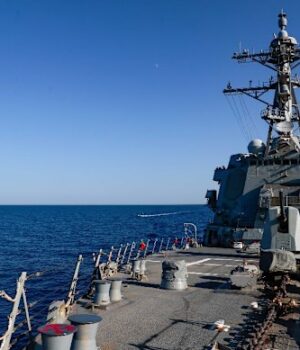
Navy destroyers could monitor Iranian ports with their radars, tracking the ships coming in and out of each, but that would require a large commitment of US warships to cover Iran’s long southern coast. Central Command could instead opt to keep a contingent of destroyers on either side of the Strait of Hormuz to board ships and use surveillance drones to monitor the ports instead.
Once a vessel has been identified as a “contact of interest”, a destroyer could be dispatched to intercept it.
After closing the distance between them and coming within visual range, the destroyer would most likely hail the vessel over maritime VHF radio, querying it according to a script that asks for information such as the ship’s destination, its last port of call, what kind of cargo it is carrying and the number of crew members aboard.
The warship could then ask the vessel to accept a “boarding party” of sailors to inspect it.
Ideally, the vessel would answer the warship’s radio calls and agree to be boarded, adjusting its course and speed and lowering a rope ladder to make the boarding safer and easier.
Or it could ignore the warship’s messages and try to make a run for it.
What happens if the US tries to board a ship?
A Navy boarding party could approach on a motorboat and use telescoping poles to hook a narrow caving ladder on the side of the target vessel. But the task becomes far more challenging and dangerous in rough seas, at night and when the target vessel is manoeuvring to foil the boarding.
The best option, then, is to fly the boarding team over in a helicopter and slide down thick, braided lines called fast-ropes to the ship’s deck. If helicopters are available, and the boarding party has the right training, fast-roping aboard is much safer and can be done far more quickly than attempting a “hook and climb” from a motorboat.
In recent memory, teams of Marines and Coast Guardsmen frequently fast-roped to board tankers in the Caribbean carrying Venezuelan oil. However, those tankers have cost the United States tens of millions of dollars to hold, and the Trump administration cannot legally sell their oil without a judge’s permission.
Does the Navy have much experience with this in the Persian Gulf?
Yes. More than a decade’s worth.
After the 1991 Persian Gulf War, the United Nations established a system allowing Iraq to export its oil so long as the proceeds from those sales benefited its citizens – often referred to as the “oil for food” program.
Navy warships routinely boarded tankers trying to smuggle Iraqi oil out of the Persian Gulf until US president George W. Bush ordered the invasion of Iraq in 2003.
The vast majority of those boardings were “compliant” – Navy parlance for when the boarded vessel co-operates.
Small teams of US sailors would be placed on tankers found to be smuggling Iraqi oil, and they would sail the ship to holding areas in the Gulf, code-named for professional baseball stadiums, such as Fenway and Comiskey, where the tanker would be anchored.
The ships would eventually go to a port in the Gulf where the host nation would sell the oil as payment for taking responsibility for the vessel and its crew. The tankers would be sold at auction, often purchased by the same holding company that owned the ship before.
It was a bit of a revolving door.
Has the Navy blockaded a country before?
Yes. But not in the Strait of Hormuz, and not at this scale for a long time.
The last time the service tried to blockade all shipping to a nation was in October 1962, when president John F. Kennedy ordered a “quarantine” of Cuba during the crisis over the Soviet Union’s deployment of nuclear weapons to the island nation. (“Quarantine” and “blockade” appear on different pages of the dictionary, but when applied to stopping shipping, they have the same meaning. Under international law, a naval blockade of a nation is an act of war.)
More recently, the Trump administration has carried out what it has sometimes called blockades of Venezuela and Cuba, but those targeted were oil shipments and did not approach the totality of the blockade on Iran.
This article originally appeared in The New York Times.
Get a note directly from our foreign correspondents on what’s making headlines around the world. Sign up for our weekly What in the World newsletter.


