
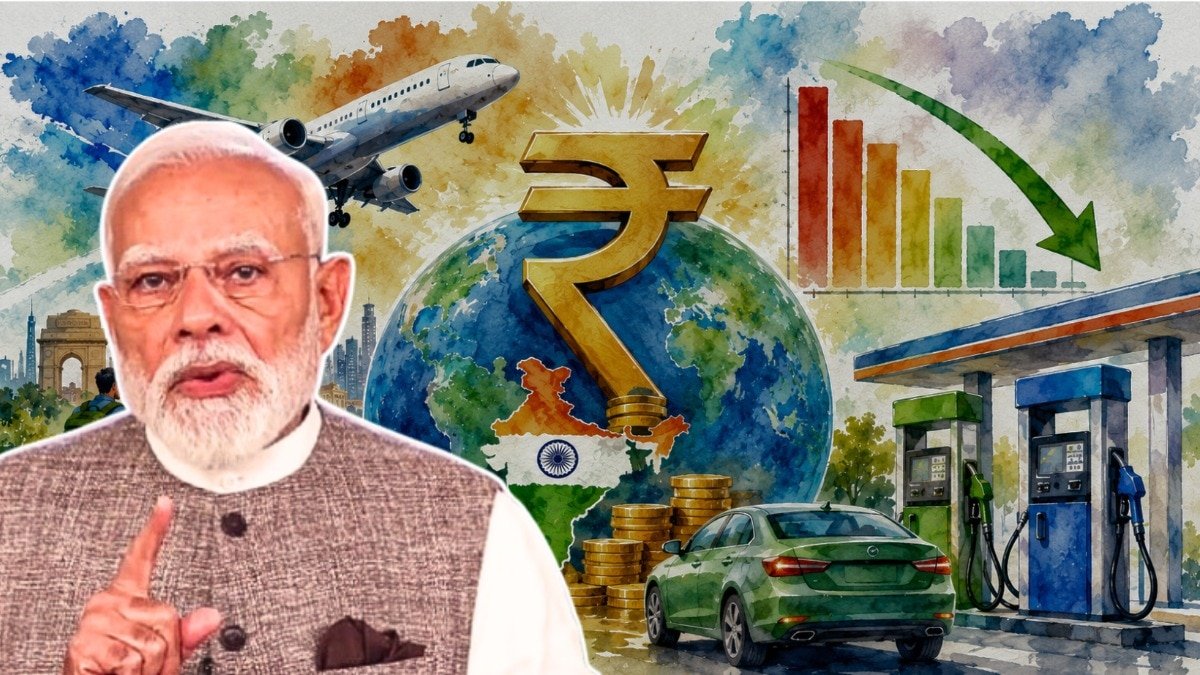
Source : INDIA TODAY NEWS
The reality of the war in the Middle East seems to be hitting India over two months after it started with the US and Israel attacking Iran. Though industrial hubs have been impacted and a panic over LPG refills was seen initially, most of India went about its business as usual. But India, which imports 90% of its energy needs, couldn’t have been left untouched by the crisis. Prime Minister Narendra Modi has urged Indians to use fuel judiciously, resort to work from home (WFH) and avoid foreign trips. The question is how much Indians can save for the country if they do as asked. Going by the Covid-19 years, we can reach a ballpark figure.
advertisement
PM Modi on Sunday, urged Indians to revive some of the habits last seen during the Covid years, like working from home where possible, avoiding non-essential foreign travel, reducing fuel consumption and buying less gold. Modi’s request came even as India is battling a massive surge in global oil prices triggered by the war in the Middle East.
Days later, Modi repeated the call during an event in Vadodara. He asked Indians to reduce the use of petrol and diesel, increase the use of public transport, carpooling, and advised WFH where possible. This was his second such appeal within about 24 hours.
With the Strait of Hormuz remaining disrupted for more than two-and-a-half months, India’s crude import bill has shot up.
Years ago, during the Covid-time lockdown (2020-2021), Indians unintentionally helped India save billions of dollars in crude imports and overseas spending simply by travelling less and consuming less fuel.
This time, unlike the Covid lockdown, there is no legal restriction. But the dips in the consumption of petrol, diesel and aviation fuel sales, show how Indians saved foreign reserves during the Covid-enforced lockdowns in 2020 and 2021.
HOW INDIA SAVED FOREX BY TRAVELLING LESS DURING COVID
Foreign exchange reserves are any nation’s first line of defence against external volatility, according to experts.
The fall in the number of Indians travelling abroad during the Covid lockdown, from a pre-pandemic peak of 2.69 crore departures in 2019 to just around 92 lakh in 2020 and 85 lakh in 2021, also helped India save millions of dollars in foreign exchange.
The decline was reflected not only in overseas travel spending, but also in aviation turbine fuel (ATF) consumption, which dropped sharply as international and domestic flights were curtailed.
During the Covid years, India witnessed one of the sharpest falls in petroleum consumption.
Between April and July 2020 alone, India spent $23.8 billion less on crude oil imports compared to the same period in 2019, according to Petroleum Planning and Analysis Cell (PPAC) data cited by news agency PTI.
Reduced commutes, widespread work from home (WFH), fewer flights and lower travel demand drastically cut India’s fuel consumption in 2020 and 2021.
Although PM Modi’s Sunday appeal was voluntary and not to be enforced like the Covid lockdown, the pandemic-era numbers give a glimpse into how much India can potentially save amid the Iran war, if citizens once again reduce fuel use and non-essential foreign travel.
Coinciding with the Covid lockdowns and relaxation of the norms. India’s forex reserves increased by approximately $125–150 billion, from around $478 billion in FY20 to $607 billion in FY22, according to RBI data.
India’s forex reserves are now racing to $700 billion (2025-26).
HOW MUCH DID INDIA SAVE ON PETROL AND DIESEL DURING COVID?
India imports nearly 90% of its crude oil requirement. So, every litre of petrol and diesel is directly linked to the country’s foreign exchange reserves.
When domestic fuel demand falls, India’s import bill also falls.
Official data from the Petroleum Planning and Analysis Cell (PPAC) shows petroleum consumption plunged during the Covid year of 2020-21.
Compared to 2019-20, petrol consumption fell by roughly 2 million metric tonnes during the lockdown year, while diesel consumption dropped by almost 10 million metric tonnes.
Petrol and diesel consumption (MMT)
| Year | Petrol (MMT) | Diesel (MMT) |
|---|---|---|
| 2018-19 | 28.3 | 83.5 |
| 2019-20 | 29.9 | 82.6 |
| 2020-21 | 27.9 | 72.7 |
| 2021-22 | 30.8 | 76.6 |
| 2022-23 | 34.9 | 85.9 |
| 2023-24 | 37.2 | 89.6 |
| 2024-25 | 40.5 | 91.4 |
| 2025-26 (proj.) | 42.0 | 94.7 |
The impact of these two widely used fuels on India’s forex bill was enormous.
Between April and July 2019, India spent $36.2 billion importing 74.9 million tonnes of crude oil. During the same four-month period in 2020, crude imports dropped to 57.2 million tonnes and the import bill collapsed to $12.4 billion.
That meant India spent $23.8 billion less on crude imports in just four months.
While the decline, induced by Covid, came under extraordinary circumstances, even moderate behavioural changes today, fewer car trips, more metro and local bus usage, hybrid offices and reduced leisure driving, could produce meaningful savings because India’s overall fuel consumption is now far higher than pre-Covid levels.
CAN WORK FROM HOME REALLY SAVE INDIA FOREX?
One of the biggest reasons behind the fall in fuel demand during Covid was the sudden rise of work from home (WFH).
Millions of Indians stopped commuting daily to offices and, as part of quarantine, people stopped visiting their friends and families. The shift reduced urban petrol consumption.
Corporate travel also collapsed as meetings shifted online.
Now, amid the Iran war, PM Modi’s appeal attempts to recreate some of those savings without imposing restrictions.
If even a section of India’s organised workforce shifts to a hybrid or a partial WFH schedule, the reduction in daily commuting could lower petrol and diesel demand substantially.
The petroleum consumption figures from the Covid years are important because they show the extent to which reduced mobility, fewer flights and work from home helped India cut fuel demand and save foreign exchange.
India’s petrol demand, which stood at 28.3 MMT in 2018-19, is now projected to touch 42 MMT in 2025-26.
Diesel demand is expected to rise close to 95 MMT in 2025-26.
Petrol consumption fell from 29.9 MMT in 2019-20 to 27.9 MMT in 2020-21. Diesel consumption dropped even more, from 82.6 MMT to 72.7 MMT during the Covid period.
That means even a small percentage reduction in usage today can translate into millions of tonnes of avoided crude imports.
HOW MUCH DID INDIA SAVE BY NOT FLYING ABROAD?
Prime Minister Narendra Modi also urged Indians to avoid non-essential foreign travel, which is another major source of foreign exchange outflow.
International travel affects India’s forex reserves in two ways.
First, Indians travelling abroad spend heavily on hotels, tourism, food, shopping and other expenses in foreign currency.
Secondly, the flights carrying lakhs of passengers consume large amounts of aviation turbine fuel (ATF). This increases India’s dependence on imported crude oil, which adds further pressure on the country’s import bill.
Aviation turbine fuel consumption (MMT)
| Year | ATF Consumption (MMT) |
|---|---|
| 2018-19 | 8.3 |
| 2019-20 | 8.0 |
| 2020-21 | 3.7 |
| 2021-22 | 5.01 |
| 2022-23 | 7.8 |
| 2023-24 | 8.2 |
Government data shows ATF consumption collapsed during the Covid pandemic. ATF consumption fell by more than half to 3.7 MMT during 2020-21 as international and domestic aviation nearly came to a standstill.
At the same time, outbound travel by Indians also came crashing, according to the data from the Ministry of Tourism.
The 72.9% collapse in outbound travel during 2020 significantly reduced overseas forex spending.
Today, outbound travel has rebounded well beyond pre-pandemic levels, with more than 3 crore Indians travelling abroad in 2024.
Indian nationals departing abroad
| Year | Departures |
|---|---|
| 2018 | 2.62 crore |
| 2019 | 2.69 crore |
| 2020 | 72.9 lakh |
| 2021 | 85.5 lakh |
| 2022 | 2.16 crore |
| 2023 | 2.78 crore |
| 2024 | 3.08 crore |
So, today, even a modest reduction in discretionary foreign holidays, luxury shopping trips and destination weddings could reduce pressure on India’s current account deficit during a period of elevated crude oil prices.
Apart from fuel and travel, Modi also flagged gold purchases as an area where restraint could help India conserve foreign exchange. India remains one of the world’s largest gold importers. Large gold imports widen the trade deficit because the precious metal is purchased largely through foreign exchange. Therefore, discretionary gold purchases during periods of high oil prices can help stabilise the Rupee and reduce external account pressure.
Readers must keep in mind that unlike the Covid-lockdown years, PM Modi’s appeal comes without legal restrictions. There are no curbs on offices, travel or mobility. The Centre appears to be banking on voluntary behavioural changes similar to those seen during the pandemic.
So, millions making some small adjustments — one extra WFH day, fewer leisure drives, avoiding a foreign holiday or delaying non-essential purchases — can collectively produce massive savings for India amid the war in the Middle East.
India’s oil dependence remains extremely high and the Middle East crisis is continuing to disrupt global energy markets. So, Modi’s message is, every litre of fuel saved, and every dollar not spent abroad helps India protect its foreign exchange reserves during a period of global uncertainty and volatility.
– Ends
SOURCE :- TIMES OF INDIA