

SOURCE :- SIASAT NEWS
On Thursday, April 30, the 62nd day of the US–Israeli war on Iran and 23 days into a fragile ceasefire, tensions remain high as Donald Trump reaffirmed Washington’s naval blockade, while Tehran signalled the possibility of escalation.
In remarks to Axios, Donald Trump said Iran was “choking like a stuffed pig” under the blockade and would eventually have to “give up”, insisting the United States would not ease pressure unless Tehran abandoned its nuclear ambitions.
Speaking from the Oval Office, he added that talks had seen some progress but stressed there would be no agreement without guarantees that Iran would not develop nuclear weapons.

Trump says UAE’s OPEC exit could ease oil prices
Donald Trump said the oil-rich United Arab Emirates’s decision to exit OPEC and OPEC+ on May 1 could help stabilise volatile markets shaken by the Iran war.
“I think ultimately it’s a good thing for getting the price of gas down, getting oil down, getting everything down,” Trump told reporters at the White House.
Trump advises against full-scale war in Lebanon
Donald Trump said in an interview with Axios on Wednesday that he had advised Benjamin Netanyahu to limit military action in Lebanon to “surgical” strikes and avoid a full-scale return to war.

Drone shot down near US Embassy in Baghdad
A surveillance drone flying near the US Embassy in Baghdad was shot down early on Thursday, Iraqi security sources said.
It was not immediately clear how the drone was downed, though both US Embassy and Iraqi defence systems were activated.
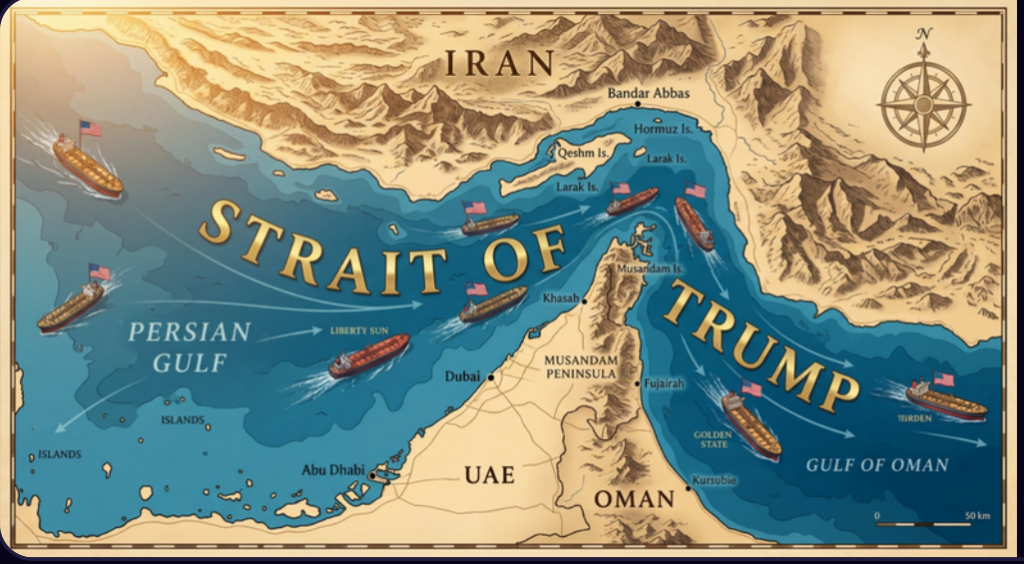
Map shows Strait of Hormuz as Trump
Trump shares a map of the Strait of Hormuz on Truth Social, highlighting US naval presence and key shipping routes amid rising Iran tensions.
US military pressure and blockade strategy
Trump said US operations had significantly weakened Iran’s military capacity, claiming its naval and air forces had been largely neutralised and much of its weapons infrastructure destroyed.
The United States Central Command said it has enforced a blockade on Iranian ports for more than two weeks, disrupting key trade routes. The aircraft carrier USS Gerald R. Ford continues operations in the Red Sea.
Reports indicate that CENTCOM has sought approval to deploy hypersonic missiles in the region, although no final decision has been made. US authorities are also pursuing legal steps to seize two Iranian-linked oil tankers captured during recent naval operations.
US officials further said Iran has not enriched uranium since strikes carried out in June.
Push for maritime coalition
The Wall Street Journal reported that Washington is working to build an international coalition to secure shipping through the Strait of Hormuz, a critical route for global energy supplies.
The initiative, described as “freedom of navigation”, would involve intelligence sharing, diplomatic coordination and enforcement of sanctions, with US diplomats urging allies to join.
Iran warns of escalation
Iran has rejected US claims and warned that continued enforcement of the blockade could trigger a strong response.
State media outlet Press TV quoted a security source as saying US actions amount to “maritime piracy” and could be met with “practical and unprecedented action”.
Iranian officials said restraint has limits, while a senior naval commander warned that new weapons systems would soon be deployed and could be used if tensions escalate further.
Parliament Speaker Mohammad Bagher Ghalibaf accused Washington of attempting to force Iran into surrender through economic pressure and internal division, dismissing claims that sanctions have severely disrupted the country’s oil sector.
Diplomatic efforts continue
Despite heightened rhetoric, diplomatic engagement appears to be ongoing. CNN reported that mediators, including those from Pakistan, expect a revised Iranian proposal after an earlier offer was rejected by Washington.
Trump said discussions are continuing by phone but indicated a preference for direct negotiations.
Israel–Lebanon tensions persist
Regional tensions remain elevated. Israel has intensified strikes in southern Lebanon, with Defence Minister Yisrael Katz ordering operations against what he described as militant infrastructure.
Lebanese President Joseph Aoun called for a ceasefire and renewed negotiations, while Israeli officials said Hezbollah activity continues to complicate efforts to stabilise the situation.
US defence stance and developments
US Defence Secretary Pete Hegseth defended Washington’s strategy before Congress, rejecting criticism that the conflict risks becoming prolonged and urging lawmakers to approve a USD 1.5 trillion defence budget.
Trump also said he had advised Israel to limit operations in Lebanon to targeted strikes and avoid widespread destruction.
Shipping incident and detainees
Six Iranian crew members detained aboard a US-seized vessel in the Strait of Hormuz have been released and returned to Iran, according to Iranian media, while 22 others remain in custody.
US officials said the vessel had been intercepted after failing to comply with navigation instructions in waters affected by the blockade.
Indian carriers resume Doha operations
In a sign of partial stabilisation, Indian carriers including Air India, Air India Express and IndiGo will resume full operations to Doha from May 1, reconnecting routes disrupted by the conflict.
SOURCE : SIASAT