
Source : INDIA TODAY NEWS
## ACT ONE: The Phone That Rang Too Late
Wednesday Morning, April 22, 2026 — New Delhi
Arvind Kejriwal is not a man who panics easily. He has survived jail. He has survived a liquor scam case that took down his closest lieutenants. He rebuilt a party from the wreckage of Delhi’s worst electoral defeat. But on the morning of April 22nd, what he was hearing from inside Parliament’s corridors made him reach for his phone with an urgency his aides had rarely seen.
advertisement
He started calling his MPs.
One by one. The calls went out. Some picked up. Some did not. Some said the right things. And then came the eerie silence where there should have been reassurance.
What he suspected by Wednesday evening was certain by Thursday. Seven of his ten Rajya Sabha MPs were gone. Not leaving. Already gone. The signatures were likely already on paper. What he was watching was not a rebellion in motion. It was a fait accompli being revealed to him in slow motion.
The most devastating detail? Till Friday morning, hours before the press conference, Kejriwal was still calling Sandeep Pathak. Still being told: Pathak is with us. Pathak has not broken.
Pathak walked into BJP headquarters on Friday afternoon.
— — —
## ACT TWO
Amit Shah’s Calendar — And the Plan That Had to Change
The Week of April 20 — West Bengal to New Delhi
To understand April 24, you have to go back to a plan that was never supposed to happen on a Friday.
The original design was deliberate and ceremonial. Home Minister Amit Shah, deep in West Bengal’s election campaign through the week, was scheduled to return to Delhi on Monday, April 20. The plan: all seven MPs would meet him in person. A formal blessing. A photograph that would never be published. Then on Tuesday, April 22, they would walk out of AAP together and make the announcement.
It was to be Shah’s homecoming gift to himself. Punjab 2027, giftwrapped.
Then Kejriwal’s phones started ringing.
Sources say AAP got wind of the operation sometime Wednesday. The calls from Kejriwal’s office became relentless, to each MP, to their aides, to anyone who might still be reachable. The panic was visible enough that word got back to BJP’s operation room. The timeline was no longer safe.
A decision was made. Move now. Do not wait for Monday. Do not wait for the in-person meeting with the Home Minister. The seven were already committed. The letters were ready. Get it done before Kejriwal could peel even one of them away.
Tuesday became Friday. The ceremonial meeting with the HM, the moment that was meant to crown the operation, was sacrificed for speed. Shah would have to welcome them from a distance. The sweets at BJP headquarters would have to be enough.
It was. By Friday afternoon, it was already over.
— — —
## ACT THREE
The Architect
The Man Who Built the Bridge — Raghav Chadha
If Amit Shah was the general, Raghav Chadha was the field commander who made it possible. And his journey to this moment did not begin in April 2026. It began years earlier, in the shadow of the Delhi excise policy case.
Sources say Chadha had been in quiet contact with the BJP since the excise case began engulfing AAP’s senior leadership. He was Kejriwal’s raazdaar, his confidant, his financial brain. As the ED closed in on Manish Sisodia and others, Chadha found himself in an impossible position: too close to the fire to be untouched, too valuable to be easily sacrificed.
Then came what sources describe as a decisive intervention. Through certain family connections – the kind that bridge Bollywood and the political corridors of Delhi with ease – word reached Chadha. Go to London. Stay for a few months. Keep a low profile. Let the dust settle.
He went. The party line was medical, a vitrectomy surgery on his eye. His colleague Saurabh Bhardwaj vouched for it publicly. The surgery was real. But the extended stay, the months of absence from AAP events, from Punjab campaigns, from party functions, had another layer entirely. London was not just a hospital. It was a recalibration.
When he returned, Chadha was not the man who had once delivered fire-and-brimstone speeches against Prime Minister Narendra Modi’s tax policies in the Rajya Sabha. Those posts quietly disappeared from his social media. What replaced them was a careful, softened, neutral public persona.
AAP noticed. They called it being “compromised.” They said he was scared of Modi. In their own way, they were right. They just drew the wrong conclusion about what he would do next.
It was Chadha who then quietly went to work on the other six. One conversation at a time. One reassurance at a time. He knew these men, their frustrations, their ambitions, their unspoken resentments. He knew exactly which door to knock on, and exactly what to say when it opened.
— — —
## ACT FOUR
Harbhajan – The Catch
The Turbanator Who Was Reeled In Long Before April
Of the seven, Harbhajan Singh was perhaps the least surprising to those watching closely, because in a very real sense, his defection had already happened. Just not publicly.
Sources say the former Indian cricketer had been in BJP’s orbit for months, quietly and steadily. But there was one moment that crystallised the depth of that hold – it didn’t happen in April, but much earlier, during a crucial Rajya Sabha vote.
Harbhajan was not in Delhi. He had skipped. As he had skipped before, and would skip again. But this time, the call that came was not from AAP’s whip office. Sources say it was a call from someone inside the BCCI.
Harbhajan flew in. He voted. He went back.
Think about what that moment reveals. The man who could move Harbhajan Singh was not Arvind Kejriwal. It was not the AAP whip.
— — —
## ACT FIVE
The Ghost Bench
The Industry MPs Who Were Always BJP’s B-Team
Here is the story AAP does not want told. Of the seven who defected, several were never really parliamentarians to begin with. They were marquee names. Brand ambassadors. Faces on a party poster.
Rajinder Gupta, founder of the Trident Group, one of Punjab’s most powerful textile and paper conglomerates. A man whose business instincts are, at their core, those of someone who goes where the government is. He entered the Rajya Sabha in November 2025. He had barely warmed his seat when ‘the call came to move’. In Parliament, he was invisible. On Punjab, he spoke warmly. Against the BJP, he never found the words though.
Vikramjit Sahney, businessman, Padma Shri awardee, social worker by designation, political passenger by practice. Like Gupta, his presence in the Rajya Sabha was more symbolic than substantive. The debates happened without him. When he could be found at all, the votes went through the motions.
Ashok Mittal, chancellor of Lovely Professional University, one of Punjab’s largest private educational institutions. A man whose entire operation depends on regulatory goodwill from the Centre. When the Enforcement Directorate knocked on his door on April 15, just nine days before the merger, the choice before him was not really a choice at all.
The pattern across all three is identical. They spoke about Punjab constantly. They attended events, gave sound bites, wore the AAP cap for photographs. But in the Rajya Sabha, when it mattered, when division bells rang and votes were called, their seats were empty. The party whip would go out. The phones would ring. Excuses would come back.
As one insider put it with brutal honesty: “They were already BJP’s B-team. Raghav’s coaxing just made it official.”
— — —
## ACT SIX
Sandeep Pathak — The Knife in the Back
The Man Who Built AAP Punjab. Then Unmade It.
Of all seven, Sandeep Pathak is the one that truly broke Arvind Kejriwal.
Not Chadha, whose estrangement had been brewing publicly for months. Not Harbhajan, whom everyone knew was a figurehead. Not even Swati Maliwal, who had spent months publicly attacking Kejriwal following her own assault allegations at the party’s inner sanctum.
Pathak.
The karyakarta who had given a decade to building AAP’s Punjab machine from nothing. The man who knew every district president, every booth worker, every village-level organiser in the state. The man who, more than anyone, owned the 2022 Punjab election, the historic 92-seat sweep that remains AAP’s greatest ever victory. He distributed the tickets. He made the calls. He put the right people in the right seats.
And then, after Delhi fell, after AAP lost the capital, Pathak was quietly put on a shelf. The men who had not done a fraction of what he had built began taking credit for Punjab. The Kejriwal inner circle tightened. Pathak was given a title and no territory.
He said nothing publicly. He smiled for the cameras. He kept attending the meetings.
And he kept his own counsel entirely.
Till Friday morning, Kejriwal believed he was safe. Sources say AK was on the phone with Pathak through the morning. The reassurances were warm. Convincing enough that Kejriwal was telling his own team: Pathak is solid. Pathak has not moved.
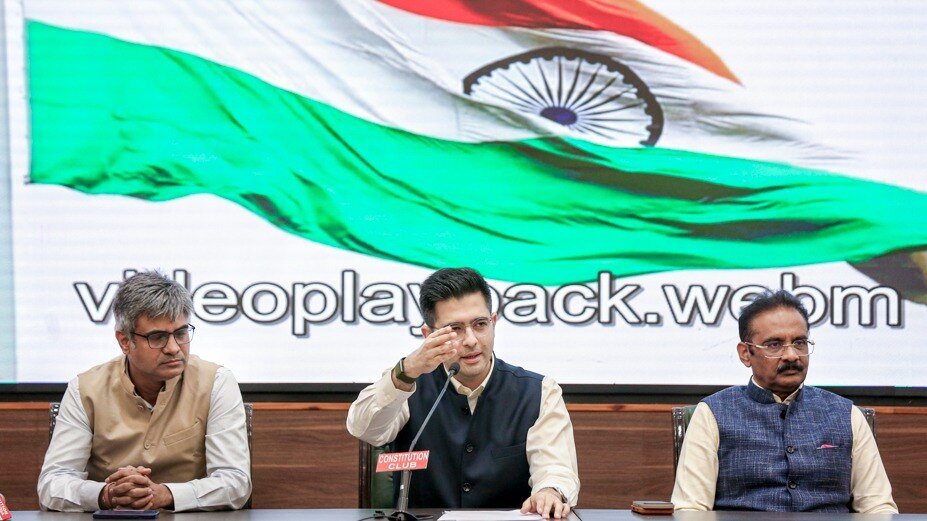
At 11 AM on Friday, Sandeep Pathak stood beside Raghav Chadha at a press conference in Delhi.
He did not need to say much. His presence said everything.
— — —
## ACT SEVEN
The ED Play
April 15 — The Lever on Ashok Mittal
Nine days before the merger, the Enforcement Directorate descended on Lovely Professional University. The FEMA probe targeted entities linked to Ashok Mittal, the man AAP had just elevated to replace Chadha as Rajya Sabha deputy leader, as if handing him a shield.
The shield did not hold.
Here is what makes the timing particularly revealing: AAP did get a signal when the raids happened. But they read it wrong. Inside the party, the ED action on Mittal was processed as isolated pressure, the Centre squeezing a business-MP who had become inconvenient. A warning shot, perhaps. Not a recruitment tool.
They saw the tree. They missed the forest entirely.
What AAP did not know, rather could not have known without seeing the full operation, was that Mittal’s ED raid was just one act in a seven-person play already in motion. While Kejriwal’s team was busy calculating what the raids meant for Mittal individually, Chadha was already across town, quietly finalising the signatures of six other MPs.
Whether the raids were leverage, a warning, or both is unresolved but undebated in Delhi.
— — —
Babaji – The Name No One Is Saying Yet
The story is not over. Sources indicate that Babaji, a significant religious and political figure with deep roots in Punjab’s social fabric, is also expected to make the move to BJP. He did not join on April 24. The timing, for reasons not yet public, was held back.
Watch for this name. When Babaji moves, it will not be a parliamentary story. It will be a cultural and spiritual signal, aimed at the gurdwaras, the villages, the voter who decides Punjab on feeling as much as on fact. Mission Punjab’s second phase will have begun.
— — —
What BJP Actually Gains – The Real Arithmetic Behind the Theatre
Strip away the drama, the press conferences, and the political one-upmanship, and a harder question sits underneath. What did BJP actually gain?
The honest answer: politically, very little. Apart from Sandeep Pathak and Raghav Chadha, none of the five remaining MPs carry any meaningful political weight in Punjab. Rajinder Gupta, Vikramjit Sahney, Ashok Mittal, Harbhajan Singh, Swati Maliwal – they are not leaders who can open villages, shift castes, or deliver constituencies. They are industrialists, celebrities, and ticket-holders who were always more useful to AAP as fundraising credibility than as ground organisers. They brought no grassroots machinery into BJP. They brought no voter bloc that was not already predisposed to the ruling party.
In Punjab itself, BJP does not gain an inch of electoral territory from this merger. The state remains as difficult for the party as it was on Thursday. The 2027 Punjab Assembly election will not be won or lost because Vikramjit Sahney changed his party affiliation.
These were, in the language of Indian politics, auctioned tickets, classic Rajya Sabha nominations handed to industry-friendly faces by a party that was funds-starved and needed to keep its donors comfortable. That transaction was always about money, not mandate.
What BJP gains is entirely different, and entirely parliamentary. Before Friday’s rebellion, the BJP held 106 seats in the Rajya Sabha. That arithmetic made every significant bill a negotiation. Every floor vote carried risk. The opposition retained, effectively, a veto on legislation that required the Upper House.
The seven defectors ended that. BJP’s standalone tally rose to 113. The NDA’s combined strength crossed the simple majority mark for the first time, ending the opposition’s ability to stall ordinary legislation. For the first time since the era of single-party Congress dominance, the ruling coalition can push bills through the Upper House without leaning on neutral regional outfits or chasing issue-based support.
This is not Punjab strategy. This is Parliament strategy. The real prize was never the 2027 election. It was the legislative agenda of PM Modi’s third term. One Nation One Election. Pending constitutional amendments. Budgetary legislation. The Rajya Sabha was the last wall of resistance. On April 24, 2026, that wall came down.
Seven MPs. No political weight. Total parliamentary value. Mission accomplished.
— — —
## EPILOGUE
What’s Left
Friday Evening, April 24, 2026 — New Delhi
By sundown on Friday, it was final. AAP, the party that swept Punjab with 92 seats, that once held ten Rajya Sabha MPs and dreamed of becoming India’s third national force, was down to three in the Upper House – Sanjay Singh. ND Gupta. Balbir Singh Seechewal.
Arvind Kejriwal put out a single line on X: “BJP has once again shoved Punjabis.”
The statement of a man who had run out of things to say and options to play.
Across town at the BJP headquarters, party chief Nitin Nabin offered sweets. Tarun Chugh and Arun Singh, National General Secretaries and strategists, stood in the background. And somewhere in the strategic mind of a man who has spent two decades playing India’s most ruthless political chess, another box was quietly ticked.
Punjab 2027. The real game has just begun.
– Ends
Tune In
Must Watch
SOURCE :- TIMES OF INDIA


