
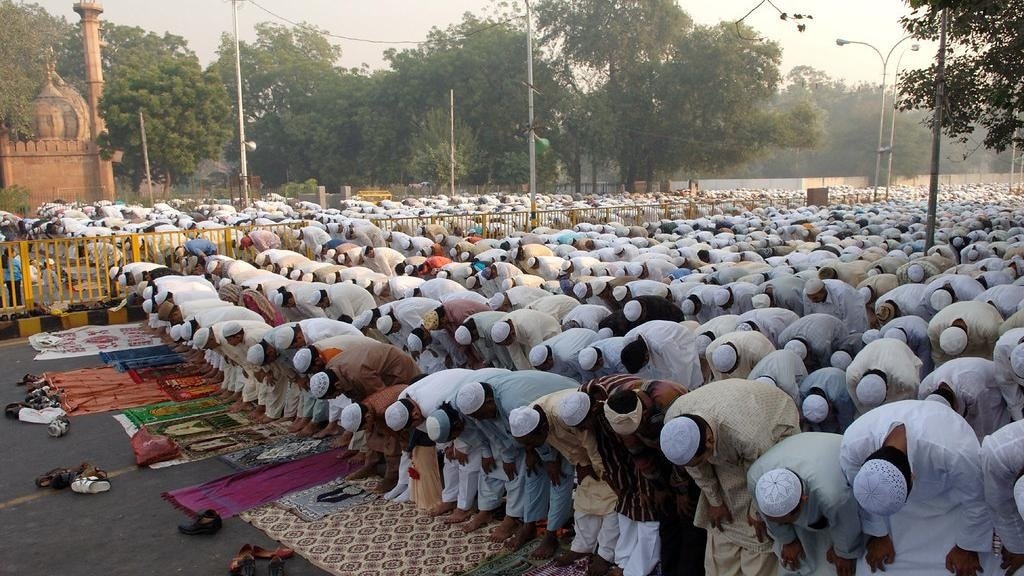
Source : INDIA TODAY NEWS
The Allahabad High Court has ruled that public land cannot be used as a matter of right for offering namaz or holding large-scale religious gatherings, observing that the constitutional right to religious freedom is subject to public order and the rights of others.
The court made the observations while dismissing a plea seeking permission to offer namaz on land in Ikona village in Uttar Pradesh‘s Sambhal district. A division bench of Justices Garima Prasad and Saral Srivastava rejected the plea filed by one Aseen, who claimed the land was his private property and sought protection from authorities to conduct prayers there.
advertisement
According to the petitioner, he was being unlawfully prevented from offering namaz despite owning the land through a registered gift deed dated June 16, 2023, according to LawBeat. He argued that restrictions on prayers violated his constitutional rights, maintaining that offering namaz on private property does not require prior permission.
The Uttar Pradesh government opposed the plea, contending that the land is recorded in revenue records as “Abadi land” (inhabited land) meant for public use and that the petitioner had failed to establish legal ownership. Authorities argued that the gift deed cited by the petitioner lacked essential land identifiers and relied only on vague boundary descriptions, LawBeat reported.
The state government told the court that namaz had traditionally been offered at the site only during Eid and that no restrictions had been imposed on such customary practice. However, it alleged that the petitioner was attempting to introduce regular congregational prayers by inviting people from within and outside the village, which could disturb the local social balance, according to LawBeat.
The High Court held that while the Constitution guarantees religious freedom, it was expressly subject to public order, morality and health. The bench said that public land is intended for common use and cannot be appropriated for recurring religious activities that may affect access, movement or civic order.
The court also drew a distinction between private worship and organised religious gatherings. It observed that personal prayer within a household or a limited private setting remains protected, but once such activity becomes organised and involves a larger gathering, it acquires a public character and can be regulated by the state government, LawBeat reported.
The bench further said authorities need not wait for an actual disturbance to occur and are empowered to take preventive action if an activity is likely to affect public order or communal harmony. Since the petitioner failed to prove ownership and the land continued to be classified as public land, the court dismissed the plea.
– Ends
Tune In
Must Watch
SOURCE :- TIMES OF INDIA


