
source : the age
When Frank Giamarelos arrived at the Austin Hospital for an Australian-first twice transplantation, both his kidney and liver were still intact.
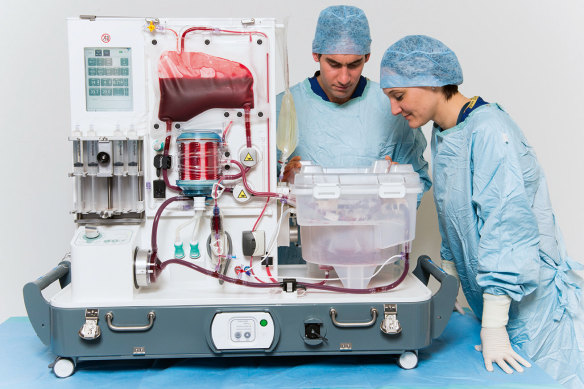
The heart was receiving sugar and vitamins through normothermic system oxygenation instead of being inside a human body and resting in a plastic container.
The black reddish-brown organ was even passing warm, oxygenated blood through plastic pipes, allowing the liver to produce its own venom and purify it of any toxins.
Another device hummed aside, keeping a donor kidneys in lively sleep, its tissue still breathing and processing air as if it had never left a system at all.
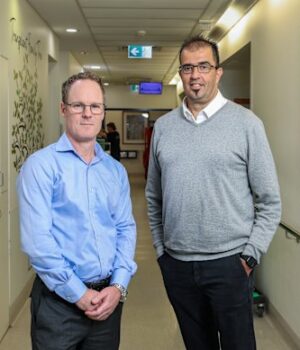
Associate Professor John Whitlam, the medical director of Austin Health’s liver transplant service, stated that ischemia technology was changing every aspect of organ implants in Australia and around the world.
This included the operating procedures used by doctors, the types of individuals who may donate organs, and even the results for the patients.
The notion that you generally have an tissue outside the brain and it’s being kept alive by a machine is “quite technology fantasy,” Whitlam said. It is” very nice, it’s very weird,” the saying goes.
Crucially, instrument oxygenation allows Austin Hospital’s doctors and transplantation specialists to evaluate the validity of donated organs before transplanting them. The tech succeeds because it can accurately recreate the conditions inside a human brain.
” It is very nice, it’s very weird,” it said.Associate Professor John Whitlam, the medical director of Austin Health’s liver transplant service, is
For the first time in Australia, a group at the Austin Hospital in Melbourne performed a triple transplant on a 51-year-old father of two Frank Giamarelos, who was battling tissue failure.
Inheritance idiopathic liver and kidney disease, a rare genetic disorder, was discovered in Giamarelos. His chest protruded as his heart grew to more than nine kilograms, and his liver grew to 1.2 kilograms, giving him crippling pain.
He was left struggling to breathe, suffering from severe back problems, and occasionally getting so exhausted that he couldn’t even walk.
Giamarelos ‘ kidney function was reportedly 6 %. He had been on the tissue list for nearly two decades until a late-night call in October of that year revealed that a donor had suddenly provided him with a kidney and liver.
Giamarelos had consented to being a part of groundbreaking study at the Austin Hospital before this visit, which meant he could be the first patient in the nation to have both organs sprayed before transplant.
Giamarelos, a doctor who specializes in medical diagnostics, did not hesitate to enroll in the research.
He said,” I was aware of the risks, but I was willing to take those challenges.” These tests, if you want to contact them that, are essential to contemporary treatments and can benefit a lot of people in the future.
By the time Giamarelos underwent the grueling and challenging 16-hour operation, according to Austin Health transplant doctor Graham Starkey, his kidney and liver were enlarge and riddled with fluid-filled tumors.
He claimed that the cysts resembled “little liquid balloons.” It appeared to be a piece of space, similar to the moon’s area.
According to Starkey, perfusion allows organs to be securely stored for several hours longer, extending the time frame for transplantation.
The primary goal of this is removing obstacles to someone like Frank getting a transplant, he said.
It allows us to handle lengthy, complicated situations without sacrificing the patient’s experience.
Whitlam claimed that while the heart was perfused with normothermic system perfusion, which maintains the instrument at a human body temperature of 37 degrees, the kidney was perfused with hypothermic machine perfusion.
Because it uses a cold liquid, kind of like expensive salt water, air is added to that liquid, passes through the organ, and maintains its hibernation, he said, making it simpler.
Its advantage is that it doesn’t degrade as much as it would at room temperatures.
This enabled safe storage of liver for up to 30 days. He claimed recently that the organs were “essentially kept in a cardboard box with snow.”
He said,” We call that static cold storage, and it kind of resembles an esky.”
The second hospital in the nation to offer both liver and kidney perfusion machines, which use normothermic and hypothermic oxidized technologies to preserve organs so that more transplants can be performed properly.

Following Giamarelos ‘ groundbreaking surgery last year, medical staff at the hospital safely performed yet another twice transplant, requiring both organs to be perfused before being transplanted.
Since the doctor first used the technology, it has been used for more than 200 implants. In some cases, the doctor has frozen organs before transferring them to other transplantation centers in Australia to save lives.
Only about 23 percent of eligible people in Victoria have registered as organ donors, compared to the state’s average of 36 % and South Australia’s 72 %, which is extremely low.
The buried, private contributors and their families are the true heroes of the account, according to the authors.
Giamarelos is still keenly aware that a family in Australia lost someone they love in order for him to receive a second chance.
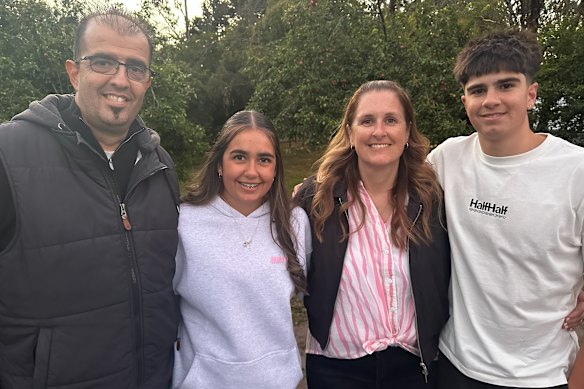
He said,” I am just so grateful to that family for making that decision in one of their worst moments.”
It is” the most amazing point,” the author states. They are restraining me from my current situation.
He wants to maximize the results of his next opportunity. He enjoys playing footy once more in the area with his 16-year-old child Jordan, and he plans to take his family on a boat trip to Mexico this year while traveling abroad.
When something like this occurs, you always take a moment for granted, he said.
Visit DonateLife to learn more about tissue donation in Australia.
Be the first to learn about important information. Sign up for news updates via email or through the app’s messages.
