
Source : INDIA TODAY NEWS
The sweep of 2014 had placed Jayalalithaa at a height that suggested not merely victory, but absolute control. Tamil Nadu had returned her with emphatic clarity in Parliament, winning 37 out of 39 seats. Her authority at home was unchallenged, and the arithmetic of Delhi had begun to include her as a variable, not an afterthought. It was the kind of moment that, in politics, is often mistaken for permanence. But in Tamil Nadu, permanence is a rumour. Power travels with memory, law and reversal, and it often chooses the moment of greatest certainty to turn.
advertisement
From Fort to Court
On September 27, 2014, that turn came. Jayalalithaa had travelled to Bengaluru to hear the verdict in the disproportionate assets case — a legal marathon that had stretched across nearly two decades. This case had survived multiple governments, crossed state boundaries from Chennai to Karnataka, and outlived several political phases. She went, by all accounts, confident of a favourable closure. There was no elaborate preparation for detention, no sign of a leader anticipating incarceration. The expectation within her camp was of acquittal and return — a day trip to court, a night back in Chennai.
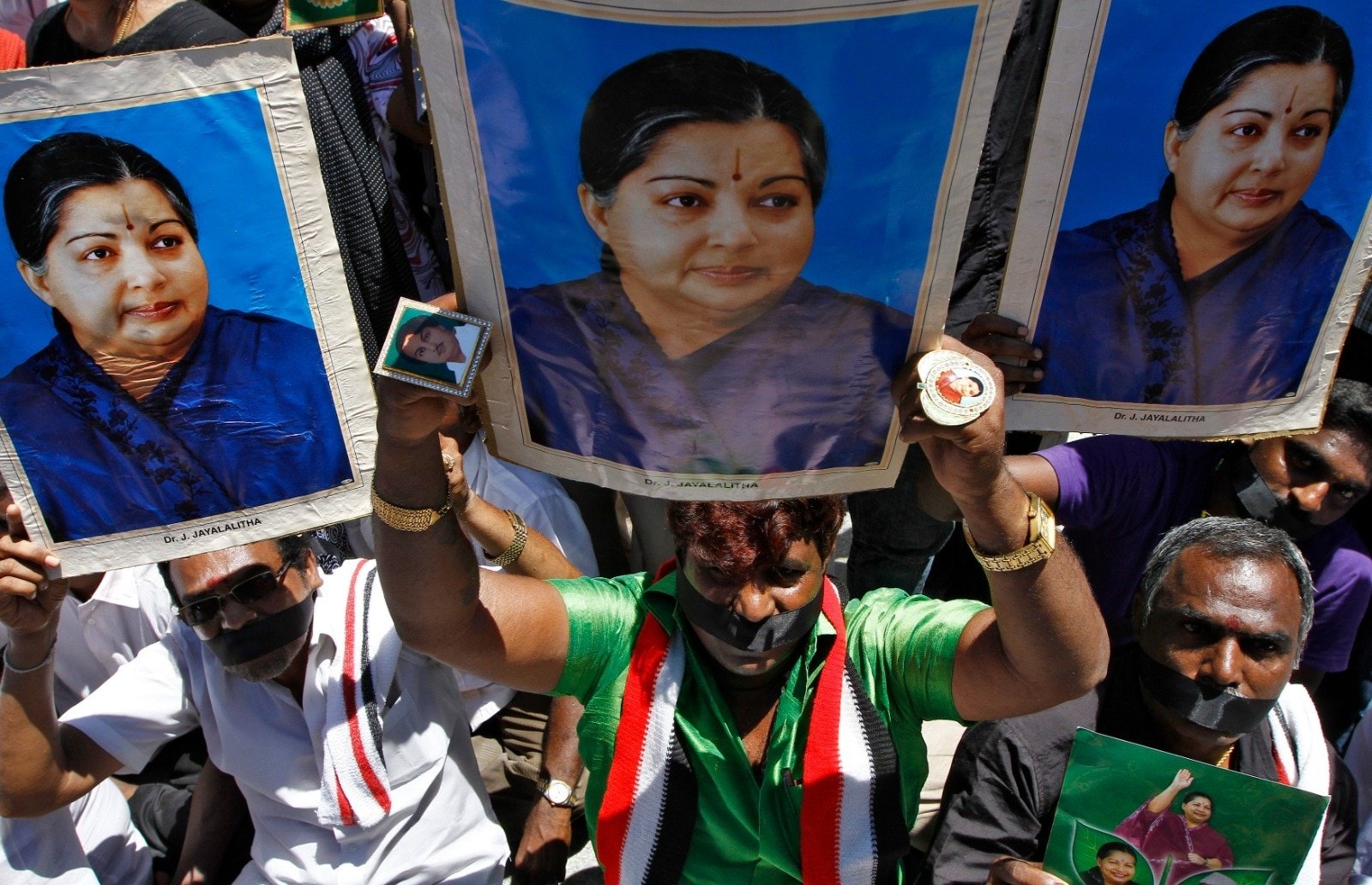
Supporters of Jayalalithaa hold her posters as they sit on a fast during a protest against the court verdict in Chennai. (Reuters)
What followed was the opposite. The trial court judge, John Michael D Cunha, delivered a verdict that shattered the gilded calm of the Poes Garden fortress. He convicted Jayalalithaa, awarding four years of imprisonment and a substantial fine of one hundred crore rupees. The immediate disqualification from office followed as a statutory consequence of the conviction. The order was executed with procedural clarity and political indifference. There was no interim cushion, no ceremonial delay, no deferential pause. From courtroom to custody, from Prima Donna to prisoner, the transition was direct.
She was taken to Parappana Agrahara Central Prison, along with Sasikala and others. The image was stark not because the conviction of public figures was unknown, but because of the immediacy of its execution. Senior leaders in India had faced charges, trials and even imprisonment. But the suddenness of a sitting Chief Minister being taken straight from court into jail, without the insulation that power often provides, gave the moment a rare severity. The Fort had not negotiated. It had yielded.
Shock, Faith and Politics of Devotion
If the courtroom spoke the language of law, Tamil Nadu responded in the language it knew best – emotion. Across the state, AIADMK cadres reacted with a surge that combined disbelief, anger and devotion. Effigies were burnt, posters screamed, protests erupted, slogans rose not against corruption, but against judgment itself. In some instances, even the judge became the subject of denunciation, as though the act of delivering a verdict was itself political aggression. This was not conventional protest. It was political faith under siege.
For many supporters, Jayalalithaa was not a leader to be assessed within the frame of legality. She was an embodiment — of authority, of protection, of identity. The conviction therefore did not register as accountability; it was regarded as injury. Tamil Nadu has always blurred the boundary between loyalty and reverence. In that moment, the boundary dissolved altogether.
22 Days and a Narrative of Exile
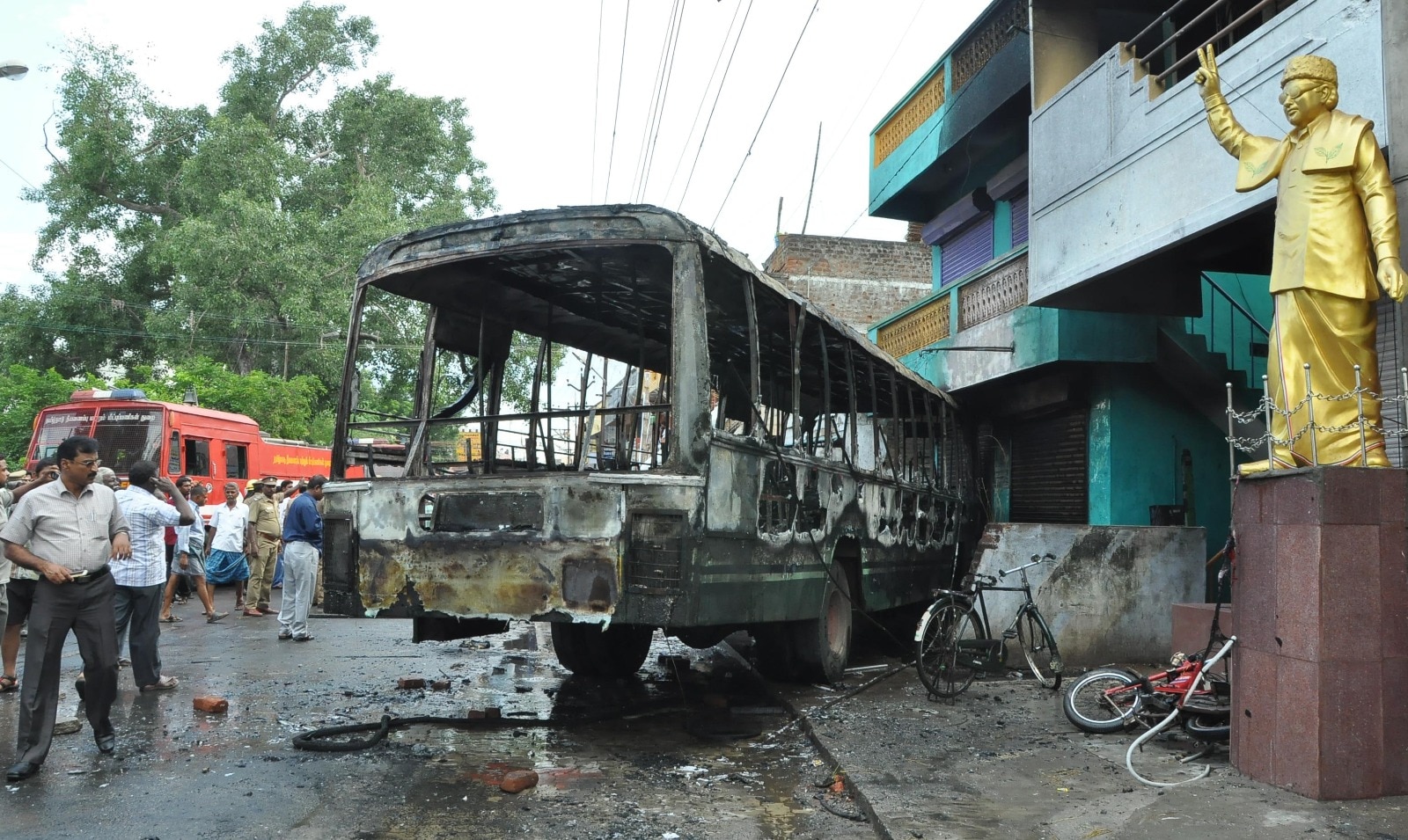
AIADMK workers set a state transport bus on fire in Kancheepuram after the conviction of Jayalalithaa (India Today)
Jayalalithaa’s stay in prison lasted 22 days, but in the political imagination of her party, it stretched into something far larger — a period spoken of less in days than in distance from rightful power. Inside, the prison routine was unremarkable by institutional standards, but the atmosphere in Tamil Nadu remained a heavy, silent vigil. Outside, the narrative grew. Silence from within was filled by assertion from without. The leader would return. Justice would correct itself. The interruption was temporary.
When bail was finally granted by the Supreme Court in October 2014, the transition from confinement to celebration was immediate. The Chief Justice of India, H.L. Dattu, provided the legal relief that allowed the leader to fly back to her base. The journey back to Chennai was staged as restoration, not as movement.
At the airport, the reception was overwhelming. Along the roads to Poes Garden, crowds gathered in thick, emotional clusters. Slogans filled the air. At one point, she halted at a temple — a gesture that folded faith into the moment of return. The imagery was unmistakable. A leader convicted of corruption, received with the fervour reserved for figures of sacrifice. In Tamil Nadu, contradiction often yields to narrative. Devotion does not pause for detail.
The Interregnum: Governance in Tears
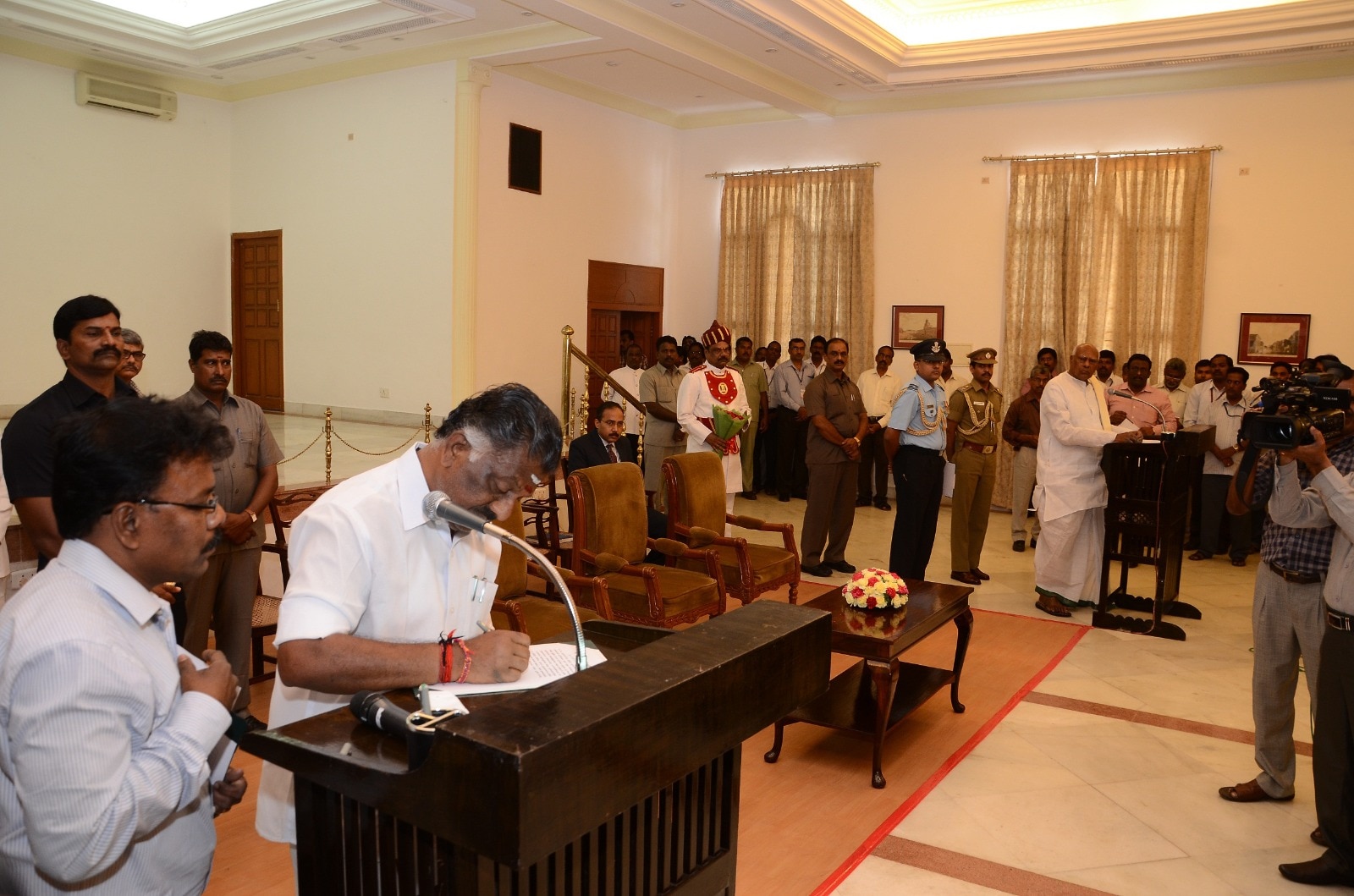
O. Panneerselvam gets emotional while taking oath as Tamil Nadu Chief Minister in the absence of Jayalalithaa at the Raj Bhavan in Chennai (India Today)
With her disqualification, O. Panneerselvam assumed office as Chief Minister. But this was not a transition of power in the conventional sense. It was a transfer of office without transfer of authority. The oath-taking ceremony at Raj Bhavan captured this distinction with unusual clarity. Ministers stood weeping. Voices broke. Composure gave way to open emotion. It was not merely a sentimental moment; it was an institutional signal. Power had not moved. It had been placed in trust.
Tamil Nadu had witnessed many political spectacles, but this was singular. A cabinet in tears, pledging loyalty not to office, but to absence. Governance, for a moment, resembled ritual. Administration took on the cadence of mourning. The phrase Makkal Mudhalvar — the people’s Chief Minister — acquired new meaning in this phase. She was not in office, but she remained central. The state functioned, but its axis lay elsewhere.
Authority Without Office
The months that followed revealed a system adjusting to a peculiar arrangement. The Secretariat remained active, files moved, decisions were issued. Yet, the perception of authority was anchored outside formal office. Panneerselvam governed with visible restraint, often refusing to sit in the Chief Minister’s designated chair out of a sense of reverential deference. Rama’s epic brother, Bharatha, would have felt an inferiority complex. The cabinet functioned, but not with independent assertion. It was a government that existed but did not fully inhabit its own authority. This was not paralysis. It was calibrated continuity. In Tamil Nadu, where leadership often assumes a singular form, the absence of that form does not create vacuum. It creates substitution. The state was in a holding pattern, waiting for the legal scales to tilt back in her favour.
Relief in Law, Return to Power
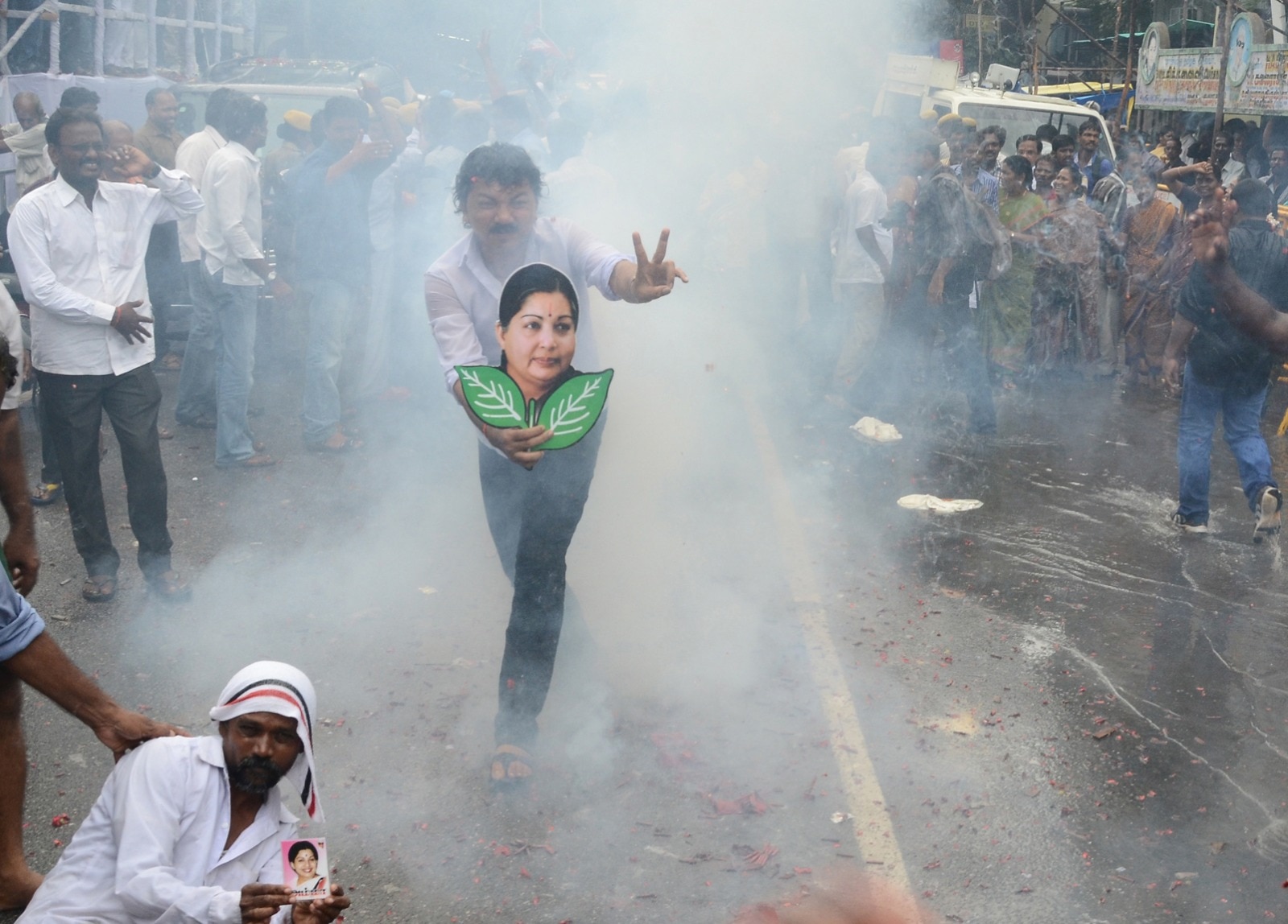
AIADMK workers celebrate after Jayalalithaa was granted bail by the Supreme Court in a disproportionate assets case, outside her residence in Poes Garden, Chennai (India Today)
On May 11, 2015, the Karnataka High Court delivered the second major shock of the decade. Justice Kumaraswamy acquitted Jayalalithaa, setting aside the conviction and the fine. He walked in, read out the verdict in two minutes flat, and left. The legal turn was decisive, even as critics pointed to arithmetical gaps in the calculation of her assets. The political consequences were immediate and unstoppable. Within days, she was sworn in again as Chief Minister. The return was not tentative. It was firm, almost as though the interruption had been procedural rather than transformative.
The Dr Radhakrishnan Nagar by-election, held on June 30, 2015, reinforced that return with emphatic electoral legitimacy. Jayalalithaa won by a margin exceeding 1.5 lakh votes, a scale that underlined the resilience of her support base. If the court had restored her eligibility, the electorate ratified her authority. The comeback was complete, but the challenges were only beginning to mount.
The Floods: Control Tested
In December 2015, that perception of absolute control was tested by the elements. Unprecedented rainfall, compounded by controversial reservoir releases from the Chembarambakkam lake, plunged Chennai and surrounding districts into one of the most severe crises in recent memory. Entire neighbourhoods were submerged, infrastructure collapsed, and lives were lost in significant numbers.
The disaster raised pressing questions about preparedness, coordination and administrative judgment. It also exposed the limits of distance-driven governance. In moments of crisis, the public looks not only for action, but for visibility. The absence of the leader from the water-logged streets during the peak of the crisis became a point of sharp criticism.
Relief efforts eventually stabilised the situation, but the episode left behind a lingering unease. Control, when centralised, must also be immediate. When it is not, even authority can appear distant. The imagery of Jayalalithaa’s face on relief packets was mocked by the media and public, only to be forgotten as polls came. The devasting Chennai floods was not even an issue.
Three Leaders, One Election
As 2016 approached, Tamil Nadu’s political stage presented an unusual tableau of three fading giants. One needed to be propped every few paces, the other had to be pushed around and the dazed third required prompting even of his practised punch dialogue. It was obvious even during the campaign that whoever were to become the CM would likely turn into a vegetable on the official table.
It was a contest shaped as much by endurance as by ideology. Jayalalithaa chose to contest largely alone, confident in her personal appeal and the organisational strength of the AIADMK. The campaign was built around her singular presence. The DMK, seeking revival, aligned with the Congress, attempting to rebuild credibility through a familiar partnership. The third front, assembled through effort and ambition, struggled with coherence and ultimately failed to provide a viable alternative. In Tamil Nadu, clarity often defeats complexity.
Cash, Campaign and the Limits of Regulation
The 2016 campaign revealed another dimension — the staggering scale of money in electoral play. One night, three lorries with close to Rs 570 crores were held and then vanished into the darkness without a trace; the news made it to papers while the precious ‘papers’ that mattered never materialised. Large cash seizures became routine with a pre-poll tally of over Rs 100 crore, not counting the above, a historic national high.
In several constituencies, elections were countermanded due to evidence of large-scale bribery, the ‘pernicious influence of money power’, to quote the Election Commission, which, confronted with such a magnitude of malpractice, appeared stretched. At one point, in utter helplessness, it bemoaned that, the ‘Election Commissioner has not to fold his hands and pray to God for divine inspiration to enable him to exercise his functions and perform his duties or to look to any external authority for the grant of power to deal with the situation’.
At moments, it seemed as though the system itself was acknowledging its limits. Money had moved from instrument to spectacle.
Jaya on a ‘High’
Despite these challenges, the election went on. Jayalalithaa’s campaign retained its distinctive grammar. She was the centre, the message and the presence.
Even the staging reflected this. Jayalalithaa seated on a sanitised perch on elevated platforms, with candidates at a safe distance, down in decks, often in the docks, as the voice of her ‘I’ iness intoned in telling clarity. The environment itself was controlled with air coolers and sundry apparatus, while the crowd waiting for hours roiled in the summer sun. Their Thalaiavi was barely visible to their teary, sweat-drenched eyes; giant screens made up for this. Indeed, Amma was always larger than life.
The Verdict of Continuity
The results of May 2016 delivered a historic outcome. The AIADMK secured 134 seats, returning to power as an incumbent — the first such re-election since MGR in 1984. In a state known for alternating governments, this was continuity by choice. Jayalalithaa had navigated conviction, incarceration, return, governance challenges and electoral uncertainty — and emerged with renewed authority. It was, in political terms, a complete recovery. But the triumph was destined to be brief.
The State in Suspension
In just four months, on September 22, 2016, the script shifted for the final time. Jayalalithaa was admitted to Apollo Hospital in Chennai. What followed was not merely a medical episode, but a prolonged and carefully managed public narrative that kept the state in a shroud of sinister suspense. For seventy-five days, the state was governed from the hospital corridors. Information was sparse, controlled and sanitised by a strategic coterie that held the keys to the ward.
Official bulletins spoke of improvement, of recovery, of gradual progress. At times, there were suggestions of normalcy — that she had eaten idlis, that she was sitting up, that she was responding well to treatment. There were reports of her issuing orders and signing files related to the Cauvery water dispute and even transfers. The Governor, C. Vidyasagar Rao, visited the hospital but did not see her in person, leading to more whispers. Leaders arrived, consultations took place, and the public was fed a diet of hope.
ICU: The Mystery of the Missing CM
Inside the intensive care unit, the reality remained hidden from the world. While the people were told she was watching television and ordering her favourite meals, the state was in a suspended animation. The cabinet met in a room near the ward, with a photograph of the leader on the table to signify her presence. Access was restricted to a chosen few, primarily Sasikala and the medical team. The lack of transparency birthed a thousand rumours. Tamil Nadu, accustomed to visible authority, now faced absence without explanation. The mood shifted from assertion to anticipation, and then to a quiet, creeping dread. It felt, increasingly, as though the state itself had entered an intensive care unit — watchful and uncertain. And anyone who dared question this opaqueness was targeted for insensitivity and even blasphemy.
The Sudden Announcement
On the evening of December 4, news of a sudden cardiac arrest began to circulate. The optimism of the previous bulletins vanished in an instant. The hospital surroundings were fortified by thousands of police personnel. By the night of December 5, 2016, the announcement finally came. Jayalalithaa had passed away at 11:30 PM. A semantic enigma gained currency: Dead and Declared Dead, remains unresolved till date.
Anyway, the news was met with a silence that was more powerful than any slogan. The leader who had survived every political battle had lost the final struggle.
Secretariat to Samadhi
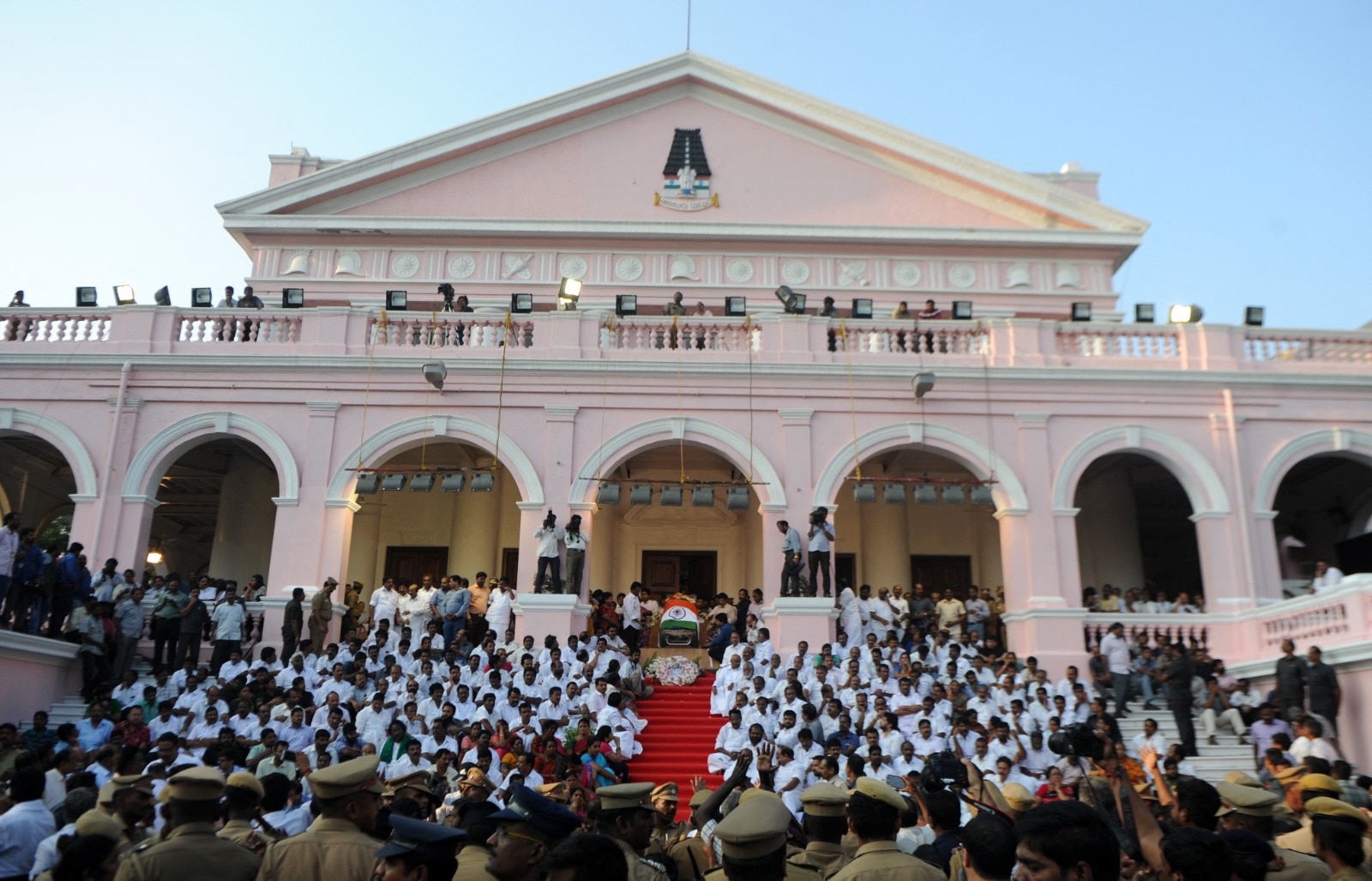
Grief-stricken supporters mourned the death of Jayalalithaa.
The transition from the Secretariat to the Samadhi was a final, grand spectacle. The body was brought to Rajaji Hall, where she was laid in state, draped in her favourite green saree. Thousands upon thousands queued for a final glimpse, their grief raw and unfiltered. National leaders, including the Prime Minister, arrived to pay their respects. The air was heavy with the weight of an era ending.
The choice of burial over cremation was a strategic final statement. By being buried in a sandalwood casket near the MGR Memorial on Marina Beach, she was placed in eternal proximity to her mentor. The burial allowed her body to remain intact in a samadhi, following the Dravidian tradition for senior leaders. It was the closing move from the Fort to her final resting place, a journey through the heart of the city she had ruled with an iron hand.
The sands of the beach now had under it three Tamil Nadu CM’s, all Dravidian – Anna, MGR and Jayalalithaa — who all died in harness, another of the state’s unique precedents.
Triumph to Tomb
The arc had been extraordinary. From the height of the 2014 sweep, through the Bengaluru jail, the acquittal, the floods and the historic 2016 return, to the silence of the hospital and the final rest on the beach — it was a sequence marked by reversal and resilience in equal measure. The Fort had been reclaimed, the mandate had been renewed, and authority had been restored.
This departure was the ultimate retake. The woman who had been a screen idol and a political goddess had left behind a state that was now fatherless and motherless at once. The passing of this unique personality marks the end of a chapter that defined the Southern soul. As the sun set over the Marina on that December evening, the silence was a powerful prelude to the detailed postmortem of a legacy that changed Tamil Nadu forever. The era of Puratchi politics ended with her; the age of the squabbling inheritors is set to begin.
A Regal Requiem
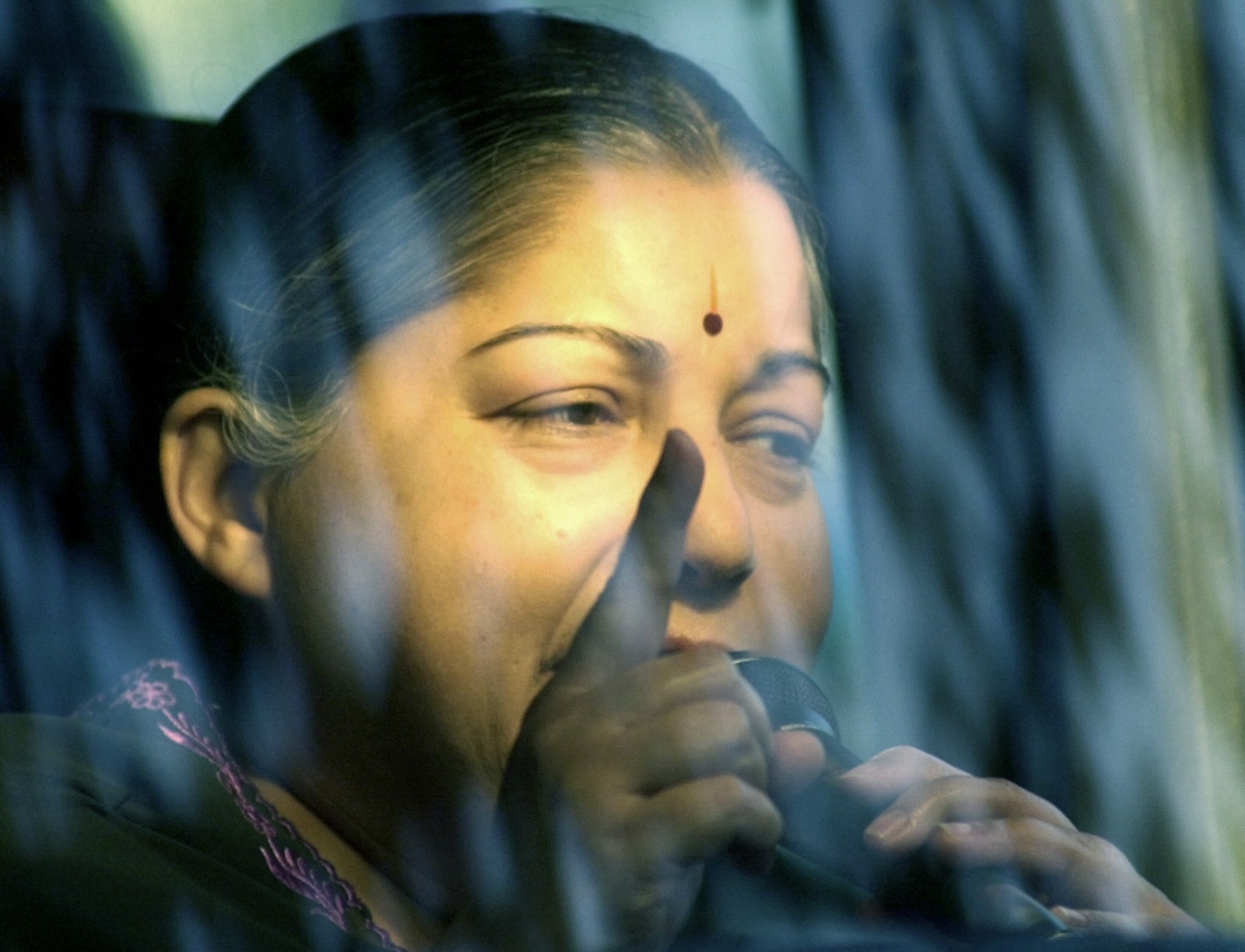
Jayalalithaa carried an aura of charm, with a commanding presence that shaped her every move.
Whatever her faults and shortcomings, Jayalalithaa was unique. Her traits and travails invited much interest and curiosity all along. She was a polyglot powerhouse of great stature, possessing a charisma, leadership, and administrative skills that few could rival. She exuded charm and possessed the gravitas that defined her every movement. By current standards, none of the recent national leadership, be it in the BJP, Congress, or the various regional satraps, can hold a candle to her. Alas, like hiding the sky with one’s own palm, she missed her chances and national ambitions by her own making.
She was highly motivated and took every task seriously. What defined her most was her amazing memory and eagle eye for minutiae. She possessed an astounding attention span and an unlimited mind space that accommodated so much, even at the height of very distracting physical, emotional, official, political, and legal stress. She would have excelled in anything. She had an aura that was at once magnetic and menacing, an ironic mix of gravity and repulsion that drew people in only to hold them at a sterile distance. Even those seemingly in her comfort zone could sense a tantalizing tension in her presence. She did inherit MGR’s party, but she was a charming, charismatic crowd-pulling colossus in her own right.
Losing her father when just two, she was always a lonely lass, lady, and then a leader. Insecurity was her lifelong companion. Those with her were never truly for her. It was the urge to escape the lingering isolation that launched her into films as well as politics. But once in public glare, being a single woman in a sea of men only made her stand out even more starkly. She understood but never grumbled about this being a misogynistic, man’s world; with real grit and guts characteristic of her. She instead set about levelling the playing field, quite literally, by unleashing many unkind cuts on ‘mankind’. Oh, how many scores were floored by the wrath of a woman singularly scorned!
The impression that she was unpredictable is wrong. She was the easiest to read. Even her famed mood swings followed a precise, pendulum-like pattern. The rules of relating with her were as rigid as the karmic laws of cause and consequence. As you sow, so you bow, be it for her benevolent best or vicious worst. Those at the receiving end surely knew what was coming.
Yes, she was an exceptional person. But all that was eclipsed by a resident evil she nurtured. The flattery fraternity that she unabashedly spawned has already filled public ears over years. Still, as the yearning for the lost joys of life appeared on that lifeless facade, a deep pang of empathy remains for a person who dominated the days of the land.
As she passed into the pits of history, she left behind in multitudes of minds many memorable montages: a cherubic child-face, the benign beam, the dignified demeanour, imperious elegance, nonchalant arrogance, nasal baritone, disarming sarcasm, crystal clear commands, a frame oozing firmness and finesse, warm manner, the gentle wave, the vintage victory sign, the graceful glide of a gait and above all a truly towering image, taller than her tiring cut-outs.
Next | The AIADMK Aftershocks and Kalaingar’s Tryst With Tomb
SOURCE :- TIMES OF INDIA


