
Source : ABC NEWS
For Imran Amjad, the memories of his daughter Uqasha Imran are of a young woman who was full of life before it was tragically cut short.
“She was a picture of, as we say, loving, caring, giving — an absolute package of that,” he said.
“But that is what most people know, what they don’t know, [is] the impact she had on a lot of young Canberrans in sports.
“She was mentoring them, she was training them, and sports was her life.“
In March 2025, Ms Imran suffered catastrophic injuries after a bus failed to stop at a stop sign and crashed into her while she was riding a motorcycle.
The 22-year-old died of a traumatic brain injury after three days in hospital and the bus driver later pleaded guilty to negligent driving causing death.
Outside court last year, Mr Amjad said the “void in our family life will never be filled”.
The family has since poured their grief into finding ways to honour Ms Imran, who they say was very clear about what she wanted to happen in the event of her death, despite her youth.
A final wish granted
Ms Imran was training in Taekwondo before her death.
“She was a second-degree black belt at the time of the accident. She was training for her third-degree black belt, literally a few weeks out of that,” Mr Amjad said.

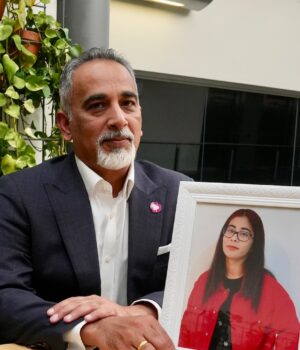
Imran Amjad, father of Uqasha Imran, said the family wanted to honour her legacy. (ABC News: David Sciasci)
In the wake of her death, Ms Imran’s taekwondo club awarded her a third-degree black belt in recognition of the fact that she had completed her training.
But he said she also put her time into helping others, training younger athletes.
“She was a complete package of a brilliant human being. Not saying that as a father, but knowing what everyone around us have told us before, and even today, telling us about Uqasha,”
he said.
It was that generosity, he said, that led her to express a wish to have her organs donated when she died.
“Uqasha had spoken to us literally a few days before that because we were planning on taking a trip and she said she wanted to sort out things,” Mr Amjad said.
“So we were already in the process. Life didn’t give her, or the death didn’t give her, the opportunity, but the intention was there, so we carried her wishes forward.”
Uqasha Imran expressed her desire to be an organ donor before her death. (Supplied: Imran Amjad)
When her wish was fulfilled three days after the crash, it gave the family comfort in their grief.
“That is where we get the courage from, how she struggled and clinged on to life on the way to help four more lives,” he said of Ms Imran’s final days in hospital.
“This gave the family, the friends around us an encouragement to say, ‘Let’s take this hope forward. This must not die with Uqasha’.“
Passion for sports passed on
This weekend, the family launched the Uqasha Imran Foundation, which aims to help young people access sport by removing financial and logistical barriers.
“And I’m very, very proud of the Canberran community who have come around us to make this a possibility,” Mr Amjad said.
“We stand ready to come with grants, come with sports equipment, come with training sessions to help them so they don’t miss out on what a kid deserves,”
he said.
The foundation is not limited to martial arts, but any sport.
Uqasha Imran Foundation director and chairperson Imran Amjad says they want to help young people access sports. (ABC News: Stuart Carnegie)
“The purpose is to help the young kids, the young athletes, depending on their circumstances, not which sport they are in,” Mr Amjad said.
“We certainly have already helped five students in different aspects of their training, mentorship, and attending the competitions and being successful.
“It was great to see a couple of these kids coming back and saying, ‘look at this, I have achieved this medal and this is because you helped us’.”
But he has hopes of seeing the foundation’s scope expand beyond the Canberra region.
“If that’s today, imagine where we can go tomorrow,”
he said.
‘Have your intention known’
But the family has another goal: to raise awareness of organ donation.
Mr Amjad said Australia was “lagging” when it came to registered organ donors.
“The message is very simple. You can be on the register. Your next of kin at the time will still have the option to make that decision whether they do or not,”
he said.
“But please have your intention known, have your heart open for generosity to help a number of other lives.”
DonateLife ACT donation specialist nursing coordinator Jean-Christophe Chatelin said for many people, organ donation was a way to make sense of their loss.
Currently, 35 per cent of the population is registered, with that rate at 27 per cent in the ACT.
“Most Australians are supportive of organ donation but unfortunately, sometimes it doesn’t translate within the registration rate,”
he said.
“So sometimes people will talk to their families and mention that they would like to become an organ donor if they had the opportunity, but it doesn’t mean that they have registered their wish or the decision.”
DonateLife ACT donation specialist nursing coordinator Jean-Christophe Chatelin says most Australians are supportive of organ donation. (ABC News)
Support and resources are available at hospitals in Canberra for those considering organ donation for a loved one, including interpreters for people who don’t speak English.
“In the hospital, for example, we can involve the representatives of the different faiths if the family wish to,” Mr Chatelin said.
“I’ve worked with families from different walks of life — Christian, Muslim — and most of those faiths are supportive of organ donation.
“They’ve got some clinical background sometimes, so they can facilitate those conversations.”
‘The beauty of organ donation’
The family has since been able to learn more about Ms Imran’s generosity in her death.
Imran Amjad says hearing from one of the people his daughter saved has helped the family. (ABC News: Stuart Carnegie)
“The beauty of organ donation is when a couple of months ago we received a letter from one of the recipients,” Mr Amjad said.
“Knowing how well they are moving on with their life, the things they are doing now, they couldn’t do it before.
“Getting those stories back and being able to, obviously with legal barriers around it, to communicate with those recipients back and forth, it is amazing.
“It’s like I’m still talking to my Uqasha.”


