
Source : INDIA TODAY NEWS
Bengal is the land of Nobel laureates like Rabindranath Tagore and filmmakers like Satyajit Ray. It is known for its literature, its cultural depth, and festivals like Durga Puja. But come election season, all of that gets reduced to one symbol: fish. The symbolism is high this poll season as the stakes are higher. Bengal votes on April 23 and April 29 to decide if BJP will dethrone Didi. So, politicians are high on fish and on poll fever.
advertisement
The BJP has not yet revealed its face for Bengal CM, but it has offered a key qualification: the person will be a non-vegetarian.
“We all BJP leaders in Bengal eat non-veg daily. I had non-veg even today. Bengal’s next CM from BJP will definitely be non-vegetarian,” Union Minister Sukanta Majumdar said while reacting to Mamata Banerjee’s statement that BJP will ban fish and eggs.
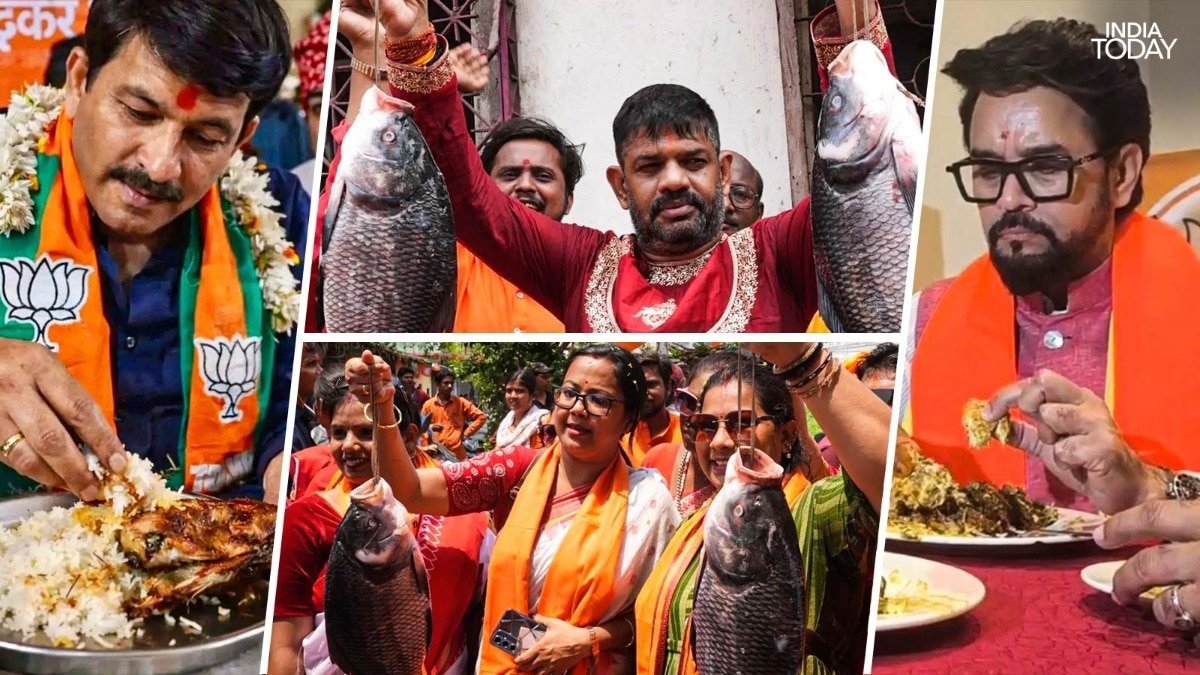
Fish is dominating both politician’s plates and speeches. When PM Modi held a poll rally in Purba Medinipur, he promised to make Bengal fully self-reliant in fish production. When fish makes it into the Prime Minister’s speech, you know it carries weight beyond the plate. Later, BJP leaders made sure to use fish as poll prop. From Anurag Thakur to Manoji Tiwari, BJP leaders are making sure that machh bhaat is on their plate when in Bengal. Even on a Tuesday (when most people are off non-veg).
The BJP has been trying to dispel fears among a section of the electorate about imposing vegetarianism in the State. Mamata Banerjee, who is seeking a fourth consecutive term, has been saying almost at every rally that the BJP will not allow people of the State to eat fish.
“The BJP will not allow you to eat fish. Nor will they allow you to eat meat or eggs,” she told a campaign meeting recently.
So, BJP leaders are left with a peculiar political task: prove that they love fish as machh as Bengal does.
“Sit with me for a fish-eating competition, I will eat 1 kg more,” Himanta Biswa Sarma threw an open challenge to Mamata Banerjee. It sounds funny, but in the middle of an election, it is serious business.
Mamata is already irked by the BJP’s fish politics. She hit back at Narendra Modi for accusing the TMC of not doing enough to make Bengal self-reliant in fish production.
“They talk of building ‘Sonar Bangla.’ Today in Haldia, he (PM) said there is not enough fish production in Bengal. But what about the fact that they themselves do not allow fish in Bihar, UP, and Rajasthan? In Delhi, shops selling fish and meat are attacked. You do not let people speak in Bengali. Are you not ashamed of it? And then you come to teach us a lesson on fish production?” she said.
Mamata is yet to respond to Himanta’s challenge, but BJP leaders seem to be preparing anyway. Anurag Thakur was seen relishing machh bhaat on a Tuesday—a day when even many Bengalis avoid non-veg.
Last month, BJP candidate Sharadwat Mukherjee campaigned in an open market carrying a fish, sending out a clear message: the party would not restrict non-vegetarian food if voted to power.
Another candidate, Rakesh Singh, staged a similar spectacle, repeatedly hoisting a fish as he moved through early-morning crowds.
But why the theatrics? BJP state unit chief Samik Bhattacharya said the idea was to “counter the TMC.” “Most people in West Bengal eat non-vegetarian food, and even BJP leadership consumes non-vegetarian food,” he said.
FISH IS TMC’S AMMO AGAINST BJP
BJP leaders’ new-found love for fish has given ammo to TMC leaders, who don’t have to prove their love for fish via these theatrics.
TMC leader Mahua Moitra shared Anurag Thakur’s video and wrote, “Hello @ianuragthakur glad to see you are enjoying fish in Bengal. Don’t worry – this is not Fantaland, You can take a river cruise on the Hooghly and eat it too without getting arrested.” She was referring to the arrest of 14 people in Varanasi last month for allegedly consuming chicken biryani during an Iftar on a boat in the Ganga River.
The TMC later shared the video, accusing the BJP of double standards and claiming that fish and meat sellers are often targeted in BJP-ruled states.
“Narendra Modi calls fish and meat-eating Bengalis “Mughals.” Paresh Rawal calls fish-eating Bengalis “Rohingyas. In Madhya Pradesh, BJP blocked the implementation of a gazette notification that listed eggs and chicken in meals for juvenile homes. Eggs banned in mid-day meals for children….Do not fall for it,” they wrote.
It is not just TMC leaders. Many people on social media are also calling out what they see as hypocrisy—questioning how eggs are removed from midday meals in states like Madhya Pradesh and Uttar Pradesh, while fish-eating is being showcased in Bengal.
A user wrote on X, “BJP leaders are going to Bengal and eating fish ahead of the elections. Meanwhile, many BJP states have removed eggs from midday meals served to school children.”
TOO MACHH CONCERN OR MOCKERY?
In Bengal, fish has always meant far more than what is on the plate, so its political afterlife feels almost inevitable. It is not just cuisine, it is emotion, identity, a staple of everyday life. On the other hand, Narendra Modi’s BJP is often associated with a more moralised idea of vegetarianism. Restrictions on meat sales in some BJP-ruled states, along with crackdowns linked to cow protection, have only strengthened that perception.
The TMC is also not letting Bengal forget the Prime Minister’s 2024 speech, where he criticised Opposition leaders—referring to a video of Rahul Gandhi and Lalu Prasad Yadav cooking mutton during Sawan and eating fish during Navratri—and accused them of having a “Mughal mindset.” The TMC seized on that remark, accusing him of shaming people for eating non-vegetarian food. With no strong counter at the time, the image stuck.
Since then, the TMC has repeatedly claimed that if the BJP comes to power, it will ban fish and eggs—a thought many Bengalis dread and reject outright.
Which is why BJP leaders are now trying hard to send one clear message: we are one of you.
But the imagery is beginning to go too far. What could have been a subtle cultural reassurance is starting to look like overcompensation, a visible attempt to shake off the party’s vegetarian image. Leaders who are rarely seen publicly relishing non-veg are now doing so, and very visibly, in Bengal.
And when something turns into a meme, it has already crossed into mockery. The messaging may be necessary, but the execution feels off: too theatrical, too eager. You don’t have to brandish a fish in front of every second Bengali to make the point. Subtlety, after all, is an art.
WHAT BENGALIS THINK
On the ground, however, the fish frenzy is being read with far more nuance than the campaigns might suggest. Akash Chatterjee, from Hooghly, thinks BJP leaders’ newfound love for fish is nothing but a desperate tactic to woo the Bengal voters, as well as to counter a narrative successfully painted by the TMC with the help of its election strategist I-PAC.
“TMC ran a campaign accusing BJP of being a party of outsiders, with no connection to Bengali culture and dietary preferences. However, with the repeated use of fish in the election campaign, BJP is only validating the allegations levelled by the TMC. The counter narrative that we eat fish and have no problems with non-vegetarian food looks like a gimmick. TMC has already encashed on it, and no matter what the BJP does, the image can’t be changed,” he said.
Prateek Chakraborty, from Kolkata, believes that politicians suddenly displaying fish during election season feels less like cultural connection and more like stereotyping Bengalis for a wider audience.
“Fish in Bengal is far more than food, it is emotion, identity and cultural memory. Any suggestion or even rumours of curbing eating habits can trigger strong reactions, which is why the issue quickly becomes politically charged. But it is striking that fish dominates election headlines while larger concerns like development, jobs, governance and Bengal’s broader cultural heritage receive less attention,” he said.
To him, the optics are the problem. “When politicians display fish during campaigns, it can feel less like celebration and more like reducing a complex identity to a single symbol. Bengal is much more than that.”
Sayan Ganguly, from Chandannagar, feels the fish campaign doesn’t matter much to Bengalis in Bengal as they know no political party would risk alienating voters over food habits.
“What applies elsewhere in India doesn’t always hold in Bengal. While Delhi-NCR saw non-veg disappear during the Ayodhya ceremony, Bengal, amid peak wedding season, carried on with fish and meat. If a similar ban had been imposed in Bengal during that period, it would have been the death of BJP’s political future,” he said.
“The issue appears more like a gimmick than a real concern, largely a media-driven narrative with little bearing on ground realities. The debate over food habits seems disconnected from the actual issues that matter to people on the ground,” he said.
Moumita Mukherjee, who came to Delhi for job, sees why fish works so well politically. “Fish is a very good political weapon here,” she said, pointing to a deeper, more emotional undercurrent—the fear that dietary choices could be interfered with.
“When I came to Delhi, it was a cultural shock. People avoid non-veg during Navratri, which, for us in Bengal, is Durga Puja. That’s where the fear comes from—that the BJP might push similar restrictions, especially during Durga Puja. My mother keeps saying that if they come to power, non-veg will be banned. In many places in north India, even pandals don’t allow non-veg—we just can’t imagine that back home,” she said.
For others, though, the entire debate feels overblown. Abhishek, who grew up in Baguihati in north Kolkata, does not see fish becoming an election-deciding issue at all.
“I don’t think all this noise around fish and non-veg will matter. Fish is part of our daily lives—it’s what we have grown up eating. No government is going to change that. Look at Odisha, where BJP came to power. People’s food habits haven’t changed,” he said.
In Bengal, symbolism can make a splash, but it doesn’t decide the catch. The real question is who truly knows these waters and who’s just fishing for votes. May the Fourth be with them, because that’s when the verdict drops.
– Ends
Tune In
Must Watch
SOURCE :- TIMES OF INDIA