
SOURCE :- THE AGE NEWS
Thank you for joining our continuing live coverage of the war in the Middle East.
Here’s a recap of the latest developments:
- US President Donald Trump said it’s “highly unlikely” he would extend the two-week ceasefire with Iran if a deal is not reached before it ends on “Wednesday evening Washington time”. “I’m not going to be rushed into making a bad deal,” Trump said in a phone interview with Bloomberg on Monday.
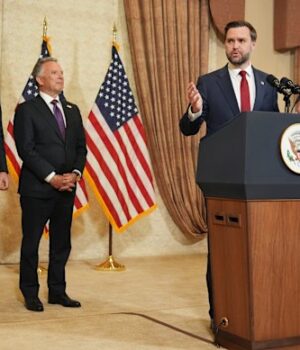
- Trump said Vice President JD Vance would lead a US delegation, which will likely leave late Monday or early Tuesday (US time), for a second round of peace talks with Iran in Pakistan. “The US delegation plans to travel to Islamabad soon,” a source familiar with plans told this masthead.
- Israeli and Lebanese representatives will hold a second round of talks in Washington on Thursday, the US State Department has confirmed. It will mark the first talks between the two countries since a 10-day ceasefire took effect last week.
Angus Taylor says the government needs to provide greater incentives for private companies to explore and drill for oil in Australia amid the global oil shock because of the Iran war.
“Whether it’s existing basins where there’s more potential, or new basins, like the Taroom or the Beetaloo, we know they are there, but we’ve got to get the incentives right to get those explorers out there exploring to get the oil and gas companies drilling and to make sure Australian oil and gas is working hard for Australians,” the opposition leader told reporters in Western Australia.
“The best stock of fuel is the stock of fuel that you can be taking out from under the ground… that’s not 30 days of stocks. That’s 30 years plus of stocks.”
US Vice President JD Vance will represent America in renewed peace talks with Iran in Islamabad this week, Axios reported.
Vance will arrive in Pakistan with the fragile US-Iran ceasefire about to expire, sources told Axios, and despite a complete deal being unlikely before the deadline, President Donald Trump could be convinced to extend the truce if progress is made.
Iran has not formally said whether it will attend the negotiations, after the last round proved fruitless.
US President Donald Trump said American bombers completely obliterated Iran’s nuclear sites last year, and it will take the Islamic Republic a long time to restore them.
In June last year, US soldiers dropped immense bunker-busting bombs on Iran’s secretive nuclear sites aiming to completely disable them.
“Operation Midnight Hammer was a complete and total obliteration of the Nuclear Dust sites in Iran,” Trump said on Truth Social this afternoon. “Therefore, digging it out will be a long and difficult process.
“Fake News CNN, and other corrupt Media Networks and Platforms, fail to give our great aviators the credit they deserve – Always trying to demean and belittle – LOSERS!!!”
Australia will invest billions of dollars to establish anti-drone defence systems as the wars in Iran and Ukraine underscore the potency of unmanned vehicles in a rapidly evolving global security environment.
Defence Industry Minister Pat Conroy announced two contracts today in the first tranche of that effort: one is with Melbourne-based Sypaq for small interceptors, and the other with AIM for a laser weapon to shoot down aerial-attack drones. The contracts totalled $30 million, with the government ultimately planning to outlay up to $7 billion on these and similar weapons.
The investment reflects the changing nature of warfare demonstrated first in Ukraine and then in Iran where drones have emerged as potent new attack weapons that are expensive to combat. The US and others have been using multimillion-dollar missiles to shoot down drones that cost Iran just thousands of dollars to make and deploy.
The new anti-drone weaponry is part of Australia’s biggest peacetime increase in defence spending, which will see an extra $53 billion invested over the next decade. This includes new frigates for the navy, a new air-defence system, long-range strike weapons, as well as increasing use of unmanned weapons in the air and at sea.
Australia aims to improve its deterrence capabilities via drones and missiles to complement a planned fleet of nuclear-powered submarines due to be delivered in the 2030s under the AUKUS deal with the US and Britain. Last year, the government announced it would be spending billions of dollars to develop the “Ghost Shark” unmanned submarine, with the first units expected to enter service this year.
Bloomberg
The financial shock caused by the war in Iran would have to continue for another three years before a downgrade to Australia’s AAA credit rating would be considered, one of the world’s key rating agencies has said.
Giving an update on the economic impact of the war to Australia, S&P Global senior analyst Anthony Walker this morning said the larger credit risk was for states and territories if they turned “temporary” cost-of-living relief into something more permanent.
Australia is just one of 11 nations that have an AAA rating from S&P.
According to Walker, Australia’s low net debt position gave it the budget “headroom” to deal with the fallout from the war.
Israeli strikes in Lebanon have killed nearly 2400 people since the US-Israel war on Iran started on February 28, the government’s disaster management unit said.
It said 7602 people had been wounded in the same period.
Meanwhile, Iranian state media reported that an estimated 3375 people have been killed in Iran since the beginning of the conflict, including 380 children.
Israeli strikes killed at least five Palestinians in separate incidents in the Gaza Strip overnight, Palestinian health officials said, and fighters from Hamas clashed with gunmen from an Israeli-backed militia, witnesses said.
Medics said one man was killed in an Israeli airstrike in the Bureij camp in the central area of the enclave, while another strike killed one person and wounded others in Gaza City.
Later, another airstrike killed at least three people in western Khan Younis, in the south of the Gaza Strip, health officials at the territory’s Nasser Hospital said.
It’s the latest violence to overshadow the US-brokered ceasefire deal signed in October after two years of full-blown war between Israel and Hamas. Progress has stalled on parts of the deal, which include the disarmament of Hamas and Israeli army pullouts.
A warning by former Russian president Dmitry Medvedev has crystallised fears among Gulf states that reopening the Strait of Hormuz may be the most Iran-US talks can achieve, falling short of the broader de-escalation they regard as vital.
Officials and analysts expect the next round of negotiations in Islamabad will focus increasingly not on Iran’s missiles or regional proxies but on uranium enrichment limits and how to handle Iran’s leverage over the world’s most critical oil shipping route.
Gulf officials warn the approach risks entrenching Iran’s grip on Middle East energy supplies by managing rather than dismantling its leverage, prioritising global economic stability even while leaving the countries most exposed to the energy and security consequences out of formal decision-making forums.
Gulf sources say US–Iran diplomacy is now centred less on rolling back Iran’s missile program and more on enrichment levels and tacitly accepting Tehran’s leverage over Hormuz, which carries about a fifth of global oil supplies.
Reuters
As an extended internet blackout prevents a majority of Iranians from using social media to share their experiences first-hand, a London-based publication, Iran International, has compiled detailed accounts of life for citizens living in Iran as the end of a fragile, two-week ceasefire looms.
The Saudi Arabia-funded outlet that supports regime change informs the Iranian diaspora about what is unfolding in Iran, and these reports provide insight into how citizens inside a country battered by massacres, instability and now war, are coping.
Before the latest conflict and US-Israeli strikes, annual inflation in Iran had already exceeded 70 per cent, with food inflation reaching triple digits. Official data shows bread and cereals recorded year-on-year inflation of about 140 per cent.
Citizens have reported large queues at bakeries as bread, a primary food source for most Iranian households, is in significant shortage due to supply disruptions caused by the war.
China’s leader Xi Jinping has called for the Strait of Hormuz to be opened, in a phone call with Saudi Arabia’s Crown Prince Mohammed bin Salman.
“China calls for an immediate and comprehensive ceasefire, supports all efforts conducive to restoring peace, and stands for resolving disputes through political and diplomatic means,” Xi said, according to a readout of the phone call reported by Chinese state media last night.
“The Strait of Hormuz should maintain normal passage, as this serves the common interests of regional countries and the international community.”
China has been cautious with its public statements on the conflict since the war began in February, when the US and Israel attacked Iran. It has largely avoided condemning the US or Iran’s retaliation, and has directed its public commentary through its Foreign Ministry rather than Xi.
It comes as a fragile ceasefire is on the cusp of expiring and with Iran refusing to join another round of peace talks in Pakistan after the US seized an Iranian ship that tried to bypass its blockade in the Gulf.