
Source : the age
US President Donald Trump said he had ordered the navy to “shoot and kill” any boats laying mines in the Strait of Hormuz after Iran seized two ships and tightened its grip on the strategic waterway during an indefinite ceasefire with no sign of peace talks restarting.
“I have ordered the United States Navy to shoot and kill any boat, small boats though they may be (Their naval ships are ALL, 159 of them, at the bottom of the sea!), that is putting mines in the waters of the Strait of Hormuz,” Trump said in a post on Truth Social on Thursday. “There is to be no hesitation. Additionally, our mine ‘sweepers’ are clearing the Strait right now. I am hereby ordering that activity to continue, but at a tripled up level!”
In a separate post, Trump claimed the US had “total control over the Strait of Hormuz” and that no ship could enter or leave without the approval of the navy.
“It is ‘Sealed up Tight,’ until such time as Iran is able to make a DEAL!!!” he said.
The status of a two-week-old ceasefire, due to expire earlier this week, has remained unclear. In a sharp about-face hours after threatening renewed violence, Trump made what appeared to be a unilateral announcement that the US would extend the truce until it had discussed an Iranian proposal in peace talks to end the two-month-old war.
But Iranian officials did not say they had agreed to any ceasefire extension and criticised Trump’s decision to maintain the US blockade of Iran’s ports, itself considered by Tehran as an act of war.
Iran’s parliament Speaker, and lead negotiator, Mohammad Bagher Ghalibaf, said a full ceasefire only made sense if the blockade was lifted.
Reopening the Strait of Hormuz, the strategic waterway that carried a fifth of the world’s oil trade before the war, was impossible with such a “flagrant breach of the ceasefire”, Ghalibaf said on social media.
“You did not achieve your goals through military aggression, and you will not achieve them by bullying either,” he wrote in his first response to Trump’s announcement. “The only way is recognising the Iranian people’s rights.”
Trump again backed away at the last moment from his repeated threats to bomb Iran’s power plants and other civilian infrastructure, which the United Nations and others have warned would violate international humanitarian law.
But little progress has been made in ending the war that started with joint US-Israeli attacks on Iran on February 28. That leaves the two sides in a holding pattern, with the Strait of Hormuz effectively closed, straining economies worldwide.
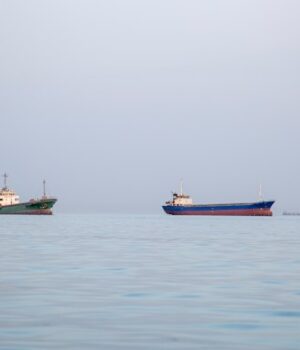
Iranian state television reported Iran’s paramilitary Revolutionary Guard had seized two ships – identified as the MSC Francesca and the Epaminondas – after three vessels were attacked in the strait on Wednesday. The two ships were reportedly being taken to Iran for “inspection of their cargo, documents, and records”.
The third vessel, a Liberian-flagged container ship, was fired on in the same area but was not damaged and resumed sailing, according to maritime security sources.
White House spokesperson Karoline Leavitt told Fox News that since the ships were not US or Israeli vessels, the seizure was not a violation of the ceasefire. She called it an act of “piracy”.
Traffic through the strait ground to a halt following the seizures. Only one ship, bulk carrier LB Energy, was seen moving through the waterway early on Thursday, with none observed entering. The tanker Ocean Jewel is currently idling at the entrance to the corridor, having aborted a transit not long after Iranian forces began firing at three ships.
The US military said on Wednesday it had so far directed more than 30 ships to turn around or return to port as part of its blockade against Iran. Far beyond the Gulf, the US has intercepted at least three Iranian-flagged tankers in Asian waters, sources said, redirecting them away from their positions near India, Malaysia and Sri Lanka.
Brent, the international crude oil benchmark, remained above $US100 a barrel in Asian trade on Thursday, having hit triple figures a day earlier for the first time in two weeks.
No new deadline
In his Tuesday announcement, Trump said he had agreed to a request by Pakistani mediators “to hold our Attack on the Country of Iran until such time as their leaders and representatives can come up with a unified proposal … and discussions are concluded, one way or the other”
He has not set any deadline for the proposal or discussions, Leavitt told reporters.
Pakistan, which has acted as a mediator, was still trying to bring the sides together after both failed to show up for tentatively scheduled talks in Islamabad on Tuesday before the two-week-old ceasefire was due to expire.
A first session of peace talks between Iran and the US in Islamabad 11 days ago produced no agreement.
Trump wants Iran to give up highly enriched uranium and forgo further enrichment to prevent it from building a nuclear weapon. Iran says it has only a peaceful civilian nuclear programme, and wants the lifting of sanctions, reparations for damage and recognition of its control over the strait.
Iran has also made a ceasefire between Israel and Lebanon’s Hezbollah militant group a condition of truce talks. On Wednesday, Israeli air strikes on Lebanon killed at least five people, including the Lebanese journalist Amal Khalil, in the deadliest day since a 10-day ceasefire was announced on April 16.
On the eve of further talks in Washington between Lebanese and Israeli ambassadors on Thursday, Lebanese President Joseph Aoun said Beirut would seek an extension to the ceasefire, which is set to expire on Sunday.


