
Source :- THE AGE NEWS
It is a blustery, overcast autumn day when Living Legends veterinary nurse Molly Stewart unlocks the gate into Chautauqua’s paddock.
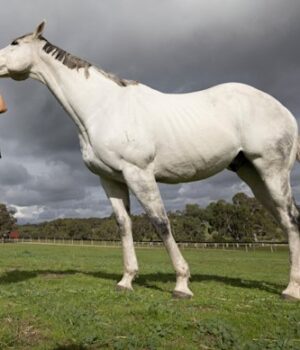
The Grey Flash stands inside, calmly picking from a feeder rack of hay. His ageing coat is almost white. A noisy passenger jet passes overhead on its final descent into nearby Melbourne Airport.
It is almost eight years since sprinting sensation Chautauqua became famous for presenting connections with a problem they could not solve – refusing to start a race.
Now the 15-year-old retired galloper has a problem of a different kind. But this one can be treated.
As Stewart entices Chautauqua away from the hay feeder with a carrot and a pat, she explains that the big gelding has been diagnosed with melanomas.
In September last year, he had surgery to remove 10 lumps at the University of Melbourne Werribee Equine Centre.
It is a condition more common in grey horses, she says, because of their pigmentation. Research shows 80 per cent of grey horses over 15 are subject to melanomas.
Stewart’s boss, Living Legends CEO and veterinary director Dr Andrew Clarke, says they “look like little marbles under the skin”.
Stewart, 22, cared diligently for Chautauqua after the operation, changing bandages daily to prevent infection.
He stands calmly by her side, pinching the carrot from her hand, while paddock mate Fawkner – the 2013 Caulfield Cup winner – nudges The Age’s photographer and casually interrupts his shoot.
There are no obvious signs of the surgery, but unlike humans, equine melanomas generally appear where the “sun doesn’t shine” – under the tail and around the sheath.
They are also less likely to metastasise or travel around the body.
Clarke and Stewart co-ordinate Chautauqua’s ongoing treatment with the Werribee Equine Centre – targeted chemotherapy injections and the application of a new $3000 equine vaccine.
The condition is not life-threatening.
“We’re looking to stop the growth and knock back the size of the tumours, and stop them developing further,” Clarke says.
“The biggest problem that happens with them is that they can get, especially the ones under the tail and around the anus, they can get infected.
“So it can be the complications around infection, such as blockages, more so than the melanomas themselves, that cause the problems.
“The treatment that he’s had and with this new vaccine, the prognosis is excellent.”
Stewart studied Veterinary Nursing at Latrobe University (Melbourne Polytechnics) and began her placement at Living Legends in 2023 before taking a full-time role at the beginning of last year.
She has been Chautauqua’s carer since he arrived at the Oaklands retirement farm six months ago.
“I shouldn’t have favourites, but he’s definitely up there,” Stewart says. “He’s hard not to love.
“He’s still as stubborn as what he was. If he doesn’t want to be somewhere, he won’t be there. If there’s a little bit of rain, he’s such a princess, he will be in his shelter, and won’t come out.
“He’s just very much like, ‘I’m gonna do what I want to do, and you can’t tell me otherwise’.”
Clarke says Chautauqua, known as “Sharky” at Living Legends, is one of the farm’s main attractions.
“He’s a hugely popular horse,” Clarke says. “He was an outstanding racehorse, but he’s also got that little bit of history of being a bit of a naughty boy, a bit of a rebel. And I think people like that.”
The gelding was a champion for the Hawkes stable. He won six group 1s and almost $8.5 million in prizemoney with a withering last-to-first finishing burst.
But one day, without warning, he decided he’d had enough. He simply stayed in the barriers while the rest of the field jumped away to race.
He had a chequered post-racing career in eventing, a line of work that dried up because he continued to show “naughty” traits such as buck-jumping before competition.
“I think he’s definitely mellowed,” Clarke says. “The whole thing around him has been, to me, has been the paddock mate.
“Historically, he wouldn’t load into a normal horse float, and they had to have him on a truck or an extra-large float with a high roof.
“Now, you walk the paddock mate onto the float, and Sharky walks in, too. He’s a much happier horse.”
As Stewart hands over her last carrot, she says Chautauqua has embraced his new life. He loves people, and people love him back.
“I feel like every tour I’ve taken, you ask people who they want to see, and it’s Chautauqua. Everyone wants to see Chautauqua,” she says.
“You often see him in the paddocks on a nice day, and there’s people walking past, and he’ll be over at the fence for a pat.”
News, results and expert analysis from the weekend of sport sent every Monday. Sign up for our Sport newsletter


