
Source :- THE AGE NEWS
Saudi Arabia’s sovereign wealth fund is on the verge of announcing it will withdraw financial support from LIV Golf, the upstart golf circuit it launched four years ago to compete with the PGA Tour, a person familiar with the matter said Wednesday.
The Saudi league splashed into professional golf in 2022, attracting some of the sport’s biggest stars with contracts that exceeded – by tens of millions of dollars – their career earnings with more established circuits like the American-run PGA Tour.
The move comes as Saudi Arabia’s $US1 trillion ($1.39 trillion) sovereign wealth fund announced a new five-year strategy on Wednesday, with the fund’s governor saying it would slow down some of its biggest projects as it focuses on “increasing the efficiency of investments”.
Saudi officials have said that the oil-rich kingdom is reevaluating its priorities amid mounting financial pressures, including the cost of its pledges to host the World Expo in 2030 and the men’s soccer World Cup in 2034.
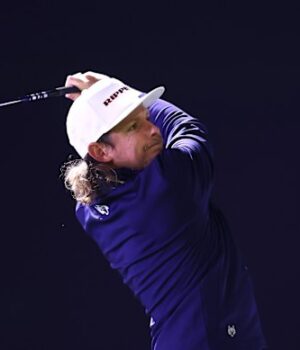
On Wednesday, Sergio Garcia, a LIV player who won the US Masters in 2017, suggested the league’s athletes were in the dark about its fate, even as speculation swirled online about its future.
Garcia said the wealth fund’s governor, Yasir al-Rumayyan, had assured players that LIV was part of a broader, long-term effort. “Honestly, we haven’t heard anything other than what Yasir told us at the beginning of the year,” Garcia said at a news conference in Mexico on the eve of a LIV tournament there.
“Honestly, you know how these rumours are,” Garcia said. “There are always a lot of them. And I can’t tell you anything more than what we already know.”
The kingdom’s wealth fund did not immediately respond to a request for comment.
The fund’s head, al-Rumayyan, said that the new strategy represents a “natural progression” of the fund’s path as it enters its second decade as a global investment powerhouse. The fund’s board had asked executives to look through their plans with an eye for “what’s must-have, and what’s good to have,” he said.
“There needed to be a reconsideration of the timing of some investments,” al-Rumayyan said, speaking during a news conference in Riyadh, the kingdom’s capital.
The fund, called the Public Investment Fund, has become a major source of capital around the world in recent years, with eye-catching investments in Uber, the Japanese conglomerate SoftBank and sports franchises like the English Premier League soccer team Newcastle United. It has poured money into the breakaway golf league and invested at least $US2 billion in a fund run by Jared Kushner, President Donald Trump’s son-in-law.
The fund was also a key locus of power for Crown Prince Mohammed bin Salman as he rose to become de facto ruler of Saudi Arabia. In one of his first moves after his father was appointed king in 2015, the then 29-year-old crown prince began to turn the fund – at the time a staid domestic entity – into a sovereign wealth vehicle capable of making momentous international bets.
In the early years of his rise, the crown prince led both Saudi Arabia and the sovereign fund on high-risk undertakings. The fund invested heavily in Magic Leap – an augmented reality company that has since floundered.
In 2017, Masayoshi Son, the CEO of SoftBank, declared that he had raised “$1 billion per minute” during a conversation with Crown Prince Mohammed, for a total of $US45 billion. The fund that money was invested into proved to be highly volatile, although it has made up for its staggering losses in recent years.
The assets managed by the PIF grew enormously during its first decade – up from an initial $US150 billion. But much of that growth came through moving other state-owned assets under the fund’s umbrella, centralising the kingdom’s wealth.
Cloaked in vague corporate language and short on details, the fund’s new, five-year strategy nonetheless reflects an important shift in Saudi Arabia’s trajectory under Crown Prince Mohammed, now 40.
In his early years, the crown prince compared himself to technology “disrupters” like Steve Jobs and Mark Zuckerberg, who pledged to “move fast and break things”. He spearheaded a disastrous military intervention in Yemen and oversaw an episode in which the Lebanese prime minister, Saad Hariri, was effectively held hostage in Riyadh and pressured to resign. In 2018, the killing of Saudi journalist Jamal Khashoggi by government agents in Istanbul sparked global outcry.
But in recent years, the crown prince has refashioned himself as a mediator and diplomat, while pulling back on some of the flashiest elements of his plans to overhaul Saudi Arabia’s oil-dependent economy.
The shift in the sovereign fund’s strategy will have a particularly noticeable effect on Neom, the science fiction-inspired region that the crown prince had planned to build along the kingdom’s Red Sea coast.
Neom is now focused on “controlled and gradual execution,” with its various projects rescheduled and prioritised according to their “commercial feasibility”, al-Rumayyan said.
Other key areas of focus for the kingdom will be investing in artificial intelligence and delivering on plans to host the World Expo in 2030 and the World Cup in 2034, al-Rumayyan said. Those projects were considered “critical” and have been prioritised.
This article originally appeared in The New York Times.


