
source : the age
A new latte line splitting Sydney has emerged, with data revealing the areas with the highest ratios of registered electric vehicles are primarily concentrated in the east, north and inner city.
The City of Sydney has the highest ratio of EVs to the total number of passenger vehicles: 21.6 per cent of the 96,698 vehicles registered in the local government area are electric, April 2026 vehicle registration data from Transport for NSW shows.
Behind it is Willoughby, Ku-ring-gai, North Sydney, and Ryde, ranging from 16 to 14 per cent, while the areas with the lowest ratio of registered EVs are Wollondilly, Hawkesbury, the Central Coast, Penrith, Fairfield, and the Blue Mountains, ranging from 5 to 7 per cent.
Sydney’s smallest LGA, Hunters Hill, has the fewest EVs, but the cars made up 12.2 per cent of the area’s 6012 passenger vehicles.
While the data shows EVs are most commonly concentrated in the city’s east and north, western Sydney is not lagging either.
Owing partly to their large populations, Blacktown and Canterbury-Bankstown have the highest and third-highest number of registered EVs, with 24,972 and 20,461 vehicles, respectively. Parramatta is also a standout, with 17,496 EVs – the fifth highest of any local government area.
Since the war broke out in Iran, the global surge in fuel prices has led to a rush of interest in the EV market. Sales climbed by 50 per cent in March, and almost one in seven cars sold across Australia in March was an EV, according to the Federal Chamber of Automotive Industries.
In Sydney, EV uptake was strongest in the north-west, with suburbs such as Marsden Park, Kellyville, and Baulkham Hills recording the most EV purchases made via the federal government’s fringe benefit tax exemption in 2025.
But a combination of factors such as a lack of chargers, higher costs and range anxiety mean some still hesitate before making the switch from petrol to electric.
“The upfront cost is one of the primary barriers to whether people can afford it or not, it’s still quite high relative to petrol cars. It does tend to be those of higher socioeconomic backgrounds who can afford it,” Macquarie University’s economics Associate Professor Rohan Best said.
EV charger deployment is also lagging in Australia, where there are 45 electric cars for every charging point compared with a global average of 11.
A swath of suburbs across Sydney also have little to no access to public chargers, which electricity network providers have pointed to as evidence of failure to keep up with surging demand.
Premier Chris Minns, himself an EV driver, previously cited a lack of access to chargers, and said the vehicles should be available for everyone – not just “for snobs that live in the eastern suburbs.
“It’s got to be available to regular mums and dads, and that means, particularly if they’re travelling and driving for work, they don’t have range anxiety, they can get access to a recharger,” he said.
To combat this, the NSW government announced this month it would roll out hundreds of new EV chargers in suburban Sydney and regional black spots to plug gaps in the state’s charging infrastructure. Part of the $100 million in new funding will deliver up to 1000 new charge plugs and kerbside chargers over the next few years.
But some in the industry claim the rollout of kerbside chargers is being slowed down by the electricity network providers, which own the grid’s poles and wires, and which are seeking to expand into the charging market.
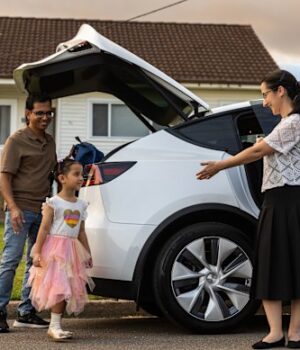
Three years ago, Blacktown resident Mahmud Rahman decided it was time to retire his family’s Mazda CX-5, and tossed up between purchasing a Toyota RAV4 petrol car, or a Tesla Model Y electric model which was $30,000 more expensive.
After much deliberation, he settled on the EV despite the higher upfront costs. Now, he saves up to $300 a month on petrol costs.
“Even if the market price was higher, I considered the benefits through the [fringe benefit] tax exemption, and it reduced my ownership cost in the long run, so I went for that,” Rahman said.
“We were earlier adopters, society wasn’t as ready for EVs at the time – there was a lot of scepticism.”
Rahman said high fuel prices had heightened interest among friends and family who were eyeing the switch to an EV.
But Rahman said gaps in charging infrastructure would remain top of mind for Sydneysiders: “I feel we need to increase the network in remote areas, so people feel confident they can travel to those places easily. If we want to travel for recreational purposes for example, and there is no charging infrastructure, then it’s challenging for people to decide [to buy an EV].”
Start the day with a summary of the day’s most important and interesting stories, analysis and insights. Sign up for our Morning Edition newsletter.


