
Source : ABC NEWS
It’s the date that is seared into Paralympic champion Alexa Leary’s brain.
July 17, 2021: the day her “second life” began, following the traumatic brain injury (TBI) she sustained in a cycling accident at age 19.
It’s the date 24-year-old Leary now wants recognised as traumatic brain injury awareness day, to help fuel understanding of the unique challenges associated with the sudden changes a TBI brings.
March is brain injury awareness month, but there is currently no specific day dedicated to TBI.
In Australia, 1 in 45 people live with an acquired brain injury, which is damage to the brain that occurs after birth.
Although Leary remembers none of it, her cycling accident, which happened while she was training as a triathlete, wiped four to five years of her memory.
It forced her parents to try and fill in the gaps of a life Leary no longer felt she had access to.

Leary poses with the Sunshine Coast doctors who helped save her life.
“People just think, ‘oh she fell off her bike’, that’s it,” Leary told ABC Sport Daily.
“But it’s like, no, I am living a full second life. I have severe traumatic brain injury.
“It has changed my whole life … it’s really hard living with a TBI.”
As documented in her new book, Sink or Swim, Leary was initially unable to walk or talk.
But the hardest part about rehabilitation was accepting the fact that the old ‘Lex’ was gone.
“I always thought, ‘I want my old life back’, but when I think about it, no, I don’t, I love who I am now,” Leary said.
“Well, I am learning to accept and understand her, it’s just, life is really hard. Honestly, it is difficult.”
‘My emotions go insane’: Leary
Leary’s difficulties include issues with emotional regulation, which may come as a surprise to an Australian public used to seeing her sing and dance her way around the pool deck.
Leary is often seen beaming on pool deck, but has revealed she has dark days. (Supplied: Swimming Australia/Delly Carr)
“My emotions go insane,” Leary said.
“I get sad, happy, angry, depressed in a day, in a second.”
The world record holder employs a behavioural coach to help manage her emotional volatility, while she says she can struggle with continuity from one day to the next.
“Honestly, [some days] when I wake up, I don’t even know who I am,” Leary said.
To cope, Leary writes notes to herself the night before, to detail what she has to do the following day.
It allows her to get “on board” with the day’s agenda.
“It’s to try and tame my emotions, to not make them so heightened,” she said.
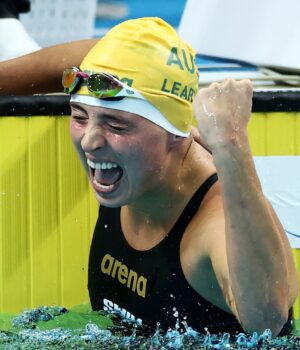
Leary acknowledges these challenges make her achievements at Paris all the more remarkable, where she won two gold and a silver medal to go along with a World Record in the women’s 100m freestyle (S9).
“It’s incredible, and I’m so proud of myself for how far I’ve actually come,” she said.
Leary won two gold medals in her Paralympic debut at the Paris 2024 Games. (Reuters: Andrew Couldridge)
Because Leary also experiences processing delays, she says it took a while for her victory to sink in.
“When I got out [of the pool], everyone was like, you’ve won, and I just couldn’t believe it,” she said.
Leary determined to raise awareness of TBI
Leary credits her determination in the pool to the attitude that saw her regain her ability to walk and talk.
Her parents were told that because the left side of her brain was badly damaged, she would struggle with activities involving the right side of her body.
Leary was initially encouraged to swim as a form of rehabilitation. (Getty Images: Adam Pretty)
As a result, her specialists encouraged her to take up swimming, to ensure she was working the right side of her body. But she was determined not to stop there.
“I wanted more than just rehab,” Leary said.
“I’d had a massive accident, so I wanted to go out there and do something good for myself. That was my biggest goal, and look at where it has got me.
“I’m a very determined and passionate person. When I want something, I want to fight for it … even when I fought to walk and talk again, I’ve just had that mindset.”
That single-minded focus is now on getting a day for TBI, with Leary saying she chose to open up about her challenges to support others.
Leary is a former triathlete, and holds two Paralympic swimming world records. (Supplied: Swimming Australia/Delly Carr)
She has met a number of other people who live with TBI, who say her journey has inspired them.
“I will fight for [an awareness-raising day] because I feel like we need to be recognised and known because we all struggle with TBI and it’s really hard,” she said.
Music, not swimming, Leary’s biggest love
That quality of determination has also driven Leary’s over-achieving mentality, not just writing a new book, but releasing several songs.
After her TBI damaged much of her brain, she says, her love of music became ‘heightened’.
Loading Instagram content
And while she was initially unable to talk, she “knew every word to every song”.
“Music is the biggest part of my life,” Leary said.
“I just love it more than anything.”
In fact, music is deeply entwined with Leary’s sporting successes, and it was Kylie Minogue’s “can’t get you out of my head” that became the soundtrack to her triumph in Paris.
“I literally had a little stage and I had to get up and sing, ‘la la la’,” she laughed.
“I was fully enjoying it and I didn’t even care about the medal. I was like, this is going off.”
But while Leary has aspirations to meet Minogue, she says she is currently “locked down” into training for the Los Angeles Paralympics and, just maybe, a home Paralympics in Brisbane.


