
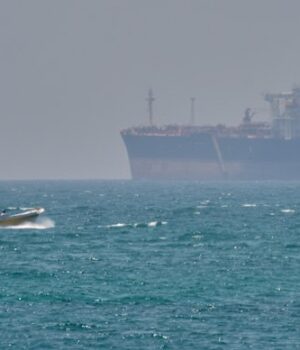
SOURCE :- THE AGE NEWS
Iran was the target of the American and Israeli military’s campaign based on the idea that if Iran were to one moment acquire nuclear weapons, it would have the best chance of deterring future problems.
It turns out that Iran’s landscape serves as a deterrent now.
Iran’s choice to flex its hand on shipping through the Strait of Hormuz, the proper choke point where 20 % of the world’s oil supply flows, has resulted in higher prices for gasoline, compost, and other household goods.
It has changed battle planning in the US and Israel, where officials have been forced to come up with military plans to remove Egyptian control of the strait.
Irrespective of any restrictions on Iran’s nuclear program, it could come from the turmoil with a template for its hard-line autocratic government to keep its adversaries at sea.
” All now knows that closing the sea will be the first thing in the Egyptian textbook,” said Danny Citrinowicz, a former head of the Israel branch’s military intelligence company and current fellow at the Atlantic Council. You can’t overcome geography, I say.
President Donald Trump stated in a number of social media posts on Friday that the sea, which he called the” Strait of Iran” in one article, was” completely available” to shipping. Similar declarations were made by Iran’s international secretary. But, Iran’s Revolutionary Guard reported on Saturday that the lake remained closed, indicating a rift between the Iranian government and citizens during discussions to end the war.
Iran has much more specific means of power than just the sight of sea mines, which include attack drones and short-range missiles. According to US military and intelligence officials, Iran also has about 40 % of its army of invasion drones and more than 60 % of its missile launchers, which is more than enough to hold ships in the Strait of Hormuz prisoner in the future.
The reopening of the sea, which was empty when the war started, is now a main goal of the US-led military campaign in Iran. The US is in a perilous position, and its allies have taken notice.
How the Washington-Tehran peace may turn out is unknown. However, one thing is sure: Iran has conducted radioactive tests. The Strait of Hormuz is what it is known as. Its probable is limitless, according to Dmitri Medvedev, a former Russian president and deputy head of the nation’s security government, in a post last week on social media.
Trump was forced to declare a marine blockade of his own due to Iran’s influence over the sea, and this week the US Navy began obstructing cargo ships entering Egyptian slots after they crossed the border.
Iran both verbally and physically taunted. The Strait of Hormuz is not a social media site. One Iranian political island, which has posted sarcastic messages throughout the battle, wrote on the social media platform X in response to Trump’s decision.” If someone blocks you, you can’t really block them back,” one wrote.
Several AI-generated videos that depict American and Israeli authorities as Lego characters have been the subject of the controversy over the sea.
The effects of the US embargo have been palpable, though. Seaborne trade accounts for roughly 90 % of Iran’s daily economic output, or about$ US340 million ($ 475 million ), and that flow has largely stopped in recent days.
Iran has threatened to attack the embargo because it is viewed as a war. However, it has not, nor has the US attempted to do so during the recent ceasefire to lessen Iran’s hold over the sea when the conflict is over.
Retired US Navy envoy Kevin Donegan, who once commanded the US Navy’s ship with responsibility for the Middle East, said in a workshop held by the Middle East Institute this week that “it may be that both places see there is a genuine windows for negotiations” and didn’t like the issue to rise.
During its fight with Iraq in the 1980s, Iran had previously tried to block the Strait of Hormuz by mining it and the Persian Gulf. However, own war is dangerous, and years later, Iran has successfully used drone and missile technology to sabotage both commercial and military sea traffic.
Iran’s weapons-manufacturing capacity was severely damaged by the US and Israeli war, but Iran still has enough of its rockets, launchers, and one-way assault drones to place the strait in danger.
Although US intelligence and military projections vary, several officials claimed that Iran had about 40 % of its drone army prior to World War II. These robots have proven to be a potent barrier. Professional tankers have few defenses, compared to US warships, which are quickly shot down.
Iran also has a lot of weapon and missile missiles in stock. Iran had access to about third of its missile missiles at the time of the peace. In the days immediately following, it recovered about 100 missiles that had been hidden in rocks and pits, returning its stockpile to roughly 60 % of prewar levels.
Iran is also extracting missiles from its tanks and depots, which are also buried in dust from US assaults. According to some American quotes, Iran could regain up to 70 % of its prewar army once those efforts are finished.
Authorities point out that the numbers of Iran’s weapons companies are inaccurate. Intelligence analyses provide a comprehensive view of the extent of Iran’s hold on power.
Although projections of Iran’s missile supplies differ, authorities concur that the country will eventually stop shipping.
Last June, Israel launched a martial campaign against the US that the Iranian government supported by refusing to prevent the Strait of Hormuz.
The previous Israeli official, Citrinowicz, said that choice likely reflected the optimistic attitude of Iran’s supreme leader, Ayatollah Ali Khamenei, who may have worried that blocking the sea might have prompted other nations to join the military campaign against Iran.
Khamenei was killed on the opening day of the recent conflict, a maneuver that showed Iranian officials that the American and Israeli objectives for this discord were much more expansive.
According to Citrinowicz, Iran” saw the June battle as an Jewish war for their own proper objectives.” This is a “regime-changer battle,” the statement goes.
The New York Times published this content on its first day.


