
Source : THE AGE NEWS
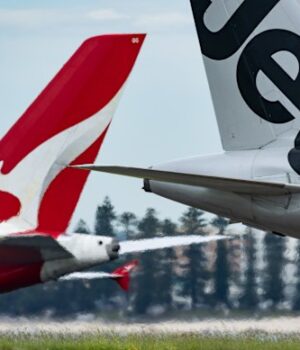
Qantas has flagged up to $800 million in additional fuel costs, cuts to domestic routes, and scaled back capital expenditure as the airline grapples with the fallout from the US-Israel war with Iran.
As consumer demand for domestic flights falters in the face of a cost-of-living crisis, the Middle East conflict has driven up oil prices and the cost of jet fuel, a major expense for airlines.
Qantas’ second-half fuel bill is now anticipated to be $600-$800 million more than previously announced, at about $3.1 billion to $3.3 billion, the company said in a market update, even as revenue per kilometre travelled rises as tickets get more expensive.
The Middle East conflict, which has closed the Strait of Hormuz through which Saudi oil flows to Asian refineries that serve Australia, has forced airlines to rethink their priorities in an environment of higher prices and uncertain demand.
Qantas said that about 90 per cent of its second half 2026 exposure to crude oil was hedged – a financial device used to reduce the impact of sudden price movements.
But the airline was “largely exposed” to rises in the separate cost of refining crude oil into jet fuel, which increased from $US20 per barrel in February to a peak of around $US120.
The open-ended conflict has seen airlines from Air New Zealand to SAS race to adjust to weaker demand by trimming flights, reconfiguring networks, and raising prices. Gulf carriers such as Qantas partner Emirates, Virgin partner Qatar, and Etihad have dramatically cut services to Australia.
Qantas said it would scrap a $150 million share buyback. Shares in Qantas fell nearly 1 per cent in the open of trade on Tuesday to $8.93.
The airline’s fiscal year 2026 capital expenditure “will now be at or below $4.1 billion, the bottom end of the previously guided range”, it said.
Since the conflict kicked off on February 28, Qantas has redeployed larger aircraft from North American routes to routes flying to Singapore, aiming to meet demand as Persian Gulf carriers are dramatically disrupted by the conflict.
Demand for international flights to Europe that avoid the Middle East has helped raise the airline’s expected international revenue unit growth – its revenue per available seat kilometre – to about 4 to 6 per cent, double previous guidance.
The increase in Qantas’ international revenue is not enough to offset costs linked to fuel, the company said. Analysts now expect Qantas’ full-year profit to take a $400-$500 million hit.
But rising fuel costs are also sapping demand for domestic travel.
The airline cut its fourth quarter domestic projections by around 5 percentage points, notifying affected Qantas and Jetstar customers of changes to flights. “[They] are being contacted directly and offered alternative flights or a refund”, the airline said.
A reduction in Qantas and Jetstar domestic flights will be imposed across the airline’s national network with an emphasis on routes where passengers have options for other flights, the airline said.
Qantas Group “is working closely with the government and jet fuel suppliers who continue to provide confidence in fuel supply for the remainder of April and well into May,” the company said in a statement to the ASX. “We are closely monitoring the situation given the ongoing uncertainty in global fuel supply chains.”
Singapore-based trade credit risk management service Coface said that higher airfares and capacity reductions have “so far helped offset rising jet fuel costs”, but this “pricing dynamic is unlikely to be sustainable over the longer term”.
Higher energy prices “increase inflationary pressure and erode consumer purchasing power, weakening demand for discretionary spending such as air travel”, Coface said.
“This would, in turn, limit airlines’ ability to continue passing higher fuel costs on to passengers…”
George Boubouras, managing director at K2 investments and advisory, said the update was “not a surprise.”
“It’s consistent with Qantas’ global peers … Besides (US-based) Delta Airlines – which has its own refinery – most global players have got some adjustments and headwinds to work through,” Boubouras said.
“Having said that, the disruption in the Middle East may be a structural benefit for Qantas once they get through this very difficult cost phase,” he said, referring to Qantas’ network footprint, which does not transit the Persian Gulf, now a choke point because of the US-Iran war.
The airline said its reduction in capital expenditure would not affect its purchase of planes.
Qantas recently revealed its first Airbus A350-1000 ULR Project Sunrise plane had rolled off the assembly line ahead of safety tests.
The plane will allow Qantas to fly direct from Sydney to London, by-passing the Middle East.
The Qantas fuel cost revelations come as one measure shows consumer confidence is getting crushed by a “cost-of-living” shock.
The Westpac–Melbourne Institute Consumer Sentiment Index, released on Tuesday, showed a heavy fall in April, dropping 12.5 per cent to 80.1 from 91.6 in March.
Expectations suggest “consumers are bracing for a return to the extended period of weakness,” Westpac said.
The Business Briefing newsletter delivers major stories, exclusive coverage and expert opinion. Sign up to get it every weekday morning.
 Chris Zappone is a senior reporter covering aviation and business. He is former digital foreign editor.Connect via X, Facebook or email.

