Source : ABC NEWS
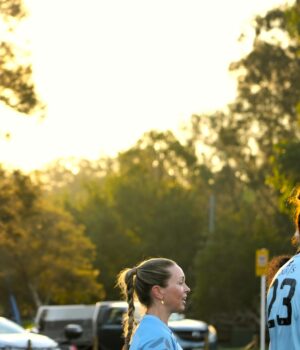
Most of the Cooks River Titans over 35s women’s team had never kicked a ball before the 2023 Women’s World Cup in Australia and New Zealand, including Carly Stebbing.
“In the wake of the Women’s World Cup and the frenzy that was everything Matildas, some mates started to suss out whether there were any women that had been on the sidelines watching their husbands play for a long time that might be interested,” she said.
“And for whatever reason at that particular point in my life, I was like, ‘You know what, why not? I’ve been on the sidelines for long enough. Let’s give it a crack.'”

Carly Stebbing had never played football before joining the Titans as an adult. (ABC Sport: Amanda Shalala)
Angela Habashy was another player who was lured off the sidelines.
“When you think about these huge tournaments and them inspiring people, the face of that legacy is quite often young kids,” she said.
“And of course, these major tournaments do inspire the next generations of stars, but they also inspire women like us as well.
“Mums over 40 who thought, ‘Yep, we’re going to give it a go, and this beautiful game has got a place for us too.'”
The Titans say they have become close friends since becoming a team. (ABC Sport: Amanda Shalala)
Titans coach and club president Nick Kambounias says the team embodies the very best of the sport.
“Football is not only about the stars. Football is also what it can give to you from a mental point of view, social, emotional point of view as well, and what this team has given to these players has been exactly that.
“The excitement on their face when they scored the first goal of the season, and then how happy they were when they got their first point from a draw.
“I think they stayed at the park for another hour afterwards when they got their first win.”
Coach Nick Kambounias says the over 35s women are his favourite team at the club. (ABC Sport: Amanda Shalala)
Clubs need to keep up with demand
The Titans’ story is one of many similar stories across Australia, as the country now hosts its second major women’s football tournament in two and a half years: the Women’s Asian Cup.
Women and girls’ participation in football has risen by 20 per cent since the World Cup.
Although it is still well short of Football Australia’s target of 50/50 participation by 2027.
Fiona McLachlan, an associate professor at Victoria University, says while the World Cup has created greater media visibility and fan engagement, there have been challenges in enshrining a legacy for the tournament.
There has been a significant increase in the number of women and girls playing football in the past couple of years. (ABC Sport: Amanda Shalala)
“In some ways, [it is] really challenging to have such a positive event because a lot of my work is spent in clubs trying to convince longstanding committee members that their club isn’t as inclusive and safe as what they think it is,” she said.
“[There’s] that idea of progress and not needing to change anything now because the Matildas have saved us from all issues of gender inequality.
“The people who put on the events do a really, really good job at containing that and making promises as well to ensure that those effects are felt,” she said.
“But then who actually picks up the stick, making sure that the community-level grassroots clubs are safe and inclusive and open and ready to receive new participants?”
The effects are being felt at the domestic level, with the A-League Women’s players repeatedly pushing to become fully professional, while many local clubs struggle to keep up with the demand.
Michelle Heyman is one of only three A-League Women players in the Matildas Asian Cup squad. (AAP: Lukas Coch)
“We are far from achieving an equitable situation, more importantly, a sustained situation,” said University of Technology Sydney lecturer Leila Khanjaninejad.
“We had a larger number of people that want to participate, but our facilities and system that we have in place are lagging behind, specifically for club levels that have been already overstretched with their facilities and not being able to offer a safe environment for people to participate, for women and young girls to participate.”
Engaging the Asian diaspora in Australia
The Asian Cup, which is being hosted in Perth, Sydney, and the Gold Coast through March, is seen as a chance to reconnect the public with the Matildas, as well as the competing countries.
About 17 per cent of the Australian population has Asian ancestry, and more than 3.5 million have heritage from the 11 visiting teams.
And the tournament is a gateway for many to celebrate their culture and community.
“When the national team comes here it helps our community to feel connected to the home,” Taiwan fan Lala Gao said.
“[I’m] very proud as a Taiwanese Indigenous [person] … it’s also about to feel all our culture and all our people represented on the big stage.”
Taiwan fan Lala Gao and others will wear traditional dress to Asian Cup games in Perth. (ABC News)
Philippines fan Neil Bravo says it is important for local fans here to support their home nation.
“It’s that connection whenever they play here in Australia before the Filipino community. We feel that we have to show up. We have to show them so that they will feel like they are in the home court,” he said.
Dr Khanjaninejad hopes this tournament drives greater attention and investment in sporting participation in multicultural communities.
“When it comes to people coming from diverse cultures and migrant backgrounds, they lack extra steps,” she said.
“We’re talking about intersectionality here, how living in a different place that might not be in the spotlight of attention for investment can prevent people to play sport, to have less volunteers, to have less facilities, not having the infrastructure, not having access to the club.
“And I think that this Asian Women’s Cup is a fantastic opportunity for us to put that in the spotlight and have a long-term plan to bring that sense of belonging.”
The current women’s football landscape is vastly different to what the so-called First Matildas experienced when they debuted at the inaugural Asian Cup in 1975.
Members of the First Matildas recently played a friendly against the Australian Chinese Soccer Association. (ABC Sport: Fletcher Yeung)
Trixie Tagg was a member of the First Matildas. (ABC Sport: Fletcher Yeung)
The players still love the game 50 years after their landmark tournament. (ABC Sport: Fletcher Yeung)
They recently played a friendly against the Australian Chinese Soccer Association to celebrate the Asian Cup. They are buoyed by how far the game has come.
“When we played, we never had anyone coming unless they were just looking at us and laughing at us,” First Matilda Sue Binns said.
“So it’s a big difference now, and the current Matildas made a big difference to that too.”
Fellow pioneer Kim Coates agrees.
“To see major tournaments coming here for women’s football — women’s football — getting that sort of a crowd, it’s magnificent.”
Leaving a leadership legacy
Much of the discussion about legacy has focused on players, but Dr Khanjaninejad says sports leadership also needs to be examined moving forward.
“When it comes to the local clubs, it’s still male-dominated,” she said.
“It’s not just a matter of attracting people, attracting participants or attracting women into the leadership role.
“It’s a matter of sustaining that position, so where they feel safe and included and they have a platform and opportunity to continue to stay and grow in that role as well.”
The Titans’ children often watch them train and play. (ABC Sport: Amanda Shalala)
The Titans hope to be an example for others. Having started with one team a couple of years ago, they’re now aiming to field four over-age women’s teams this year.
For Carly Stebbing, it’s been life-changing.
“In terms of mindfulness, I can think of no better thing to take your mind off everything else that is going on in the world or your life or your family than showing up for your team, getting onto the field no matter the weather,” she said.
“Sometimes I’d be out there and think, ‘For God’s sake, Carly, you’re 40 years old. What are you doing?’
“You show up for each other and you just think about that ball for 90 minutes.”
Angela Habasy feels the same.
“We didn’t know each other to start with,” she said. [We were a] group of strangers.
“And heading into our third season together, we’re all absolutely hooked.
“We’ll keep playing for as long as our bodies allow us and it’s been transformational.
“It’s a part of my life now that I will never, ever, ever give up.”