
Source : ABC NEWS
In March 2020, news filtered through that NRLW players would be paid for the first time.
Mel Kawa, who had just been announced as captain of rugby union team Melbourne Rebels, was at a press conference to launch the Super W season.
Super W is Australia’s national women’s rugby union competition, and was at the time unpaid, despite launching in the same year as NRLW (2018).
Kawa remembers being “thrilled” for her league counterparts, but sat smiling wryly as then-Rugby Australia (RA) chief executive Raelene Castle told gathered media that the governing body would have to “grow towards paying the players to play Super W”.
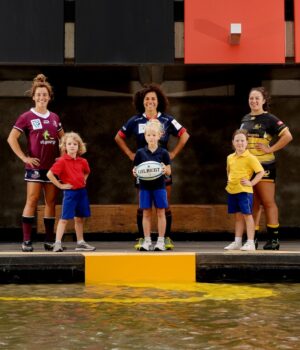
Afterwards, Kawa was asked to pose next to a young girl for promotional purposes.

Mel Kawa (centre) said she “felt like a fraud” encouraging girls to get into rugby when she was playing for free. (Getty Images: Tracey Nearmy)
“I was feeling really sick about myself,” she told ABC Sport.
“I almost felt like a fraud holding this little girl’s hand.
“She was looking at me as if I was this poster person, and I thought … I’m not doing enough for you because I’m asking you to play a game for free, when I know you’re worth so much more than that.”
Kawa, who recently retired, was one of 152 athletes from across 47 sports who took part in the ABC and Deakin University’s inaugural Elite Athletes in Australian Women’s Sport Survey, which showed 39 per cent of respondents did not earn anything from sport, and few earned more than $20,000.
Melanie Kawa wants to see women paid more in Australian rugby. (Getty Images: Tracey Nearmy)
The 40-year-old said things were “getting so much better” in rugby union, but her sport was progressing at a “snail’s pace”.
Her sentiments reflected those of athletes across a range of professional team sports, including A-League Women (ALW) player Aimee Medwin.
“I think the majority of players are unsatisfied with the growth we’ve seen in the game,” 26-year-old Medwin told ABC Sport.
“I think it’s at a really critical tipping point where we need to have a full-time league in order to be as successful as we want to be.”
Aimee Medwin is pushing for full professionalisation of the A-League Women’s competition. (Getty Images: Kelly Defina)
Receiving $2,000 salary one of Kawa’s proudest moments
It was not until 2021, a year after that press conference, that Kawa, who captained Papua New Guinea in both the 15-a-side format as well as sevens, would receive her first payment for playing rugby union in Australia.
That year, after leading the Rebels to their most successful season yet, she remembered attending an end-of-season function where members of the board announced it was time their Super W players were paid.
With some corporate sponsors in attendance, the Melbourne side crowdfunded a sum of about $500 per player, effectively enough for each to purchase a couple of pairs of boots.
The following season, Kawa received her first salary of $2,000. Despite the paltry amount, she said it was the “proudest” moment of her career.
Melanie Kawa leads the Rebels out during the round one Super W match against the Fijiana Drua in 2022. (Getty Images: Kelly Defina)
“It was basically enough to pay the tolls here in Melbourne,” she said.
“But for the very first time, it felt like the dam was breaking open just a little bit and trickling out.
“I felt like we were at the point that if we didn’t do anything, it would be a massive injustice because of what the girls were putting out on the field.
“It was never just about money, it was about the recognition.”
Melanie Kawa says the drain on her finances led her to think about quitting the game she loved. (Getty Images: Kelly Defina)
Kawa said financial difficulties led her to think about quitting “all the time”.
“It was incredibly hard and anxiety-inducing,” she said.
“You’d break down in tears some nights after training, going, ‘What am I doing? Is the juice worth the squeeze on this game?’
“I’m literally spending every spare moment of the day towards this sport, asking to be professional and still being told, ‘Well we just don’t see it,’ … ‘We don’t have the resources,’ or, ‘We’re not going to invest in it.'”
Super W, A-League Women players paid poorly
Kawa was one of several rugby union players who responded to the survey expressing similar concerns.
One noted “increasing difficulty balancing sporting commitments and time investment” and wrote the choice to continue playing rugby meant she would “financially not be in as comfortable a position, i.e. paying my mortgage and saving for the future”.
As of the most recent 2025 season, Super W players each receive a $4,000 payment from RA for a seven-week competition, consisting of five rounds of home-and-away matches plus two weeks of finals.
Clubs have the option to “top up” the contracts, but the capacity to do so varies across the teams.
It compares unfavourably to the women’s rugby sevens program, which has been full-time since 2015 and is funded by RA.
It also makes Super W the poorest paid domestic women’s professional sporting competition in Australia, while A-League Women’s (ALW) players do not fare much better.
Over a 22-round season, ALW players are paid a minimum salary of $26,500.
The Australian Professional Leagues (APL) oversees the salary cap and sets the minimum wage for each club.
This is a far cry from the Matildas, whose top players can earn up to $200,000 a year based on their most recent collective bargaining agreement (CBA).
The table below shows the most up-to-date figures the ABC could verify on the minimum and average wages players receive for participating in each of Australia’s professional women’s sporting competitions, noting that season length varies across each competition, as do contracts.
The PFA claims the ALW has the lowest minimum salary of all major Australian women’s sporting leagues, excluding Super W, and recently launched Ready For Takeoff — the players’ vision for the future of the competition.
It pushes for the immediate professionalisation of the ALW competition, arguing any additional costs would be “offset by increased revenues almost immediately”.
“We want to be full-time,” Medwin said.
“We want to be respected. We want to be thought of by our league.”
Loading Instagram content
ALW players consider stepping away: Medwin
Medwin was on the Western United roster in 2025 when the club’s license was abruptly cancelled.
Such was the late notice, there were no roster spots left at any Victorian-based teams. It left Medwin and many of her teammates with a choice between leaving the game or swiftly moving interstate.
She chose the latter, taking up a contract with Brisbane Roar, but it meant she had to quit one of her jobs as an AFLW strength and conditioning coach and heavily reduce her hours for the other.
Aimee Medwin says the expectation that players perform like full-time professionals is taking a toll. (Getty Images: Daniel Pockett)
Medwin said her salary was subsequently been “halved” and she had to leave behind her partner, with whom she had just bought a house. She said she was paying the mortgage on their Melbourne home as well as rent in Brisbane.
About to finish her master’s degree, she is employed at a local gym in a role well below her qualification levels because, as she puts it, employers are reluctant to take on someone who has so many commitments outside of work.
The Roar train four to five times a week, usually from 6am or 7am, with up to six hours of commitments per session.
Matches are often scheduled for mid-week, sometimes interstate, meaning she can be away for three days at a time.
Aimee Medwin has considered stepping away from soccer, with the financial strain becoming a real burden. (Getty Images: Hagen Hopkins)
“The expectation is that we’re full-time professional athletes, without the consideration that we’re not,” she said.
The situation has taken such a toll, Medwin said there had been times when she reconsidered her future.
“I think if it continues down the path it’s going, I will have to step away, just because I can’t financially do it anymore; it’s too much,”
she said.
“I’ll wait for the next CBA to come out, because I don’t think many of us can do this for much longer.”
The APL operates, markets and commercialises the A-Leagues.
In response to the issues raised by ALW players, APL chief executive Steve Rosich said the “current investment in women’s football is at record levels and our strategy will continue to grow that in a sustainable way”.
“Since the APL’s inception, in partnership with our clubs, we have proven our commitment to the growth of the women’s game,” he said.
“We’ve extended the season in line with the biggest leagues in the world, welcomed new teams into the competition, and broadened revenues through new partnerships and broadcast arrangements to help support the growth of the league.
“Having just commenced as CEO of the A-Leagues, an important priority is reviewing our strategy through to 2030, and as part of this we will have a bold and sustainable vision to grow the A-League.”
Investment in women’s sport ‘smart’ and ‘overdue’
Melanie Kawa says her sport is progressing at a “snail’s pace”. (Getty Images: Kelly Defina)
Kawa and Medwin said appropriate investment in women’s sport was long overdue.
Australia is due to host the Women’s Rugby World Cup in 2029, but no major funding announcements have been made in the interests of growing the women’s game locally.
This is despite RA receiving up to $120 million in funding from the recent British and Irish Lions tour, which reportedly put the governing body back in black.
As RA negotiates a new collective bargaining agreement with its players, Kawa is adamant now is the time to make a historic investment in women’s sport, citing the success of the 2023 FIFA Women’s World Cup.
“Tournaments like that completely break things open, so people understand what a great investment women’s sport is,” she said.
“Women’s sport is littered with brand new opportunities … and is probably less saturated than men’s.
“Ahead of the first Women’s [Rugby] World Cup to be held in Australia, this is a perfect opportunity for RA to prove they are willing to invest in the national 15s competition so that future generations of women and girls can be recognised as the professional athletes that they are.”
Australia will host the Women’s Rugby World Cup in 2029. (Getty Images: Andrew Matthews)
In response to a number of queries sent by the ABC, an RA spokesperson said the organisation had “substantially increased its investment into women’s programs over the last Rugby World Cup cycle and is forecast to do so again ahead of the once-in-a-generation opportunity presented by the 2029 Rugby World Cup in Australia”.
“The full-time Australian Women’s Sevens program is among the best in the world and Rugby Australia is committed to evolving our XVs program with the goal of playing on the final weekend in 2029,” the spokesperson said in a statement.
“The Wallaroos will play a minimum of 10 Tests per year throughout this cycle, including the first-ever tour of the USA and the launch of the WXV Global Series this year.
“Plans for a strong, aligned and well-supported women’s program for the next Rugby World Cup cycle are progressing well and will be implemented in a phased approach in 2026.”
Loading Instagram content
Benefits of FIFA WWC have not reached ALW: Medwin
While Medwin agrees with Kawa that tournaments like the FIFA Women’s World Cup can be game-changers, she warns the blistering success of the 2023 edition has not yet resulted in “trickle-down” benefits.
“I don’t think we have received a direct, tangible benefit from [the tournament] on a domestic, national competition or grassroots level,” she said.
Indeed, after the conclusion of the tournament, many of the Matildas’ biggest names packed their bags and headed back to much better-funded and resourced leagues overseas.
Loading Instagram content
“The only way we can earn more money in our sport is to leave the country and go play somewhere else … it’s pretty dire,”
Medwin said.
“It feels to us [players] that there is a lack of plan and strategic direction.
“That’s not reflective of the players or the PFA, it’s reflective of the APL.
“We’re not set up for success … it just feels like we [women] are not front of mind, ever.
“It’s such a huge source of frustration for us athletes, particularly on the women’s side, because we know we’re an afterthought.”
Aimee Medwin says female soccer players need to leave the country to earn more money. (Getty Images: Bradley Kanaris)
Medwin was not the only footballer and survey respondent who felt this way, with another ALW player saying that women were “treated as secondary sportspeople”.
It is a sentiment shared among ALW fans, with the Ready For Takeoff report noting the word “afterthought … came up constantly” during focus groups.
As concrete actions, Medwin hopes to see a more gender-diverse APL board put in place, with independent representation, not just current ALW clubs, as well as dedicated staff with a vested interest in the women’s league, and full-time support and medical staff.
She said the changes, alongside full-time professionalisation, would allow women to reach their full potential.
“I think it would take so much of the stress off the players and the part-time staff who support us,” she said.
“We want people to come and play [in Australia], but we need that investment.
“The players are so ready for it, the coaches are ready for it, the fans are ready for it. We just need it all to collectively come together to give us this opportunity.”
— with Sean Lawson