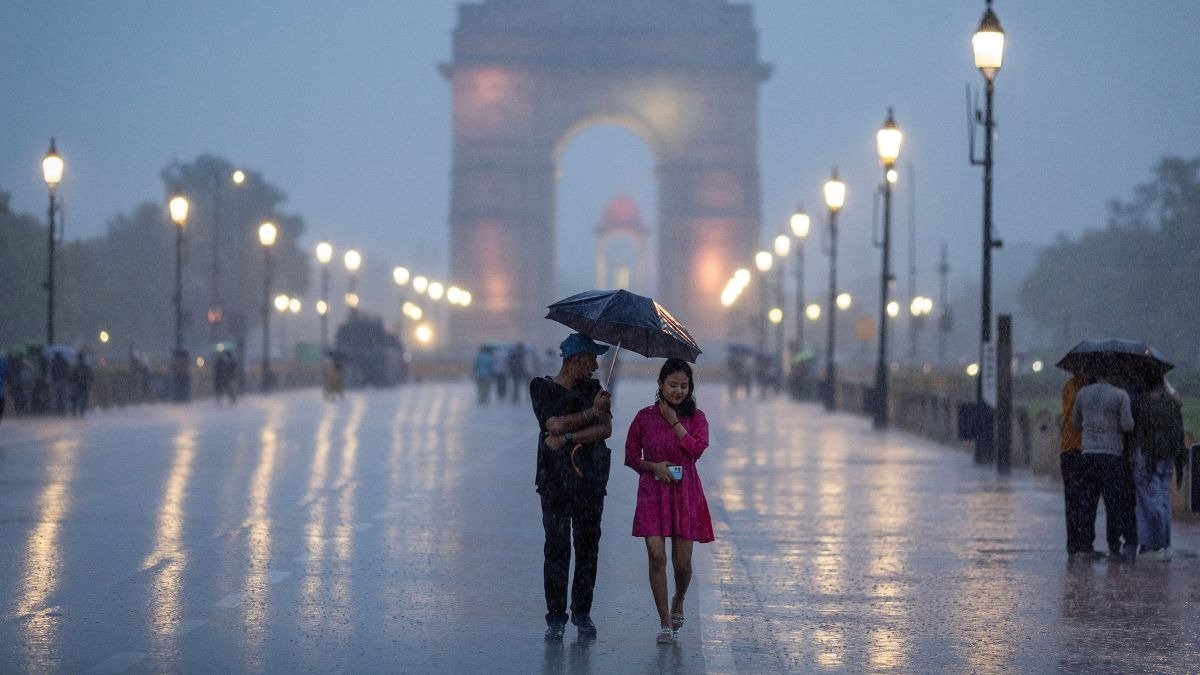
Source : INDIA TODAY NEWS
If you stepped outside in Delhi on Sunday morning to find grey skies and gusty winds instead of the scorching heat you have come to expect by mid-March, you were not imagining things.
The India Meteorological Department (IMD) had forecast light rain accompanied by thunderstorms and lightning, with surface winds gusting up to 50 kmph over the National Capital Region during the morning and forenoon hours. Temperatures, which had been running appreciably above normal, were expected to fall by 3 to 7 degrees Celsius from recent levels.
advertisement
WHY IS IT RAINING IN DELHI IN MARCH?
Western disturbances are low-pressure systems that originate over the Mediterranean Sea and travel eastward across Iran, Afghanistan and Pakistan before reaching the Indian subcontinent. They typically bring rain and snow to the northern hills in winter, but a series of them arriving back-to-back in March has pushed moisture deeper into the plains than usual.
Devendra Tripathi, founder of Mausam Tak and a weather vlogger for Kisan Tak, said that on Sunday, March 15, rain and snowfall were likely across the mountainous states of Jammu and Kashmir, Himachal Pradesh, and Uttarakhand, with the activity extending into the plains.
“There has been a slight drop in temperature, and there can be some more drops. There can be relief from the heat in some places, including in Madhya Pradesh, Gujarat, South Rajasthan and Maharashtra,” he noted.
HOW LONG WILL THE RAIN AND COOL WEATHER LAST?
The IMD has confirmed that a fresh western disturbance is likely to affect northwest India from the night of March 17, further extending this cooling trend.
Independent weather expert Navdeep Dahiya has pointed out that wind discontinuity will also trigger pre-monsoon rains in southern and eastern India from mid-March into April. He believes India could avoid a severe heatwave until at least 15 to 20 April, which would be a significant reprieve given how early temperatures had already begun to spike this year.
WHICH PARTS OF INDIA WILL GET RAIN?
The IMD paints a fairly widespread picture. Heavy to very heavy rainfall is expected over Assam, while Sub-Himalayan West Bengal and Sikkim, as well as Arunachal Pradesh, can expect heavy downpours.
Thunderstorm and lightning alerts have been issued for Jammu and Kashmir, Himachal Pradesh, Uttarakhand, Punjab, Haryana, and parts of Uttar Pradesh between March 15 and 19. Isolated hailstorms are also expected across several of these states.
Tripathi added that moisture from the Bay of Bengal will bring cloudiness and light rain to Odisha, Chhattisgarh, and Maharashtra, while Bihar, Jharkhand, and West Bengal are likely to witness rainfall too. The northeastern states, including Arunachal Pradesh, Assam and Meghalaya, may experience heavy downpours.
IS THIS GOOD NEWS FOR FARMERS?
Not entirely. While the dip in temperatures does ease moisture stress on standing rabi crops such as wheat, chickpea and mustard, the IMD has flagged serious concerns.
Pre-monsoon rain accompanied by hailstorms and gusty winds, reaching 50 to 60 kmph and gusting to 70 kmph in some areas, can damage horticulture and standing crops, injure people and cattle, and cause minor to major damage to power and communication lines.
Farmers across Jammu and Kashmir, Himachal Pradesh, Uttarakhand, Punjab, Haryana and Uttar Pradesh have been advised to use hail nets in orchards and vegetable plots, and to keep livestock indoors.
– Ends
SOURCE :- TIMES OF INDIA