
SOURCE :- THE AGE NEWS
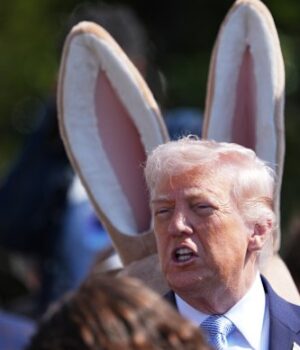
It was a supremely confident Donald Trump who appeared behind the podium in the White House briefing room on Monday, full of verve and vigour and some leftover Easter cheer.
“We had a great Easter – this is one of our better Easters, I think, in a lot of different ways. Militarily, it’s been one of the best,” he began.
And why not? The US just pulled off a daring mission in hostile territory to rescue two airmen whose F-15E fighter jet was shot down by Iranian forces. It was, as chairman of the joint chiefs of staff Dan Caine said, “an incredibly dangerous mission”, which succeeded with minimal injuries.
Trump relishes his recent military successes: the B-2 bombers’ 36-hour round trip to blow up Iran’s nuclear facilities last June, the strikes on alleged drug boats in the Caribbean and the audacious capture of Venezuelan leader Nicolás Maduro this year – and now this.
Given all of that, Bruce Wolpe, a senior fellow at Australia’s United States Studies Centre, believes there is a 90 per cent chance Trump will follow through with his threat to strike Iran’s civilian infrastructure, in what would be a significant escalation of the war.
“Trump’s confidence in the military to do the job is boundless,” Wolpe says.
And yet, there is some doubt. Trump likes to retain an element of surprise.
When he authorises attacks, it tends to be with little direct warning. In this case, it’s all out in the open. He says if Iran does not make a deal by 8pm on Tuesday (Washington time), its power plants and bridges will be destroyed in the following four hours.
That’s awfully specific, and it gives him little room to move if there is no deal.
If he were to back down from the ledge, it would be the biggest TACO (Trump Always Chickens Out) moment of this term, and hand Iran a huge symbolic victory.
Nonetheless, Trump clearly wants to find an acceptable off-ramp. While his news conference dominated the headlines, it was his earlier remarks – on the sidelines of the annual Easter Egg Roll at the White House – that were potentially more interesting.
In his own way, Trump acknowledged American public opinion was not on his side. He said if it were up to him, he would conduct a mission to seize Iran’s oil – one of his many lifelong preoccupations. But, “unfortunately”, Americans wanted their troops to come home.
“If I had my choice, I’d keep the oil,” he said. “But I also want to make the people of our country happy … I just don’t think the people of the United States would really understand.”
Trump has made his limits fairly clear. He does not appear to be willing to commit ground troops, which would be required to seize the oil or take one of Iran’s geostrategic assets such as Kharg Island. Air strikes on civilian infrastructure are a different story.
Aaron David Miller, a veteran Middle East analyst and negotiator, says it doesn’t really matter whether Trump TACOs on Wednesday morning (AEST) or not. The real question, he says, is whether launching the strikes would bring either party closer to ending the war on terms both sides can accept.
“There are only two ways out of this war – through a diplomatic agreement, or, presumably, through military pressure,” Miller says.
“I see almost no circumstance – unless the president is willing to commit 250,000 ground troops and basically occupy the country – that he’s going to change Iran’s risk calculation.”
Wolpe agrees. He says if Iran agrees to a ceasefire and to reopen the Strait of Hormuz, it would be a massive victory for Trump, “but I think the Iranians are too hardline to accept Trump’s terms”.
There will be consequences, however, to any escalation. Miller predicts that Iran would respond with widespread attacks on regional energy facilities, while the Houthis in Yemen would probably enter the conflict by targeting Saudi Arabia’s East-West Pipeline – its main oil alternative to the strait.
“You could be talking about oil at $US175 to $US200 dollars a barrel,” he says. “Then you’re talking recession.”
Markets largely ignored Trump’s remarks on Monday. The Dow Jones rose, as did the price of oil – marginally. Traders appear to be counting on a presidential backdown.
The idea that a substantive deal with Iran could be stitched together in the next few hours is implausible. But what about a tenuous deal? A “framework” where Iran makes a few concessions, allows a few more oil tankers through the strait and agrees to keep talking – that might be a palatable outcome.
A lot can happen in a day.
Get a note directly from our foreign correspondents on what’s making headlines around the world. Sign up for our weekly What in the World newsletter.
 Michael Koziol is the North America correspondent for The Age and Sydney Morning Herald. He is a former Sydney editor, Sun-Herald deputy editor and a federal political reporter in Canberra.Connect via X or email.