
Source : THE AGE NEWS
Pull some items off the rack at boutique fashion chain Incu and you might find a black tee for $390, or a white tank top for $270. A nude-coloured sheer dress will set you back $1135. A pair of brown sweatpants? $695.
It’s the details that make the difference. The black tee has a gathered bust and a bow, and the white tank, from Jean-Paul Gaultier, has buckles like overalls. Irish designer Simone Rocha is behind the sheer dress, while the sweatpants are from Eckhaus Latta, a label from New York that ignores traditional gender lines.
“The best compliment we had was a guy who said, ‘I love the store so much I don’t tell my friends where I buy my T‑shirts – I don’t want them wearing the same ones’,” says Vincent Wu, who co-founded Incu alongside his brother, Brian, in Sydney in 2002.
Where a snappy dresser may have once visited David Jones to splash on an evening dress, today they may be more likely to visit a curated boutique like Incu’s 13 stores across Sydney, Melbourne and the Gold Coast. There, most of the pieces are essentially streetwear, sourced from contemporary designer labels from around the world.
But the fight to hold the modern consumer’s attention, splintered and diverted dozens of times a day across multiple devices, has never been more intense. International and domestic brands have proliferated, online shopping is surging, and traditional retailers from Noni B in Australia to Saks Fifth Avenue in the US have gone broke.
Then there are the artificial intelligence-driven algorithms of ultra-cheap fast fashion giants Shein and Temu that have gained market share at a blinding rate, driving a race to the bottom in some parts of fashion retail.
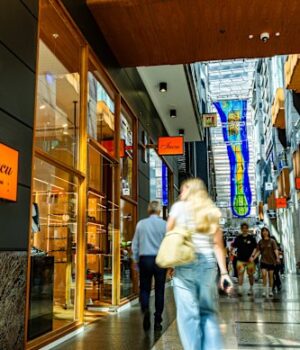
Yet customers such as Ayu (who declined to share her surname) are still coming to Incu. The 26-year-old chef had just bought a $1300 handbag from Incu’s store at The Galeries in central Sydney that her father had found during a previous shopping trip in Melbourne.
“I don’t know what the brand is, but I thought it’s cute for my mum, so I grabbed it today,” says Ayu. “I came here and I saw it … I’m so happy.”
A regular Incu shopper, Ayu enjoys browsing the latest drops from cult international brands A.P.C., Maison Kitsune and Maison Margiela among others.
Her best friend, Nat, who was visiting an Incu store for the first time, says she has also become a fan. “I feel like you should know your style when you go there,” Nat suggests. “But it also opens up your horizon as well.”
Old-style department stores, she says, are “for the masses”. “David Jones and Myer have a certain collection that you can find everywhere else.” Myer declined to comment. David Jones did not respond to a request for comment.
Despite being able to shop anywhere, any time, customers are returning to Incu for something fashion retailers are desperately trying to cultivate: a sense of cool.
“They’ve got so much cultural credibility,” says Melbourne fashion consultant Elizabeth Formosa, who says there aren’t many multi-brand retailers owning the space between premium and luxury.
“Boutiques like Incu succeed because they’ve got a stronger sense of identity … They’re very selective about their brand mix and their aesthetic.”
When shoppers can feel overwhelmed with so much choice at their fingertips, being a trusted curator is incredibly powerful, Formosa adds. “Customers really trust their point of view and often look to them to discover new brands and trends.”
It’s not something that can be found in the data. “In fashion, if you stand still, you let everyone pass you. The spreadsheet tells you the past. Your gut tells you where you should go next,” Vincent says.
“We don’t want to be one of those stores that once was cool and then, like, the owner got a bit older and then lost the relevance.”
Brick by brick
Born in Hong Kong, Brian and Vincent Wu grew up with a shopaholic mum and inherited an appreciation for the theatre of retail.
Australia’s fashion landscape was, in the early 2000s, still mostly insular: shopping centres were dominated by a handful of brands such as Jay Jays, Just Jeans and Cotton On. Most were local. International brands such as Zara and H&M had yet to land Down Under; the department store reigned supreme. The dot-com boom had just bust, driving retailers more adamantly back towards bricks and mortar.
“Back then, I thought there was no one doing interesting things,” Brian says. “And so we just, I think, broke every rule.”
Brian, who was drawing up business plans in his management consulting job, created one for Incu – short for incubator – which is what the twins envisioned the little retail outlet in The Galeries would be for up-and-coming local global fashion brands. To find clothes to fill the store, Brian and Vincent flew to Los Angeles, where they rode the elevator to the top floor of designer showrooms and knocked on every door.
“When you’re that young, you’re naive enough to do it. You just have that confidence,” Vincent says. “I think they let us in because we’re from Australia. ‘Oh, you’ve travelled this far. We’ll let you in, have a look.’ We would never do it this way now. We picked up a few brands that way.”
‘We were very nervous for a long time, but the reception has been so good.’
Incu co-founder Brian Wu
It took years for the Wu twins to nail their niche. Become too mainstream and Incu would its edge; become too edgy and the chain would end up inaccessible.
”We never wanted to be mass market or fast fashion, and we never wanted to be luxury and stuffy. We always wanted to sit in between,” Vincent says.
Nailing Incu’s core demographic is less about customer profiles or age than mindset. “It can be a 17‑year‑old or a 70‑year‑old,” Brian adds. “They love interesting design and quality, and they’re looking for something different.”
It’s hard not to suspect, though, that their shoppers skew towards the younger – but not so young that they cannot afford a $1485 plain grey jacket from Stone Island – end of that range.
‘You shouldn’t just chase big sales’
Fashion is, by nature, transient: silhouettes, products and brands perpetually fall in and out of style. The cost of overheads such as rent and wages are only increasing.
Incu’s revenue for the 2024 financial year came in at $58.9 million, an increase of 2.9 per cent, its latest report filed to the corporate regulator shows. It posted a loss of $2 million, most of which was attributed to compliance with accounting standards that factor in leasing interest expenses. Excluding this, losses were closer to $400,000, figures provided by the company show.
A year earlier, underlying operating profits for financial year 2023 were $1.6 million. The company has returned to profitability in fiscal 2025, Brian says.
“Because our market is so concentrated, it’s more about optimising it, making it as efficient as possible because your overheads are all going to exist anyway,” he says.
“You shouldn’t necessarily just chase big sales. It’s more about, how do you make it so efficient that you run it really profitably?”
To this end, Incu has evolved from being a multi-brand retailer to a vertically integrated company: it operates two standalone stores apiece for minimalist Parisian label A.P.C. and Copenhagen-based label Ganni.
A key focus for the Wu brothers is growing its in-house label, Incu Collection, launched in 2018, which the duo were initially a little apprehensive about.
“Our customers want to see brands that we discover or pick up from overseas, but do they want our take of it? We were very nervous for a long time, but the reception has been so good,” Brian says.
The retailer-designed collection of elevated basics comprises 12 per cent of clothes in store and is part of a broader trend among retailers to own a bigger slice of what they sell: designing and selling products in-house means greater control, higher margins, and the ability to adapt more quickly to trends. Then there is Incu 1976, a line of menswear made from Japanese fabrics designed by Brian and Vincent themselves, for themselves, named after their year of birth.
There is a risk in these brands, however: high-end fashion labels don’t want their clothes in stores that are going to overwhelmingly favour house brands and shunt their wares to discount racks or pokey corners.
The twins are adamant that their in-house brands will never take over the store.
“Incu is an umbrella,” Vincent says. “Our job is to make sure that people fall in love with Incu, and then whatever we stock underneath it is a revolving door of interesting brands.”
The Business Briefing newsletter delivers major stories, exclusive coverage and expert opinion. Sign up to get it every weekday morning.
 Jessica Yun is a business reporter covering retail and food for The Sydney Morning Herald and The Age.Connect via X or email.

