
SOURCE :- THE AGE NEWS
Welcome to our continuing coverage of the conflict in the Middle East. Here’s what you need to know.
- US President Donald Trump says he is considering winding down military efforts in the Middle East as the US gets close to meeting its “objectives”.
- The comments came despite the US moving to send three more warships and 2500 troops to the region, as Trump seeks an extra $US200 billion ($284 billion) from Congress to fund the war, and considers a risky ground invasion of Iran’s oil processing hub, Kharg Island.
- When asked what he’d like Australia to do, Trump told Canberra to get involved in the conflict and claimed Australia had declined his request for help.
- But Prime Minister Anthony Albanese and Defence Minister Richard Marles both denied the US had made any request of Australia, with Albanese saying Australia had “done what we have been asked to”.
- Trump earlier slammed NATO allies as “cowards” for not sending troops to help reopen the Strait of Hormuz, a crucial waterway for global oil trade.
- People have been urged to work from home, drive at lower speeds, and avoid air travel to offset the risk of a severe oil shortage if the Strait of Hormuz remains shut.
- Japan’s press report Iran is in talks with Tokyo to allow Japan’s ships to join the limited vessels from countries such as China that Iran is currently allowing through the crucial trade artery.
- Meanwhile, strikes have continued across the Middle East, in Iran and Lebanon, as falling missile debris struck Jerusalem’s Old City, and missile and drone attacks were reported in Kuwait, Saudi Arabia and the United Arab Emirates.
- Iran’s Revolutionary Guard’s spokesman Brigadier General Ali Mohammad Naini warned that “parks, recreational areas and tourist destinations” would not be safe for its enemies. Soon after, Iran reported Naini had been killed in an Israeli strike.
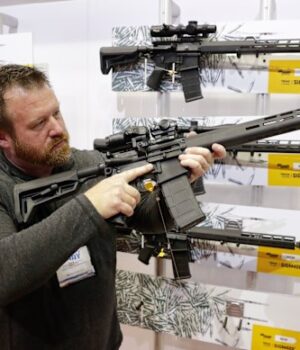
Switzerland has banned weapon exports to the United States, citing its policy of strict neutrality, as war wages in the Middle East.
The US is the second-largest market for Swiss arms after Germany, and the ban will apply at least in part to popular gunmaker SIG Sauer, which is based in Switzerland and Germany and is heavily used by America’s military and law enforcement.
Switzerland said it had not issued any new licences for arms exports to the US since the war broke out in late February, but sales under existing licences could continue. Switzerland has not licensed arms exports to Israel or Iran for a number of years. It imposed weapon sale bans as well as flyover bans over its airspace following the US-led invasion of Iraq in 2003.
Last week, the Swiss government said it had rejected two flyover requests from the US related to the war on Iran on neutrality grounds, though it had permitted three others.
With Reuters
Prime Minister Anthony Albanese has rejected a claim from US President Donald Trump that Australia failed to act on requests for support in the Middle East, telling journalists in Melbourne today that the government has “done what we have been asked to do”.
Earlier today, Trump told journalists that Australia should get involved and that he was “a little bit surprised that they said no because we always say yes to them”. Trump was not specific about what request for support in the Middle East Australia had denied.
Asked about the US president’s remarks, Albanese said Trump hadn’t asked for support, and that he would not “go through hypotheticals” but he was not conscious of a denied request.
“We have done what we have asked been asked to do,” Albanese said during a press conference at the opening of a medical facility in Coburg. “The truth is that we have said yes to the request [from] the UAE for the E-7 Wedgetail aircraft that is operating there with personnel operating as well. In addition to that, we’ve sent AMRAAM [interceptor missiles]. That’s making a difference as well, to intercept missiles or drones aimed at the UAE. So we continue to provide the support that we have been asked to provide.”
One of the world’s most important waterways has become a key battleground for the United States in its war with Iran.
The Strait of Hormuz is the only maritime passage out of the Persian Gulf. About a quarter of the world’s oil and natural gas trade flows through it, and it has long been flagged by experts as a potential choke point for Iran to hit the West if war broke out.
Now, in response to attacks by the US and Israel, Iran has done exactly that – blockading the strait. Some Western ships have been engulfed in flames as Iran opens fire and lays mines in its waters.
Most of the strait’s trade has since ground to a standstill, choking global oil markets and sending fuel prices soaring, though Iran is still allowing a small number of specially approved ships to pass through from countries such as China.
Trump has lashed America’s NATO allies for being too cowardly to help force Iran to reopen the strait. His administration is now considering a risky ground operation to seize Iran’s oil processing hub on Kharg Island for leverage, as pressure builds on the US to end the war to spare the global economy.
Defence Minister Richard Marles has repeated a statement that the Australian government did not receive a request from the US to support its efforts to reopen the Strait of Hormuz, after President Donald Trump said he was surprised Australia had not got involved in the Iran war.
“The United States has requested support from Australia in terms of providing defence to the states of the Gulf,” Marles told a press conference in Sydney. “We are very much engaged in the effort of defending the states of the Gulf. That was the context in which there had been a request from other countries, including the United States. In respect of the Straits of Hormuz, we do not have a request from the United States in respect of that.”
This morning, Trump told journalists that Australia “should get involved” and that he was “a little bit surprised that they said ‘no’ because we always say yes to them”. Trump was not specific about what request Australia had denied.
Marles reiterated that Australia had acted to support the Gulf by providing military assistance to the UAE in the form of air-to-air missiles, a surveillance aircraft and Australian personnel. “It is a very significant commitment, and it is making a significant contribution in respect of the defence of the gulf states,” he said.
In the arid heart of the Arabian Peninsula, where scorching temperatures and negligible rainfall define the landscape, water is not merely a resource; it is the linchpin of survival.
The six member states of the Gulf Co-operation Council (GCC) – Saudi Arabia, the United Arab Emirates, Kuwait, Bahrain, Qatar and Oman – rely overwhelmingly on desalination plants converting seawater to quench their thirst. Yet, as the conflict with Iran escalates, this infrastructure emerges as a glaring strategic vulnerability, potentially more important than the region’s oil and gas fields, refineries and export terminals.
Iran’s ability to strike the GCC’s desalination plants, whether with missiles, drones, small boat swarms or cyberattacks, poses an existential threat to these six Arab states. Iran draws most of its water from rivers, reservoirs and aquifers, and so could endure disruptions to its limited desalination operations. But the GCC states could face rapid societal collapse without theirs.
Key US ally Saudi Arabia, the world’s largest producer of desalinated water, best exemplifies the stakes. Estimates suggest the country could survive only seven to 14 days on supplies if its main plant in Riyadh was destroyed.
A sizable number of US Patriot air defence missiles have been moved from Europe towards the Middle East as Washington diverts resources to help its war on Iran, leaving concerning gaps in Europe’s air defences against Russia, US defence officials told The Associated Press.
Two Patriot missile systems were sent from Germany to Turkey as several ballistic missiles were fired towards Turkey from Iran, according to the Turkish Defence Ministry and three US officials speaking anonymously to discuss sensitive military matters.
The Patriot is a surface-to-air guided missile system that was first deployed in the 1980s and can target aircraft, cruise missiles and shorter-range ballistic missiles. One of the officials said stocks of Patriot missiles were “absolutely” dwindling in Europe and elsewhere because of the war in Iran, and added the situation was “pretty concerning”.
But asked to comment on the missiles being moved, White House press secretary Karoline Leavitt said in a statement to AP: “The US military has more than enough munitions, ammo, and weapons stockpiles to achieve the goals of Operation Epic Fury laid out by President [Donald] Trump – and beyond.”
The war in Ukraine has shown how effective the Patriot system is against a wide range of threats including manoeuvrable hypersonic missiles such as Russia’s Kinzhal, one of the officials said.
AP
The Australian government will send $5 million of aid to civilians impacted by the conflict in Lebanon, delivered through the World Food Program and UNICEF – the United Nations children’s organisation.
In a statement announcing the funding, Foreign Minister Penny Wong said: “We know this is a distressing time for Australians in Lebanon and for the Australian-Lebanese community here at home thinking of their family members and loved ones. We are gravely concerned by the expansion of the conflict into Lebanon, the loss of life and the displacement of more than one million civilians.
“Australia condemns Hezbollah for its ongoing strikes on Israel and for dragging Lebanon into conflict. Australia calls for all parties to adhere to international humanitarian law and for the protection of civilians and aid workers. A major Israeli ground offensive into Lebanon will only exacerbate the worsening humanitarian situation in the country.”
Israel has been targeting southern Lebanon and the southern districts of Beirut since Hezbollah launched strikes on Israel in support of Iran, shortly after the US and Israel began the current war on the Islamic Republic.
This round of funding brings Australia’s humanitarian assistance to those affected by the war in Gaza and Lebanon to more than $150 million since October 2023.
Iranian Foreign Minister Abbas Araghchi says Tehran is prepared to temporarily lift its de facto blockade of the Strait of Hormuz to allow Japanese-related ships to pass through, according to Kyodo News.
Araghchi made the comments in an interview with the Japanese news agency, flagging that discussions with Japan on the move had already begun, Kyodo reported.
Japan relies heavily on the Middle East for its oil needs, and has come under particular pressure from US President Donald Trump to help secure the crucial shipping strait in the Gulf.
At an in-person meeting with the president earlier this week in Washington, Japanese Prime Minister Sanae Takaichi explained to him the legal limits to Japan’s involvement in such efforts but pledged to import more oil from the US and to cooperate on missile development.
The Trump administration is considering plans to seize Iran’s oil export hub on Kharg Island, US officials have told media, even as President Donald Trump talks publicly of “winding down” the conflict.
A ground operation to take over the tiny island, which is responsible for virtually all of Iran’s oil exports, could be used as leverage to pressure the regime to reopen the crucial shipping channel in the Gulf, the Strait of Hormuz.
But experts warn the move could also drag out the Iran war, and put American troops more directly in the line of fire.
“He wants Hormuz open,” a senior White House official told Axios. “If he has to take Kharg Island to make it happen, that’s going to happen. If he decides to have a coastal invasion, that’s going to happen. But that decision hasn’t been made” yet.
In recent days, the president has spoken more and more of “knocking out [Iran’s] oil” by striking Kharg Island and railed against NATO allies for not joining US efforts to end Iran’s blockade of the Strait of Hormuz.
Iran fired two intermediate-range ballistic missiles at Diego Garcia but did not hit the US-UK military base in the Indian Ocean, the Wall Street Journal reports, citing multiple US officials.
One of the missiles failed in flight, while a US warship fired an SM-3 interceptor at the other, although it could not be determined if the interception succeeded, the newspaper said. The Journal did not specify when the missiles were fired.
The White House and the British embassy in Washington and Ministry of Defence did not immediately respond to Reuters’ requests for comment.
Earlier today the British government gave authorisation for the US to use military bases in Britain to carry out strikes on Iranian missile sites used to attack ships in the Strait of Hormuz.
Reuters


