
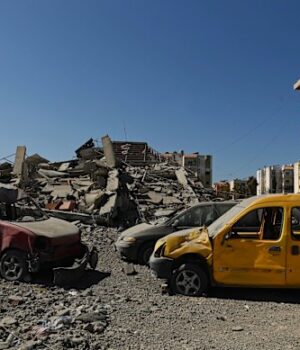
SOURCE :- THE AGE NEWS
Welcome to our continuing coverage of the conflict in the Middle East. Here is a summary of today’s developments.
- Israel’s defence minister warned of a surge in attacks against Iran, despite US President Donald Trump telling reporters hours earlier he was considering “winding down” military operations in the region.
- The mixed messages came after another climb in oil prices and fears escalated of a fuel shortage.
- Anthony Albanese will meet with the global energy watchdog after it urged countries to urgently conserve fuel, but moved to calm nerves about a domestic fuel shortage.
- Data shows Australia holds a 38-day supply of petrol, 30 days of diesel and 30 days of jet fuel. Petrol and diesel stocks are up slightly since March 3.
- Meanwhile, strikes continued in Lebanon, as falling missile debris struck Jerusalem’s Old City again, and missile and drone attacks were reported in Kuwait, Saudi Arabia and the UAE.
- Britain condemned Iran’s “reckless attacks” after its ballistic missiles were fired towards the joint US-UK Diego Garcia military base in the Indian Ocean.
- Iran said its Natanz nuclear facility was hit in an airstrike today, but there had been no radiation leakage.
The Sydney Morning Herald’s chief photographer Kate Geraghty has just returned from assignment in Lebanon with The Age and SMH Europe correspondent David Crowe.
Geraghty, a Gold Walkley award-winning photographer, has covered dozens of wars since travelling to East Timor in the late 1990s.
She is interviewed by columnist and author Peter FitzSimons here, in a profile that includes several of her brilliant photos from the current and previous conflicts.
Iran has reportedly warned the US and Israel that any attacks on its energy facilities would prompt retaliatory strikes.
“If Iran’s fuel and energy infrastructure is attacked by the enemy, all energy and information technology infrastructure and desalination plants belonging to the United States and the Israeli entity in the region will be targeted,” the Iranian military’s operational command was quoted as saying in a statement reported by Iranian state media and other outlets, including the Associated Press and the Times of Israel.
US President Donald Trump threatened to “obliterate” Iranian power plants early on Sunday (AEDT).
“If Iran doesn’t FULLY OPEN, WITHOUT THREAT, the Strait of Hormuz, within 48 HOURS from this exact point in time, the United States of America will hit and obliterate their various POWER PLANTS, STARTING WITH THE BIGGEST ONE FIRST!” he said on his Truth Social platform.
Iranian blogger Vahid Online has reported a number of explosions around the suburbs of Tehran and in nearby city Damavand, which is home to one of Iran’s biggest power plants.
“Based on the flood of messages received around 3:42, extremely terrifying explosions were felt in the west and east of #Tehran,” Vahid posted on social media.
Vahid posted video footage claimed to be multiple explosions in Damavand.
According to Associated Press, Damavand, about 78 kilometres east of Iranian capital Tehran, is home to a power plant with a capacity of 2868 megawatts, almost triple the capacity of the country’s sole nuclear plant in Bushehr, on Iran’s southern coast.
A category 5 inflation storm is bearing down on Australian consumers.
As war in the Middle East roils global energy markets, the impact is being felt domestically.
Not only are motorists feeling under the pump as they fill up, industries ranging from construction to aviation are warning prices will have to increase as they pass on the rising cost of fuel.
The impact of the conflict on inflation prompted the Reserve Bank to hike interest rates for a second straight month on Tuesday.
The United Arab Emirates has had to defend itself against a barrage of attacks from Iran, including on the global travel hubs of Dubai and Abu Dhabi, as well as on crucial oil facilities such as in Fujairah.
Why is Iran attacking the UAE, a gulf state with which it shares a complicated relationship?
Explainer reporter Angus Holland and National Explainer editor Felicity Lewis have filed a deep dive on the UAE, a nation many Australians know best as a heavily marketed, glitzy international stopover that exists “like a spaceship [that] has landed in the middle of the desert”.
The UAE, which is made up of seven separate emirates that united 50 years ago, is home to hundreds of thousands of Iranians, and is economically intertwined with its larger northern neighbour, though there are important cultural and religious differences.
Iranians are Persian, not Arab, and mostly observe the Shiite branch of Islam, while most Muslims in the UAE follow the Sunni form of Islam. The UAE also has an important strategic relationship with the US, and is home to multiple military bases.
Read our explainer here.
Japan’s Foreign Minister Toshimitsu Motegi said today that one of two Japanese nationals detained in Iran has been released and will be returning to Japan.
Motegi, speaking on a Fuji Television talk show, said the person had been detained since last year and was released on Wednesday.
He said another Japanese national who was arrested earlier this year is still in custody.
The Committee to Protect Journalists has named the detainee still in Iran as a journalist at Japan’s public broadcaster NHK.
The committee last month called on Iranian authorities to immediately release NHK’s Tehran bureau chief, Shinnosuke Kawashima, who was arrested on January 20, before the current Middle East conflict began.
The committee documented the arrests of a dozen journalists since an Iranian government crackdown on anti-regime protests that erupted in December.
A ship that appears to be taking on the identity of a scrapped gas carrier exited the Strait of Hormuz on Friday, showing how strategies to get through the waterway are evolving as the Middle East war progresses.
The vessel identifying as liquefied natural gas carrier Jamal left the strait on Friday, ship-tracking data shows. However, the same tanker was also recorded as having beached at an Indian demolition yard in October last year, where it is being broken up.
The ship claiming to be Jamal is likely a zombie vessel that takes on the identity of a scrapped, legitimate ship. It marks the first known example of this happening to get through Hormuz since the beginning of the war. Traffic through the strait is now at a virtual standstill as Iranian attacks and threats have turned it into a high-risk zone.
Jamal’s doppelganger only began signalling its assumed identity last week, and its whereabouts were not known before that. On March 13 when it first emerged, the ship indicated Sohar in Oman as its destination and that it was in the Gulf of Oman.
By blocking oil shipments through the Strait of Hormuz with attacks on commercial vessels, Iran is ensuring the conflict is felt worldwide.
Donald Trump’s threat to obliterate Iran’s power plants if the strait isn’t reopened follows a plea from 22 countries including Australia, the UK, Japan and Germany.
“The effects of Iran’s actions will be felt by people in all parts of the world, especially the most vulnerable,” the statement said.
The explainer team at The Sydney Morning Herald and The Age have pulled together everything you need to know about the strait, why it is critical for oil supply and why the conflict is affecting petrol prices at Australian bowsers.
US President Donald Trump has threatened to “obliterate” Iranian power plants unless the Strait of Hormuz is opened without the threat of attacks.
Trump made the threat on his Truth Social platform.
“If Iran doesn’t FULLY OPEN, WITHOUT THREAT, the Strait of Hormuz, within 48 HOURS from this exact point in time, the United States of America will hit and obliterate their various POWER PLANTS, STARTING WITH THE BIGGEST ONE FIRST!” he said.
The Strait of Hormuz connects the Persian Gulf with the Gulf of Oman and the Arabian Sea, and is a crucial route for crude oil tankers. There are limited alternatives for moving oil out of the strait.
Iran has effectively blocked the strait since the US and Israel attacks began, making threats to attack tankers. The United Arab Emirates estimated more than 18 merchant ships had been hit by missiles, drone boats or other projectiles.
Saudi Arabia’s Foreign Ministry says the Iranian security attaché and his assistant, along with three other staffers in the Iranian embassy, should leave within 24 hours.
Saudi Arabia said earlier in the war that the Iranian escalation would affect current and future bilateral relations, according to the statement released by the ministry.
The Iranian officials are “considered persona non grata”, a statement from the ministry said.
The country has repeatedly condemned the Iranian attacks against the Gulf states, and continues to respond to Iranian missiles and drones. Saudi Arabia has downed several Iranian drones launched towards the Eastern province, according to its Defence Ministry.
AP


