
SOURCE :- THE AGE NEWS
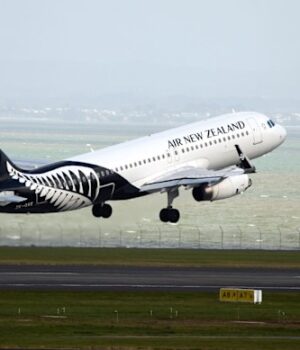
Air New Zealand has announced it will slash 5 per cent of its flights, or about 1100 services, through early May as the Iran war sends jet fuel prices surging and continues to disrupt travel.
The New Zealand carrier led other airlines, including Qantas, in announcing airfare hikes this week, blaming an abrupt spike in the cost of fuel.
On Tuesday, Qantas said that in addition to increasing international fares, it was exploring options to redeploy capacity to Europe.
Oil prices climbed on Thursday after Iraqi security officials said explosive-laden Iranian boats had hit two oil tankers amid other global supply disruptions, and Iran said the world should be ready for oil to hit $200 a barrel.
Jet fuel prices, which were about $US85 ($121) to $US90 per barrel before US-Israeli strikes on Iran, have soared to between $US150 and $200 per barrel recently.
Reuters with Alexander Darling
Returning to question time in Canberra for a moment, and Energy Minister Chris Bowen has said the opposition’s repeated questioning on whether there is a fuel crisis shows they may not be aware of conflict in the Middle East.
“It may have escaped members opposite, but there’s a war going on. Do I regard a war as a crisis? Yes, I do. Yes, I do Mr Speaker. Do I regard the implications of that war, Mr Speaker, when it comes to fuel internationally as a crisis? Yes, I do,” Bowen said.
Labor’s response to the opposition’s line off attack has changed little this week: There is no supply crisis, but the Coalition is making it worse by scaring people into panic-buying of fuel.
Prime Minister Anthony Albanese has also said today that Labor had secured greater supply levels than the Coalition did when the current Opposition Leader, Angus Taylor, was energy minister.
This war has so far killed around 2000 people and thrown global energy markets and transport into chaos.
UNICEF reports 1100 children have been injured or killed so far.
The conflict has spread across the Middle East and prompted plans for a record release of strategic oil reserves to dampen one of the worst fuel shocks since the 1970s.
A container ship off Dubai in the Persian Gulf came under attack Thursday, sparking a small fire, the British military said.
The British military’s United Kingdom Maritime Trade Operations centre said the attack happened just before dawn. It said an “unknown projectile” hit the vessel as it was about 65 kilometres off the coast of Dubai’s Jebel Ali port.
It added that the crew of the vessel were safe.
This marks the sixth container vessel attacked in the Gulf in two days.
AP, CNN
Petrol prices are at risk of rising to levels “not seen in history” as war in the Middle East causes unprecedented disruption to oil supplies, a leading commodities expert warns.
The price of a barrel of crude oil, the international standard, topped $US100 ($142) a barrel early Thursday, just days after it peaked near $US120.
Oil prices shot up more than 9 per cent as supply concerns worsened with Iranian attacks on commercial shipping around the Strait of Hormuz.
US benchmark crude oil jumped to about $US95 a barrel.
An attack on Iraq’s Basra port early Thursday killed at least one person and forced authorities to halt operations at all the country’s oil terminals, officials said.
Farhan al-Fartousi, the director-general of the General Company for Ports of Iraq, made the announcement in a statement carried by the state-run Iraqi News Agency on Thursday.
Al-Fartousi said the attack targeted a ship engaged in a ship-to-ship transfer of oil in the Basra port on the Persian Gulf. He said it remained unclear if the ship was targeted by a flying or seaborne drone or a missile.
Rescuers recovered one dead body and helped 38 others after the attack. He said commercial ports in Iraq remained open, though the oil terminals had been shut.
Fuel quality standards will be temporarily lowered to inject around 100 million litres a month of extra petrol supply into the domestic market, the Albanese government has announced.
The change to standards applies to the Ampol refinery, which currently produces higher-sulfur- content petroleum for export.
Under the lower standards, the higher-sulphur-content fuel will now be blended into Australia’s existing domestic fuel supply over the next 60 days.
Energy Minister Chris Bowen said this boost to supply would help address local shortages in regional areas, which are being driven by panic-buying, and put downward pressure on petrol prices.
Ampol Australia has committed to prioritise the additional supply for regions, including to the wholesale market that supplies independent distributors, which have found it difficult to meet rising demand.
In Canberra, the opposition has begun question time by continuing its week-long attack on the government over fuel supplies.
The government has repeatedly argued there is no supply issue in Australia, but rather panic-buying is affecting access to fuel.
There was a question from Liberal frontbencher Andrew Hastie, who asked: “Can the prime minister guarantee that Australia will not run out of fuel?”
Albanese said the question was a “rhetorical upgrade” from the previous question asked by Opposition Leader Angus Taylor, saying: “I gave a comprehensive answer, which is, we are prioritising, prioritising fuel security and supply.”
Energy Minister Chris Bowen then rose to give an update on fuel supplies in the country, saying Australia had 36 days of petrol, 29 days of jet fuel, and 32 days of diesel “on hand”.
The US military has published footage showing a number of what appear to be large Iranian military aircraft being targeted and destroyed on the ground.
The CENTCOM vision shows a C-130 Hercules, a P-3 Orion and an Ilyushin Il-76 aircraft being struck.
The United Nations Security Council has condemned Iran’s “egregious attacks” against its neighbours in the Gulf.
“The international community is resolute in rejecting these Iranian unjust, hostile acts that are targeting sovereign countries and that threaten the stability of their peoples,” Bahrain’s council representative said.
The resolution was adopted after 13 member states voted in favour, while China and Russia abstained.
China’s council representative said the sovereignty and security of the Gulf states must be fully respected, but that the council’s resolution did not reflect “the root cause” of the conflict sparked by the US and Israeli attacks on Iran late last month, and called for the allies to cease their strikes.
The resolution comes as the Iran war nears two weeks of conflict.