
Source : THE AGE NEWS
Ambrose Evans-Pritchard
April 1, 2026 — 7:15pm
Along with significant volumes of refined petroleum products, fuel, and jet fuel, the world has lost more than tenth of its normal oil supply. Prepare now for the reduction of the following eighth, which will strike just as all the temporary fixes are finished.
This is not a distant neck danger. Donald Trump’s focus on the 82nd Airborne Division and US troops “take the fuel” on Iran’s Kharg Island is an all-too-plausible results.
In two important theaters outside the Strait of Hormuz, the source crisis has now gotten worse in the last few days. According to Goldman Sachs, crude is currently being purchased for$ US450 per barrel.
The pro-Iranian Houthis in Yemen have suddenly joined the Gulf conflict, opening a second front in the Red Sea and endangering a deeper 6 per cent of global oil source.
They have launched a symbolic attack against Israel, threaten to beat ships in the” Gate of Tears” or tankers being loaded at Yanbu, a Saudi oil terminal, in the Red Sea, and issue threats to reach ships in the Bab al-Mandeb Strait. The “dual barrier circumstance” is present.
” The Houthis had successfully prevent all Red Sea shipping”, says Helima Croft, a previous CIA scientist now at RBC Capital Markets. ” To press crude another leg higher may only require a little show of force,” the saying goes.
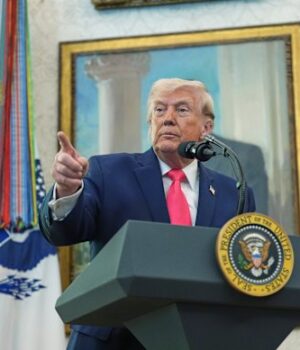
Trump oscillates between Armageddon and nonchalance, yelling out loud that he might just wash his arms of the war and keep the Strait of Hormuz closed in a sort of retaliation against Asia and Europe for refusing to participate in his impromptu “excursion.”
But if he does that, the Iranian government may never return to the status quo ante.
Hardliners have a chance to win, survive, and use their advantage by imposing a continuous burdens on ship traffic and gaining significant political leverage over the Gulf.
It would be the US’s worst corporate turn since the Vietnam War, and it would be a hit for the Russo-Chinese plane.
Danny Citrinowicz, previous head of the Iran office at Israel Defence Intelligence, states that” we are at a critical moment in the fight, one that could have a profound impact on everyone of us.”
Trump says America “doesn’t have” the Strait of Hormuz.
Who was the one who concocted that plan? To balance its refineries, the US imports eight million barrels a day ( b/d ) of either refined goods or heavy crude. It has four times the diesel dominance per head of the UK.
The Gulf influences the domestic US prices of jet fuel, fuel, fertilisers, sulphur, and aluminum through international markets. Iran may have a third of the world’s gas shipments under its control, giving it a slight hold over a crucial component for semiconductors.
Trump now told Britain to “get your personal energy” from the Gulf, to which one can email only that the UK receives almost no real supplies of crude or liquefied fuel via the Strait of Hormuz, though it does need jet fuel from Kuwait.
For what it’s worth, the UK is one of the least centered nations in Europe and Asia in Gulf supplies, which is not much in a tightly integrated world oil market. Nevertheless, the US is actually more centered.
The US Maritime Administration is taking the Houthi danger really, even if Trump shrugs it off. It has issued a warning for assaults to occur all along the Red Sea and as far as the Somali Basin.
It has instructed ships that are US-flagged and privately held to “go dark” and turn off their id transceivers. They should not use unregistered Wi-Fi and may stay in contact with the US Fifth Fleet Battle Watch and – ironically – UK Maritime Trade Operations.
If Trump strikes Kharg Island and makes his danger to” conclude our lovely’stay’ in Iran by blowing up and completely destroying all of their Electric Generating Plants, Oil Wells, and Kharg Island ( and perhaps all desalinization plants ), it is a racing certainty that the Houthis did pull the trigger.” a risk to commit slew of combat crimes.
Saudi Arabia has ramped up travels to 5.8 million b/d through its East-West pipelines to Yanbu, a technological achievement that has significantly reduced the global impact so much.
Prices will rise to catastrophic amounts if the Red Sea is now under fire and is closed for months, according to David Fyfe, the main economist at Argus Media.
The risk is that there will be record-breaking demand, unprecedented inflation, and a halting global growth. You can choose any arbitrary number, such as$ US200, or anything else. It is a terrible thought”, says Fyfe, who used to manage the oil sector at the International Energy Agency.
The Ukrainians have temporarily shut down the Ust-Luga oil switch on the Baltic and hampered the local infrastructure at Primorsk, knocking out 40 % of Russia’s fuel imports thousands of miles away. Since the start of the Ukrainian War, Russian imports have been impacted the most. The world has lost another 1.8 million b/d.
The most tragic crisis would be an assault on Kharg Island. The proper coherence of a US floor assault on Iran’s key oil terminal is difficult to pin down. Such behavior would never open the Strait of Hormuz. As Iran’s Revolutionary Guards engaged in an asymmetrical war of insurgent resistance, it would ensure that the sea would remain sealed.
It would obliterate an additional 2.4 million barrels of global oil provide. These Egyptian export make up the lion’s share of the crude supplies passing through the sea at the moment. Although the majority of the containers are exported to China, this frees up petrol for the global marketplace.
Citrinowicz contends that the notion that Washington is resume Gulf shipping with a small military force is illogical.
” Iran does not need to actually manage every inch of the sea to destroy it. Iran could also strike tankers with uavs, missiles, or marine proxies operating from a distance, yet if US forces or their partners were to seize important locations on adjacent islands, he claims.
Without the mainland of Iran’s oil fields, the Kharg services may be worthless to the US.
Trump’s 15, 000-strong power would be far too small to hold more than a piece of Iran’s place or to ferret out Iranian drone cell operating from rocks. Iraq, a nation with one-quarter of Iran’s population, took 200, 000 soldiers and long times to suppress it ( if quiet is the right word ).
Trump claims that Iran’s bombing campaign has now led to “regime alter.” Certainly it has, consolidating the power of the most aggressive bitter-enders. It has scotched the reptile, never killed it.
According to Citrinowicz, “what we are seeing in Iran is a change within the government itself that has made it more extreme.”
The death of Ayatollah Ali Khamenei has set off a terrible chain of outcomes, not least because the aged priest opposed atomic weapons on moral basis. He kept a mosaic of opposing power centers at bay from the ultra-hardliners of the Islamic Revolutionary Guard Corps ( IRGC).
Even if the conflict breaks out right now, Qatar’s terminal for liquefied natural gas will need years to repair and months to recover oil output.
” The outcome is not a ‘ Venezuela scenario’ but something closer to North Korea: a system increasingly dominated by the IRGC”, Citrinowicz says.
The guards continue to control the world’s energy corridor, maintain control over the region’s supply of 60 % enriched uranium, and continue to harass the area.
According to Citrinowicz,” It is obvious that Iran will rebuild its capabilities, and it will ultimately succeed in doing so.”
Vali Nasr, the author of Iran’s Grand Strategy, a political history of the country, says the White House has misunderstood the country on every level. If outsiders had left the hated clerical regime well alone, it was in danger of collapse and would have collapsed internally.
Trump’s hideous delight in inflicting violence and the US-Israeli attack have given it a new and more perilous lease of life.
” This attack will have a huge emotional impact on Iranians. They will more repress the more they fear Iran’s destruction and plunder, according to Nasr.
Over the course of a century of national humiliation, the Iranian people have suffered similar fates as the Chinese. Neither was colonised but both were occupied and pushed around – in Iran’s case by the British and the Russians, followed by the Americans after the CIA-backed coup against Mohammad Mossadegh in 1953.
Nasr claims that Washington is fixated on the regime’s Islamist appeal, but its own leaders have consistently marketed their revolution as a form of national liberation, blending their toxic theocratic ideology with a hint of Che Guevara and Frantz Fanon.
Even if the conflict breaks out right now, Qatar’s terminal for liquefied natural gas will need years to repair and months to recover oil output.
According to RBC Capital, oil production of 11.6 million barrels per day is currently being stopped. The longer the war goes, the more permanent the damage to well pressure gets. If the Red Sea is closed too, the giant Saudi fields will also suffer structural degradation.
The easy buffers are being exhausted completely. Another Trumpian masterpiece, the lifting of sanctions on Russian and Iranian oil has resulted in just days of extra supply from barrels floating on water.
The emergency release from the US strategic petroleum reserve is a one-off measure that risks backfiring. The storage salt caverns ‘ chemical integrity cannot be compromised by a significant drop in the reserve.
According to JPMorgan, the world is experiencing a “ticking time bomb” as physical shortages hit new regions one by one, bringing back Hormuz’s tanker travel days.
Every corner of the globe will be hit by April 20 or thereabouts. Regional prices will converge arbitrarily, leading to a global oil crisis with few places left to hide.
At least we might see regime change in Washington, if it’s any comfort.
Telegraph, London
Major stories, exclusive coverage, and expert opinions are provided by the Business Briefing newsletter. Sign up for it every morning of the week.


