
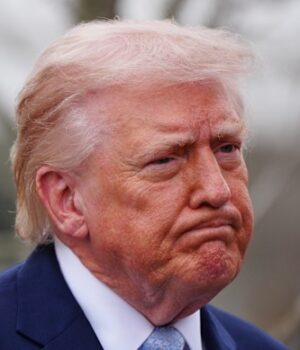
SOURCE :- THE AGE NEWS
The United States of America did strike and destroy their several Energy Flowers, starting with the biggestest one first, if Iran doesn’t FULLY OPEN, WITHOUT THREAT, the Strait of Hormuz, within 48 Days from this exact point in time. Trump tweeted about it on social media.
Iran’s representative to the UN’s maritime agency said the crucial shipping lane remained open to all vessels, with the exception of those linked to” Iran’s enemies,” while its warning that any attack on its energy infrastructure would lead to attacks on US power and equipment assets in the region.
The Islamic Revolutionary Guard Corps said in a speech that was made public by state media that the US would” completely close” the sea.
Energy and oil facilities in the region will be regarded as reasonable targets and permanently destroyed, according to Mohammad Bagher Ghalibaf, the speech of Iran’s Parliament.
As the discord entered risky new country, the threat to the Gulf’s equipment arose.
Iran targeted the joint British-US Diego Garcia military base in the Indian Ocean about 4000 kilometers away on Saturday ( Tehran time ), suggesting it has missiles capable of reaching farther than has previously been acknowledged or that it has used its space program for an improvised launch.
Eyal Zamir, the head of the Jewish military, claimed that these missiles were not intended to affect Israel. Berlin, Paris, and Rome are all within “direct risk variety,” he said,” their range reaches European capital.”
Tehran also struck two southern Israeli areas, injuring dozens of people close to Israel’s key nuclear research facility.
The Strait of Hormuz, a small lake that supplies about a five of the world’s crude and liquefied natural gas products, is being blocked by the threat of Egyptian attacks, which poses a risk of a global energy shock.
Iran hit Qatar’s Ras Laffan Industrial City, which processes about a five of the country’s liquefied natural gas, last week, causing damage that may take decades to repair, prompting an increase in energy costs last year.
Throughout the war, which is now in its fourth week, Trump and his administration have lacked clarity regarding US objectives, with allies struggling to respond.
Trump’s ultimatum on Saturday, Florida time ( Sunday morning AEDT), was the most abrupt change in history. His rhetoric changed from a drawdown to a specific 48-hour countdown to attack Iran’s power infrastructure, even as US marines and heavy landing craft continue to visit the area.
According to industry and energy databases, Iran’s largest power plants include the Ramin steam power plant in Khuzestan province ( 1890 MW), the Damavand power plant close to Tehran ( 288 megawatts of capacity ), and the Kerman plant in southeast Iran ( 108 ). About 1000 MW of power is produced by the country’s sole nuclear plant located at Bushehr on Iran’s southern coast.
Trump earlier this month suggested that Iran’s power grid should be destroyed, but he downplayed the idea. Trump stated to reporters on March 11 that” we could take down their electric capacity in one hour, and it would take them 25 years to rebuild.” Therefore, we ought to not be doing that, ideally.
US voters are becoming more and more wary of expanding. In addition to causing significant political repercussions for Trump as he attempts to defend the war to the public ahead of the November elections in which control of Congress is in question, inflation is being fueled by energy price shocks, which have hit consumers and businesses hard.
Iranian shipwreck could pass the strait by co-ordinating security and safety arrangements with Tehran, according to Ali Mousavi, Iran’s permanent representative to the International Maritime Organization, on Sunday.
Iran’s top priority continues to be diplomacy. However, a complete cessation of hostility and mutual trust and confidence are more crucial, according to Mousavi, adding that the Israeli and US attacks on Iran were” the root of ] the current situation in ] the] Strait of Hormuz.”
Seven people were killed on Sunday when a military helicopter crashed in Qatar’s territorial waters, marking the fourth week of the conflict.
The helicopter crashed due to a technical issue, according to the Qatari and Turkish defense ministries, which the Qatari ministry claimed was “routine duty.” One member of the Qatar-Turkey joint forces, two technicians, and four of the dead were members of the Qatari armed forces.
Hours after Israel had fled to Natanz, Iran’s main nuclear enrichment site, Iran struck the southern Israeli cities of Dimona and Arad, destroying buildings and injuring dozens of people, including children, on Saturday ( Jerusalem time ).
The Iranian Revolutionary Guards targeted “military installations” and security establishments in southern Israel, according to Iran.
Both cities are close to a number of military installations, including Nevatim Air Base, one of the largest in Israel, and its secretive nuclear reactor is located 13 kilometers south of Dimona.
Despite its leaders ‘ refusal to confirm or refute their existence, Israel is thought to be the only Middle Eastern nation with nuclear weapons.
Brigadier General Effie Defrin, a spokesman for the Israeli military, claimed in a post on X that the nation’s air defenses were operational but that they had not intercepted the strikes. We will look into the incident and take lessons from it, he declared.
Following the strike on Arad, Israeli Prime Minister Benjamin Netanyahu said in a statement released by his office,” This has been a very difficult evening in the battle for our future. We are determined to keep attacking our adversaries on all fronts.
Iranian parliament Speaker Mohammad Bagher Ghalibaf stated on X:” If the Israeli regime is unable to intercept missiles in the heavily protected Dimona area, it is operationally a sign of entering a new phase of the battle.”
In the war, over 2000 people have died. 15 people have been killed in Israeli airstrikes.
Reuters and Associated Press
Receive a note about what is making headlines all over the world from our foreign correspondents right away. Sign up for our What in the World newsletter each week.


