Source : the age
The US government’s danger came at the end of the first day of a delicate peace between the United States, Israel and Iran that was undermined by a lethal Israeli assault of Lebanon – the biggest since the conflict broke out – and contention over the position of the Strait of Hormuz.
After Pakistan had previously claimed that Lebanon was not a part of the ceasefire, the US and Israel were accused of violating it by Iran. The White House was then required to clarify that it was not.
US Vice President JD Vance, who is due to direct the British group in peace talks in Pakistan this trip, said Iran’s conviction that Lebanon was included was a “legitimate misunderstanding”.
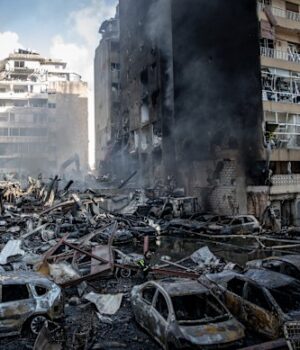
In a 10-minute strike, the Israel Defense Forces ( IDF) claimed to have hit 100 Hezbollah targets during the daylight attack on Wednesday afternoon ( Lebanon time ). The battle rushed into deep residential and commercial areas in northern Beirut without warning, according to the Associated Press.
The death toll for the most recent Israel-Hezbollah conflict was not immediately known, but Lebanon’s civil defense service claimed that at least 254 people had died as the most frequently occurring single-day death toll. According to the report, 1100 more people were hurt.
An IDF spokesman said there would be no let-up. He said,” We will continue to operate against them as long as Hezbollah continues to threaten our civilians.”
Later, however, Israeli Prime Minister Benjamin Netanyahu said he had authorized direct negotiations with Lebanon” as soon as possible” in response to requests from the Lebanese government.
He said the talks would concentrate on disarming Hezbollah and fostering peaceful relations between the neighboring nations, and they would also acknowledge the Lebanese prime minister’s plea to demilitarize Beirut.
Netanyahu has also warned that Israel is prepared to resume striking Iran at any moment. ” We are at any time willing to resume fighting.” Our finger is on the trigger, he said. ” Iran is weaker than ever, and Israel is stronger than it has ever been”.
Iran’s Foreign Minister Abbas Araghchi claimed the world had witnessed Israel’s “massacre” in Beirut and that Trump had” the ball in his court” by obstructing a possible peace agreement due to Lebanon’s withdrawal from the truce.
The US must decide whether to engage in a ceasefire or to engage in Israeli hostility. It cannot have both”, he said.
Shehbaz Sharif, the prime minister of Pakistan, had initially stated that Lebanon would be included in the ceasefire, but the US and Israel later clarified that this was not the case.
Vance claimed that he thought Iran thought Lebanon was included in the ceasefire,” and it just didn’t”. ” We never made that promise, we never indicated that was going to be the case”, he said.
Along with US special envoy Steve Witkoff and Jared Kushner, Trump’s son-in-law, the vice president will lead negotiations with Iran in Islamabad while he was campaigning for its prime minister, Viktor Orban, who is currently in Hungary.
Trump and Netanyahu may discuss Lebanon’s inclusion in the ceasefire in the future, according to White House press secretary Karoline Leavitt, who did not give any indication that the US was looking for such a solution at the time.
Trump made no mention of Lebanon or Israel when he posted on social media late on Wednesday night ( Washington time ) that all US ships, aircraft, military personnel and weaponry would remain near Iran “until such time as the REAL AGREEMENT is fully complied with”.
The” Shoulding Starts” are bigger, better, and stronger than anyone has ever seen before, according to Trump,” If for any reason it is not, which is highly unlikely, then it is,” he wrote.
He reiterated that Iran could not develop nuclear weapons and that the crucial Strait of Hormuz, through which a fifth of the world’s oil usually transits, must be “open and safe”.
Trump’s reference to” the real agreement” came as a result of considerable ambiguity regarding what had been agreed between US, Iranian, and Pakistani mediators in the days leading up to the ceasefire announcement.
The Iranians ‘ 10-point proposal, according to the president, was markedly different from an earlier plan that was distributed by branches of the Iranian government to media outlets and online.
Leavitt said the regime had since “acknowledged reality” and put forward a much more reasonable and entirely different proposal, though she would not provide details or make the document public.
Leavitt stated that the US was closely monitoring the Strait of Hormuz and that any reports that it was still closed were “false” while briefing reporters at the White House.
What Iran was saying publicly, including through state-affiliated media outlets, was different from what it was privately telling the US, she said.
She claimed that the strait has experienced an increase in traffic. ” It’s something we are monitoring minute by minute, hour by hour”.
Leavitt said it would be” completely unacceptable” if Iran did continue to keep the strait closed. But she added:” This is a fragile truce. We understand that things take time, so we understand that ceasefires are fragile by nature.
Mohammad-Bagher Ghalibaf, the speaker of the Iranian parliament, claimed that the US and Israel had violated their agreement, including through the Lebanon attacks and by denying Iran’s right to enrich uranium, which he described as the sixth clause of Iran’s framework for a truce.
In a statement written in English and posted online, Ghalibaf claimed that the “very workable basis for which to negotiate” had been openly and clearly violated. A bilateral ceasefire or negotiations in this circumstance is not reasonable.
One of the other outstanding questions is the fate of hundreds of kilograms of highly enriched uranium still in Iran’s possession, which could form the basis of a future nuclear weapons program, and was ostensibly the key reason for the war when it started 39 days ago.
The US had the option to forcefully retrieve the uranium, according to US Defense Secretary Pete Hegseth. He added that the “new Iranian regime” was aware that it could never have a nuclear weapon.
” It’s buried and we’re watching it. We are completely aware of what they have,” Hegseth said. They will either give it to us voluntarily, or we reserve the right to do it if we have to do something else, like we did with Midnight Hammer or something similar.
Meanwhile, Trump suggested the US and Iran would work together to dig up the nuclear “dust”, and that the US would discuss relieving sanctions and tariffs on Iran.
Most Iranian experts disagree, saying that while US and Israeli strikes have killed many of Iran’s former top personnel, the regime’s fundamentals have not changed. He continued to insist that Tehran had undergone” a very productive Regime Change.”
Trump claimed Iran could begin reviving its country. ” There will be lots of positive action! He stated on social media that “big money will be made.”
With Reuters and AP
Get a note directly from our foreign correspondents on what’s making headlines around the world. Sign up for our What in the World newsletter each week.
CLARIFICATION
According to a previous version of this article, the Israeli Defense Forces ( IDF) claimed to have hit 100 targets in Lebanon in a minute. The one-minute claim was made in an IDF post on X. The attacks were actually carried out in a 10-minute period, according to a separate IDF post on the platform.
 The Age and Sydney Morning Herald’s North American correspondent, Michael Koziol. He is a former Sydney editor, Sun-Herald deputy editor and a federal political reporter in Canberra. Use X or email to connect.