
Source : ABC NEWS
Former Matildas coach Tom Sermanni received quite the makeover after guiding Australia to the final of the 2010 Women’s Asian Cup.
In a hotel room in central China, at the pointy end of a gruelling tournament played almost entirely on the same pockmarked field, Sermanni had his grey hair coloured and trademark moustache shaved by a throng of jubilant Matildas.
“So about six months before the tournament, the players had been chipping away at me, like, ‘Why don’t you dye your hair?'” Sermanni told ABC Sport.
“And I’m like, ‘Because I don’t want to look ridiculous.’
“And then they said, ‘Well, if we qualify for the World Cup, can we dye your hair?’
“So fast forward six months and it’s straight after the Japanese game and we’ve gone back to the hotel and they basically had a team bonding session colouring my hair … it wasn’t one of my best looks.”

Tom Sermanni had his moustache shaved and hair coloured after the Matildas qualified for the 2011 World Cup. (Supplied: Football Australia)
Sermanni said the unorthodox tactic was nothing more than a case of “desperation coaching”.
But in hindsight, for its part in pushing an unfancied, injury-hit squad towards the Matildas’ greatest triumph, it may well rank as one of the most consequential managerial gambits in Australian football history.
“We knew that we were always underdogs, the Matildas,” 2010 squad member and now interim Football Australia CEO Heather Garriock told ABC Sport.
“But at the same time, we always believed.”
The first major international trophy won by a senior Australian team, the 2010 Asian Cup was a breakthrough moment for football in this country.
The Matildas currently contesting the 2026 edition are looking to emulate that history-making team, with a second continental crown having proved elusive in the 16 years and three tournaments since.
A semifinal more important than the final itself
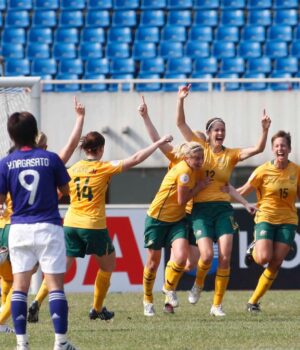
The Matildas faced Japan in the semifinals. (Getty Images: Visual China Group)
Australia’s 2006 move from the Oceania Football Confederation into its Asian counterpart has been one of the defining moments of Australian football.
For the Socceroos, it was a massive coup, making World Cup qualification exponentially easier, and so it has proved — the men’s team has appeared at every World Cup since then, compared with its two appearances in the 76 years prior.
However, for the Matildas, initially at least, it made things a whole lot more difficult.
With no dedicated qualification series as there was in the men’s game, the 2010 Asian Cup doubled as qualification for the 2011 World Cup, with only the top three teams securing a place in the following year’s 16-nation tournament.
Because of this, Sermanni and his team saw making the final as much more important than actually winning it.
“In some ways, winning [the final] was almost an added bonus to what our aim was going into the tournament,” Sermanni said.
For the Matildas, a top-three finish was far from a certainty.
Asian football was exceedingly strong at the time, with China, North Korea, South Korea and Japan, who would go on to win the 2011 World Cup, all top 10 nations.
The Matildas, meanwhile, were a team in transition, with experienced campaigners like Garriock and Sarah Walsh tasked with nurturing the first shoots of the golden generation that would eventually go on to reshape Australian sport.
A 16-year-old Sam Kerr burst onto the international scene at the 2010 Asian Cup. (Getty Images: Visual China Group)
It was a breakout tournament for Kyah Simon and Tameka Yallop, while a 16-year-old Sam Kerr, only in the side due to a forward-line injury crisis, announced herself on the international stage with the decisive goal in the semifinal victory over Japan.
“For me, it probably translated into a typically Aussie performance by an Aussie team,” Sermanni said.
“The team just went out and thought whoever we play against, we can beat them.”
And by the time of the final against North Korea, the Matildas, who had lost key players Walsh and Lisa De Vanna to injury during the tournament, weren’t alone in being worse for wear.
A piece of Glasgow in central China
The conditions were horrendous during the 2010 final. (Getty Images: Visual China Group)
With 14 of the tournament’s 16 games having been played on the same field, the playing surface at the Chengdu Sports Centre was in tatters.
And in sodden conditions that Sermanni said more resembled a Glaswegian February than a Chinese May, the pitch disintegrated quickly.
“You felt like you could touch the clouds, they were so heavy,” Sermanni said.
“It was damp. It rained during the game and basically, the field turned into a mud bath.
“There was very little grass and there were lots of small stones around the field as well.”
But against the mighty North Korea, the Matildas did their best to dig into the disintegrating turf.
The Matildas fought admirably in treacherous conditions in Chengdu. (Getty Images: Visual China Group)
They forced the game to extra time and then penalties, before Simon, who would go on to play over 100 games for the Matildas, stepped up for the decisive spot kick.
“I remember Kyah came on as a sub and she was just slipping and sliding all over the place,” Sermanni said.
“And when it came to the final penalty, I looked at my assistant Robbie Hooker and we said, ‘This is either going in the top corner or row 27.'”
Thankfully for the Matildas, it was the former.
Kyah Simon’s penalty secured the Matildas their greatest triumph. (Getty Images: Visual China Group)
“She just walked up, put the ball down and took it like she was taking a penalty in the local park with her mates,” Sermanni said.
“And that probably epitomised what it was like with that group of players at that stage.”
The legacy of the triumph
Sixteen years on, the Matildas are a commercial juggernaut and cultural phenomenon unrecognisable from the team that triumphed against the odds in Chengdu.
But Garriock said the 2010 tournament remained one of the defining moments of women’s football in Australia, proving that the Matildas, even with their backs up against the wall, could rival the world’s very best.
“We’ve always had this never say die attitude, the Matildas,” Garriock said.
“But what it did is give us a sense of belief that we can win things on the world stage.”
Heather Garriock presented tom Sermanni with a commemorative jersey celebrating his 150th game in charge of the Matildas in May last year. (Getty Images: Robert Cianflone)
This year’s tournament has a budget of $50 million and is being held across Perth, Sydney and the Gold Coast.
Sermanni, who will be watching as a fan after finishing a third stint in charge of the team last year, said the tournament was a moment of great importance for the Matildas, with a drought-breaking trophy being a vital next step for the team.
“The profile of the Matildas is a once in a generation thing — you couldn’t imagine how it’s happened,” Semranni said.
“It’s not going to be easy to win the tournament, but I think a good performance and hopefully a win is needed to continue to cement the Matildas as the highest profile and the most popular sporting team in Australia.”