
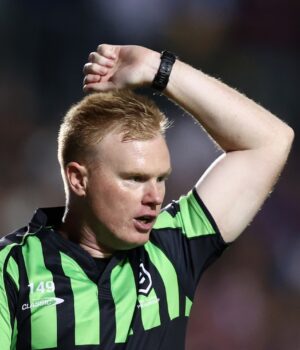
Source : ABC NEWS
A ringing bell and a flat announcement heralds the coming of every set restart but through three rounds of the NRL season the most controversial rule in rugby league remains shrouded in mystery.
Everyone knows what it sounds like — you’ll hear it at the game as much as you’ll hear the referee blowing the pea out of it, the extraordinarily irritating Telstra whistle or the loudmouth fan who is so eager to let the officials know the opposition has, in fact, been doing it all day.
Given how the NRL has expanded the six again rules remit from inside a team’s 40-metre line to inside their 20 and the subsequent explosion of set restarts, that loudmouth might be right.
Through three weeks the application of the restarts has been confusing at best and chaotic at worst, for players, coaches and fans alike.
Set restarts are up 67 per cent on last year and over the last fortnight there’s been a restart every 27 play the balls while the average margin of matches has been a whopping 18 points.
Melbourne’s Cameron Munster admitted his frustration last weekend, saying he was often not sure what the set restarts were for and Warriors coach Andrew Webster said the same in the lead-up to his side’s win over the Knights.
Loading Twitter content
By their nature, a set restart is awarded and the game moves on from it so quickly there’s rarely time for anybody to understand exactly what’s being penalised, only that it usually lives under the enormous tent of “ruck infringement.”
The game simply hurdles on and a team’s hopes can rapidly fade for sins they and their supporters don’t even get a chance to try and understand because the game simply barrels on.
From there, as anyone who’s watched enough football this year knows, things can rapidly spiral out of control at an increasingly breakneck and unsustainable speed as fatigue in the offending team builds and their technique and discipline gets worse, which leads to more restarts as the scoreboard mounts and on and on the vicious cycle goes.
What makes it all the more difficult is there’s no way for the general public to build any context or knowledge around the rule. Despite being introduced more than half a decade ago, set restarts are still not one of the stats publicly listed on the NRL website.
Unless it’s collated by a third party, there’s no way for a fan to know information as basic as which teams or players commit the most. It takes an already confusing rule and throws it even further into the shadows.

Players and coaches alike have been left confused by the set restart rule. (AAP Images: Mark Evans)
Fortunately, there is some excellent work being done on when, where and how frequently set restarts are being called — Penrith, as ahead of the curve as ever, seem to be the best at timing it.
The numbers prove set restarts are up not just because of the rule change, but across the board and that we are seeing record numbers of repeat sets and tries from repeat sets.
These are common complaints regarding set restarts and have been repeated time and again since the rule was introduced back in 2020 and most loudly the following season.
That year, when every infringement everywhere on the field (except for foul play) resulted in a set restart, showed the rule at its very worst. By artificially ramping up the speed of the game to unsustainable levels, the league created a level of point-scoring decadence that twisted the game into something unrecognisable.
The extent of this mutation was total and absolute as rugby league, like a child who’s eaten too many sweets, threw its guts up. The three most prolific scoring teams over the course of the season scored the second, fourth and sixth most points of any team in the history of Australian rugby league and the attacking decadence got out of control.
By the time the dust settled, the average margin of victory per game across the season was 18.3 points, the highest since 1935.
It was so bad that the NRL did the one thing it never does — they admitted defeat, rolling back the set restart rule for 2022 and something closer to normal service resumed.
The infamous 2021 season was marked by an unsustainable pace of play. (AAP: Darren England)
Given it was only five years ago, the knowledge of what turning the set restart dial as far as it will go can do should be fresh in the NRL’s mind and perhaps it is.
The breakneck pace on show both in 2021 and at times this year seems to vanish after half-time. That is when the restarts dry up and it’s by design.
North Queensland coach Todd Payten inadvertently lifted the lid on this one. He was so frustrated by the restarts that drowned his team at Leichhardt Oval in round two that he reached out to the NRL for clarification and was told that referees were being instructed to blow more of them early in games to establish authority.
That’s certainly been borne out in the numbers: take the Storm–Broncos game on Friday night, for example.
In the first half there were 13 set restarts and in the second stanza there was just three, with none being awarded over the final 30 minutes of the match.
It was a similar story across the whole weekend — for the second round in a row, just one of the eight matches played had more set restarts in the second half than the first. The Eels–Dragons match had seven before half-time and none afterwards.
Such disparity essentially turns each half of the game into two different sports, placing referees in an impossible position and fans in a hellish one.
What was deemed worthy of punishment in the first half does not seem to matter as much in the second.
All ruck infringements are not created equal — if a referee wanted, they could wave a restart on almost every tackle — but such uniform swings in discipline across so many matches involving so many teams and so many variables are highly improbable.
That leaves us with a rule that many in and outside the trenches of the game do not understand, where the latter has no way to educate themselves on its intricacies and all indicators show it is applied differently at different times of the match. No wonder we’re all so confused.
But what’s most baffling is the NRL’s decision to ramp up the set restarts at all.
Brisbane won last year’s premiership on the back of a thrilling style of football. (AAP: Mark Evans)
Last season, as the NRL is not shy about telling people, was one of the most successful of recent times and in the aftermath of Brisbane’s premiership victory, which was defined by a style of play that resembled lightning war, the game seemed as in healthy a place as it had been under this administration.
The competition was close — just four wins separated second from eighth — and the finals series was proof that winning a points shootout and grinding out a low-scoring struggle were both equally viable paths to victory when it counted.
The game had found a fine balance between the NRL’s obsession with speed and ball-in-play time and the diminishing returns that occur when that dial is turned all the way up. Nobody was asking for anything other than what they’d just enjoyed.
And yet the NRL, who cannot seem to help tinkering with the rules of the game at every opportunity, could not resist a return to a model of the game they should have known was faulty
They have now sacrificed a good thing on its twin altars of excitement and unpredictability, as if raw, uncut point-scoring is the only way to heaven, and in doing so, the NRL risks a return to it’s most lopsided season in the past 90 years.
That’s not to say the next seven months will be a waste of time. The beauty of this game is that it always finds a way to save itself from itself.
In 2021, for all the blowouts that resembled rugby league brainrot, there were still gems — like Penrith’s three finals wins en route to the first premiership of their dynasty, where they never scored more than two tries in a single match.
Despite the gamy start there will be other games to favour this season even amid the wreckage the set restarts have wrought.
Some teams like the Panthers and Warriors have already adapted to the new ways — they’re currently first and fourth in set restarts conceded but have enjoyed the most dominant three-game stretch to start a season since 2008.
Perhaps other teams can adapt. Perhaps they cannot and we’re bound for another year like 2021, where the top three teams on the ladder lost a combined 10 games between them across the regular season.
What is assured is as long as the set restarts and the uncertainty around them reigns, there will be more and more points, more than anyone can imagine or stand
As the totals mount and the scoreboards groan for the weight they’re forced to carry we will all be reminded of a lesson the game had to learn the hard way — that too much of a good thing can be worse than none of it at all.


