Source :- THE AGE NEWS
On the eve of another NRL season and the imminent announcement of record revenue and profit, the 17 clubs now enjoy what English author Charles Dickens in another genre described as “the best of times”.
An aura of complacent optimism pervades the league. The expectation of a massive TV rights deal is driving clubs to be on their best behaviour, lest reports of dissatisfaction with head office undermine ARLC chair Peter V’landys and CEO Andrew Abdo in their delicate negotiations with broadcasters.
All teams are undefeated. No club has lost a game yet … well, a meaningful one, anyway. Results of the Pre-Season Challenge are illusory, with clubs holding back their top players or running a strong squad against an opponent’s weak squad. This competition has replaced trials, which were games where the word meant something in the adversary sense insofar as one team succeeded and the other failed.
Clubs accept that these games exist merely as content to satisfy pay TV. The Dragons and Sea Eagles staged an in-house scrimmage, closed to the public. Compare that to the first Charity Shield match in 1982 between the Dragons and Rabbitohs. The word “charity” applied only in the sense the gate receipts went to local hospitals. There was zero goodwill on the field. Tensions were already high before kick off and boiled over when South Sydney broke an agreement on the use of replacements. As coach of the Dragons, I retaliated, causing an argument on the sideline which was cheered on by a group of Souths fans specially bussed in and positioned behind the St George bench to heckle our squad.
Compare that to the collegiate spirit which now pervades the NRL. Financial security is the basis of the comity between clubs. None are under threat of going broke. Rugby League Central funds every club’s player wages bill, and provides an additional $5m to assist in its administration expenses. Gate receipts, sponsorship and membership income usually cover the rest of its operating costs. Sure, the Holman Barnes Group of licensed clubs has been forced to tip in $34m to Wests Tigers the past 25 years, but that has mainly been to pay out the contracts of sacked coaches and officials.
Co-operation has presumably replaced competition in the sense that no club has been caught for significant salary cap breaches in six years. Compare this with the rorting over a three-year period (2016-19) when three clubs (Eels, Sea Eagles and Sharks) were fined up to $1m, lost premiership points and had club officials banned. (Curiously, those three clubs did not learn from the Draconian punishments handed to the Melbourne Storm in 2010, suggesting that NRL clubs have been on a steep learning curve over the same period since.)
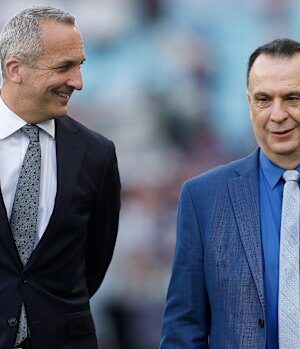
Happy days: NRL CEO Andrew Abdo and ARLC chairman Peter V’landys.Credit: Getty Images
Nor has there been any off-season “atrocities” of the kind that led the NRL to introduce an automatic stand-down policy for serious breaches, such as sexual assault. Off-field crimes were running at the rate of one every 22 days. Broncos half Ezra Mam was the last to be stood down, copping a nine-game ban and $120,000 in fines for an October 2024 car collision while testing positive to a cocktail of drugs. There have been no reported incidents in the most recent off-season. As the NRL’s brand reputation has improved, sponsorship income has increased – but at the expense of players’ loss of the presumption of innocence.
The harmony between the 17 clubs contrasts with the days when my president at Wests, Bill Carson, addressed a regular general committee meeting of Sydney clubs and declared, “In here, you’ve got to catch and kill your own.”
Souths’ clandestine poaching of Broncos forward Payne Haas did not elicit a murmur of outrage from Brisbane. Instead, each club issued statements cleared by the other’s CEO before release. No-one from the Broncos mentioned that the Skinny Coach, Wayne Bennett, likes nothing better than to exact revenge on the club which sacked him twice.
OK, Parramatta and Melbourne are heading to court over the Zac Lomax case, amid revelations the Storm pressured the NRL to force a deal. But the NRL had been set to approve the contract, until fear of a backlash from their fans forced the Eels to get tough.
The NRL double-header in Las Vegas, now in its third year, positions the code to jump-start the season. Vegas has become such a signature event that it has further eroded the status of the pre-season fixtures, especially the Charity Shield and the All Stars Match.
The eyes of reporters are focused on the Nevada jamboree, which doubles as a networking opportunity for media executives all keen to receive an invitation to V’landys’ cocktail party.
V’landys is, of course, the chief locomotive pulling the NRL gravy train. His vision, together with his administration’s revenue raising and rule manipulation, has brought the code wealth and close results, reflected in the record TV ratings and crowd figures.
Last season’s Brisbane-Melbourne grand final was a boon for the NRL because it produced record TV numbers in two cities where there is plenty of ratings upside. Coincidentally, the Dickens line above comes from his book A Tale of Two Cities. Set in London and Paris before and during the French Revolution, its famous opening line is “It was the best of times, it was the worst of times.”
While NRL clubs now enjoy the best of times, revolution is never far away in rugby league – especially if money becomes the issue. The addition of two new clubs – Perth in 2027 and PNG the following year – evokes memories of 1995, when the ARL, rather than select one team from the bidding franchises (Perth, North Queensland and a second Brisbane team) to join with newly admitted Auckland, chose all three. Rapid expansion of clubs is the El Niño of sport. It causes extreme conditions.
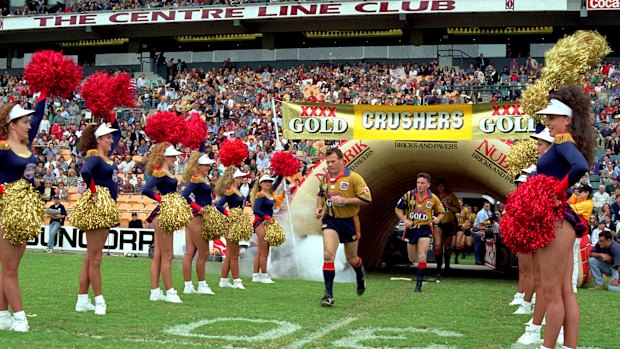
Trevor Gillmeister leads out the South Queensland Crushers in 1996.Credit: Getty Images
The 1995 expansion damaged the game, as the new clubs chased players and sponsors. It led, of course, to the internecine Super League war and an inflationary spiral of payments, unchecked by any salary cap.
The expectation of a bumper TV rights deal later this year has allayed club concerns about sharing revenue with Perth and PNG. Furthermore, V’landys has also gifted each NRL club between $3.5m to $4m from the $600m funding windfall the Australian Government paid for PNG to enter the competition.
However, player depth is a problem, certainly in terms of football ability, compared to athletic prowess. Some NRL coaches will concede privately that the depth in their top 30 squad is not as strong as a decade ago. Perth and PNG each must contract 36 players. Perth have already signed six players from Super League and the recent Test match series against England showed the weakness of the northern hemisphere game at the elite level. Meanwhile, the NRL continues to recycle players, such as Matt Lodge – now at his sixth club.
As the talent pool becomes increasingly shallow via the addition of new franchises and the loss of players though a rising injury toll associated with an increasingly brutal game, playing standards fall. It’s not obvious to most fans because clubs play each other. A strictly enforced salary cap is therefore a guardian of mediocrity because top clubs like Penrith cannot stockpile talent and are forced to release their superstars.
But if Perth and PNG pressure other clubs to breach the cap, we may experience the “worst of times”.