
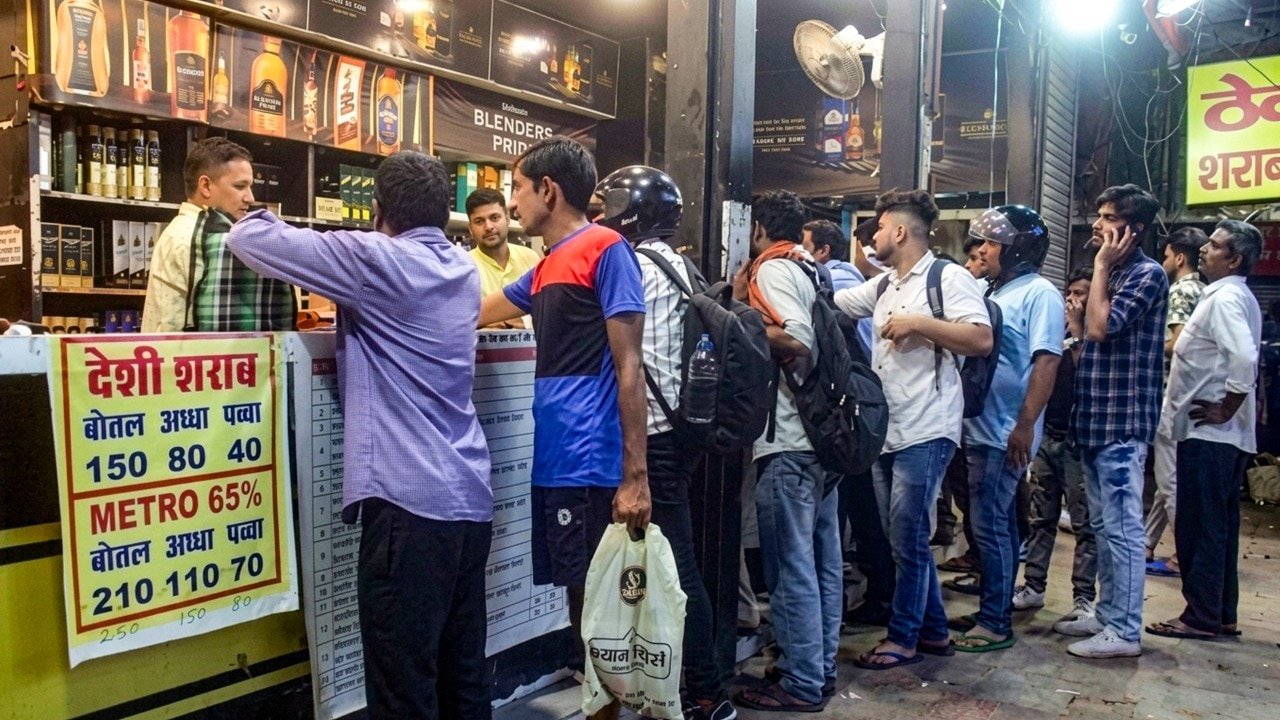
Source : INDIA TODAY NEWS
Kishore had rehearsed the whole thing on the walk from Delhi’s Uttam Nagar Metro. Walk in, ask for his whisky, pay, leave. Simple. But the moment he reached his neighbourhood government liquor venue, the plan fell apart.
A dense crowd pressed against a narrow counter. The air was thick with impatience. Men thrust cash forward, shouting brand names at a salesman already drowning in the noise. Kishore squeezed through, reached the grill, and asked: “Bhaiya, [brand] milegi?”
advertisement
The salesman barely glanced up. “Ye nahi hai.” Then, without pause, he barked the name of a whisky Kishore had never heard of. “Ye le lo.” Someone shoved from behind. Another voice bellowed a brand into the chaos. The salesman gestured, irritably, for Kishore to move. Cornered, Kishore nodded. He walked away with a bottle he never wanted.
“Why do they stock brands no one’s heard of?” he thought. “And what happens to the ones we actually ask for?”
THE ALLEGATION THAT WON’T GO AWAY
For many Delhi consumers, the answer feels obvious: someone, somewhere, is being paid to push obscure labels. And that suspicion isn’t entirely unfounded.
The issue has surfaced even in policy circles. Officials have acknowledged that poor brand availability is driving Delhi residents across the border to Gurugram and Noida. In late December, the Delhi government moved to curb brand monopoly at its liquor vends, following reports that a handful of brands had come to dominate shelf space, effectively crowding out leading alcobev names.
The Delhi Tourism and Transportation Development Corporation (DTTDC) issued a directive to its vends to address what it described as “uni-modal and bi-modal dominance” across whisky, vodka and beer segments. The language was bureaucratic. The problem it described was not.
Enforcement raids have only deepened public mistrust.
In one case, inspectors acting on a tip-off entered a partially opened vend at a mall in Narela, run by the Delhi State Industrial and Infrastructure Development Corporation (DSIIDC). Inside, they allegedly found four people refilling empty premium bottles with a mixture of cheap liquor and water. Outside, a vehicle waited with a bag of empties. In another incident, also in Narela, employees were caught selling refilled bottles of expensive brands diluted with cheaper alcohol. The excise department has since stepped-up surveillance across all 793 vends in the capital.
A MONOPOLY WITH NO COMPETITION
Every liquor outlet in Delhi today is run by a government corporation. 793 stores, operated by four state entities – DTTDC, DSIIDC, Delhi State Civil Supplies Corporation (DSCSC) and Delhi Consumers’ Cooperative Wholesale Store Ltd (DCCWS) – serve a city of nearly 20 million people.
The system was introduced after the rollback of the 2021 excise policy, partly on the grounds of transparency. What it has produced instead, many consumers say, is a sterile monopoly: limited choice, indifferent service and an experience that can border on hostile.
Marketing professional Anmol Jaiswal is blunt: “Salesmen are usually busy and unapproachable. They don’t guide customers. The stores are crowded with long queues and poor product display.”
Junaid, a sales executive living in Jamia Nagar who drinks occasionally, is more resigned than angry. He describes the staff as “neutral, not rude, but not helpful either.” Popular brands go missing on weekends. Sometimes he visits multiple stores before finding what he wants.
For women, the barrier is often less about stock and more about atmosphere.
“I haven’t visited one in years,” says Vasundhra Enclave Akansha Mathur. “They’re too crowded and don’t feel safe. Most are in shady locations. And the staff — for female customers, the attitude is often judgemental.” She pauses. “Compared to private stores in Gurugram, the difference is stark.”
Many women have stopped going altogether. Those who still do describe the experience not with anger but with a kind of weary familiarity.
“Government stores have a sense of indifference,” says Advertising Professional Supriya Sen, who visits a corporation-owned theka in her Mayur Vihar extension locality once every few months. “They’ll help if you ask, but the staff rarely know the products.” She’s a wine drinker, and the knowledge gap frustrates her. “If I’m looking for a pinot noir, I don’t want to hear ‘we only have Sula.’ Customers want guidance, not just a transaction.”
In several large Gurugram stores, companies have begun stationing qualified sommeliers precisely for that reason.
CROSS THE BORDER, ENTER ANOTHER WORLD
Twenty minutes from Uttam Nagar, across the Delhi-Gurugram border, the contrast is almost absurd.
Gurugram’s liquor stores look like modern retail outlets. Brightly lit. Air-conditioned. Organised like supermarkets. Staff greet customers at the door, ask about preferences, walk them through whisky regions and wine varietals. A basket is handed over; customers browse at leisure.
No shouting. No elbowing. No unfamiliar bottles pressed into unwilling hands.
“The variety is immense, the infrastructure is better, and the staff are polite and helpful,” says Mathur. “It feels civilised. And safe.” Parking is easier. Billing is faster. The environment rewards exploration rather than punishing it.
This gap is especially conspicuous in a city like Delhi — India’s capital, home to diplomats, expatriates, senior bureaucrats and high-net-worth individuals. In most global capitals, liquor retail has become an experience-driven sector, competing on ambience, selection and expertise. Delhi, by contrast, remains stuck in the era of the neighbourhood theka: functional, graceless, designed for throughput rather than the customer.
Officials have reportedly begun discussing reforms, modernising certain high-footfall outlets, improving layouts and infrastructure. But as long as structural problems persist with limited competition, poor service culture, erratic brand availability, the experience is unlikely to change meaningfully.
For many Delhi drinkers, the calculus is already settled. They drive for twenty minutes. Across the border, shelves are full, staff are welcoming, and buying a bottle doesn’t require bracing for a crowd. Every such trip is a lost sale for Delhi’s excise coffers – and a quiet, damning verdict on what government monopoly has made of the city’s retail ecosystem.
Kishore, staring at the unfamiliar bottle in his hand, reached the same conclusion. Next time, he decided, he’d skip Uttam Nagar entirely.
Gurugram wasn’t that far.
– Ends
SOURCE :- TIMES OF INDIA