
SOURCE :- THE AGE NEWS
April 5, 2026 — 6:00am
Almost 20 years ago, Gerard DeGroot, a professor of modern history at the University of St Andrews, wrote a book titled Dark Side of the Moon: The Magnificent Madness of the American Lunar Quest. In it, DeGroot launched a scathing critique of America’s ambition to fly itself to the moon.
The tenor of the book can be summed up at the outset, as DeGroot wrote: “Putting men in space was an immensely expensive distraction of little scientific or cultural worth. The American people, in other words, were fleeced: they were persuaded to spend $US35 billion on an ego trip to the moon, and then were told that a short step on the desolate lunar landscape was a giant leap for mankind.”
It was, of course, a different time. In the 1960s, America was mired in an unwinnable war in Vietnam and a global contest with the Soviet Union during the Cold War, that took the world to the edge of nuclear war, via Cuba. What platform for distraction and bragging rights to a greater civilisation could there be than landing people on the moon?
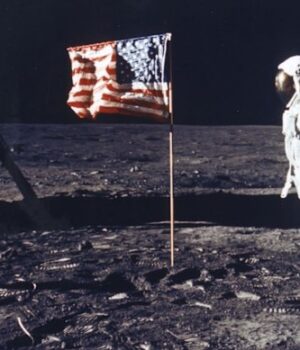
And so in July 1969, and in subsequent missions, we on Earth looked up to the moon and in awe-struck thought, men have walked up there. They played golf and jumped around, light as a feather up there. They pronounced, this was just a little step for a man but a giant leap for mankind. And thus the myth was born. The starving and destitute on Earth would probably have had a different emotion. Perhaps food, water and shelter would be nice.
And now more than half a century later, Artemis II, at a cost of $4 billion, has fired off into the moon’s orbit. Not to land, mind you, just to do a quick trip around the block, have a look at the dark side and come back to Earth. They could have just listened to Pink Floyd.
It’s true the moon has been the inspiration for many a song and book (from Fly Me to the Moon to The Moon’s a Harsh Mistress, for example). Indeed, the former was adopted by NASA with a cassette (remember them?) played on the Apollo 10 mission, which orbited the moon, and Apollo 11, which landed on it.
It’s also true that in times of darkness, a little light must shine. As night falls over the bombed-out cities of the Middle East, over the lives blighted by war’s destruction, over the corpses of such wars, is there redemption for humanity in looking skywards and thinking, well, even though there’s all of this, there is also this?
There might be, if all things were of equal worth and value. But they’re not. And, in its paradoxical manner, reinvesting in flights to the moon, makes this disparity even clearer and wretched. The Artemis trip is seen as the prelude in creating a base on the moon for humans. Why? This is the cosmologically sized question without a good answer. Of course, NASA is excited, and so it should be, technologically speaking. Why they even named the mission after the twin sister in mythology of Apollo.
“Ladies and gentlemen, I am so, so excited to be able to tell you that for the first time since 1972 during Apollo 17, human beings have left Earth orbit,” said NASA’s Lori Glaze. Astronaut Jeremy Hansen, aboard Artemis, said: “Humanity has once again shown what we are capable of, and it’s your hopes for the future that carry us now on this journey around the moon.”
Whose chest wouldn’t swell with pride at those sentiments? If the human race can aspire to be free of the shackles of its own gravity, then the possibilities are endless.
This is hubris speaking before it transforms into myth yet again. The greater, more inspired journey would be into the heart of darkness that tosses aside what a human life is worth and establish a base for equality of dignity and the value of each life. You may say I’m a dreamer.
Artemis II is scheduled to splash down into the Pacific Ocean next Friday. I’m reminded of what Buzz Aldrin found on the moon. “Magnificent desolation,” he said.
He could have been looking at humankind’s sense of priorities.
Get a weekly wrap of views that will challenge, champion and inform your own. Sign up for our Opinion newsletter.


