
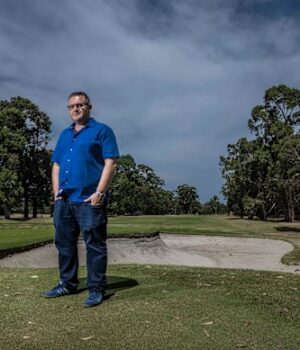
source : the age
A Cranbourne golf club established in the 1950s by Melbourne Jews who had been barred from other courses due to antisemitism will be closed down and potentially redeveloped into a new suburb with more than 1000 homes, under a local council proposal.
Part of the planned housing estate would be built within the buffer zone of one of Melbourne’s largest active landfills, whose owner was fined a record $1 million in November for its failure to manage odour and leaching.
Planning officers have recommended City of Casey councillors approve carving up the northern half of the 70.4-hectare Cranbourne Golf Club, arguing it is a rare opportunity to provide large-scale housing in an established suburb, rather than on the sprawling fringe.
But residents’ groups have urged the council to reject the proposal at a meeting on Tuesday night, given its proximity to a landfill with a poor record of environmental breaches.
The proposed subdivision of the golf club marks the first time councillors in the area will vote on a significant development since a previous council was sacked in 2020 over a corruption scandal involving alleged private payments for favourable development decisions.
The Independent Broad-based Anti-Corruption Commission charged former Casey mayor Sam Aziz and consultant John Woodman over their alleged part in the bribery scandal in September, following a five-year investigation.
Councillors called in the golf club proposal for a vote in December, owing to its broad community interest. Previous planning decisions have been delegated to council officers since the council was reformed in November 2024.
The Casey Residents and Ratepayers Association has objected to the proposed redevelopment, arguing housing would be situated unacceptably close to Veolia’s Hampton Park landfill, which is licensed until 2040.
Veolia was ordered to pay a record $1 million to a community fund in November for its failures to manage noxious gas emissions and contaminated liquids at the landfill site.
The penalty, issued in the Supreme Court, was the largest given since Victoria’s Environment Protection Authority had its powers to pursue breaches of “general environmental duty” strengthened in 2021.
Part of the golf course lies within the EPA’s 1500-metre landfill separation buffer for human health and amenity impacts. Council officers’ recommendation for the development relies on an assessment that homes can be built within 1000 metres of the landfill if odour and leachate is properly managed.
Association president Anthony Tassone said residents were deeply concerned about the prospect of homes being built inside an active-landfill buffer.
“The former Cranbourne Golf Course sits about 1.25 to 1.3 kilometres from the Hallam Road landfill, which remains licensed until 2040 and falls within the EPA’s default 1.5-kilometre separation distance.
“While developer-appointed consultants have reportedly described the odour risk as low, no independent, peer-reviewed assessment endorsed by the EPA has been publicly released to justify reducing that buffer. Until that occurs, the precautionary principle should apply,” Tassone said.
“Approving housing closer to an active landfill without transparent, independently verified evidence that it is safe simply shifts risk onto future residents and the existing community.”
Veolia aims to close the landfill before its licence expires in 2040 and convert part of the site into a waste transfer station.
The proposal remains deadlocked, after the EPA rejected Veolia’s application last April, finding the transfer station presented “unacceptable risk to human health … primarily from odour and noise emissions”.
Veolia appealed through VCAT and a judgment is pending.
Nine south-eastern suburbs councils, including Casey, have signed contracts to supply kerbside rubbish to the facility.
Lynbrook Residents Association president Scott Watson said the council should, at the very least, wait until the VCAT judgment has been published.
“How on earth can they possibly consider to put hundreds of additional homes within the buffer when the EPA have said the current proposal for a waste to energy facility is not safe? It’s illogical to even consider approving this when it’s still up before VCAT,” Watson said.
Cranbourne Golf Club is due to close on February 28, after 72 years.
The land was previously owned by the Cranbourne Country Club, which sold it to developer and former Carlton footballer Fraser Brown for a reported $190 million.
Country club president Bradley Wein said the golf club had lost many of its members because Jewish golfers no longer face the same discrimination they did when the course was opened.
“Our role as the owner of the land was founded 70 years ago with a view to promote Jewish golf through the community, because of antisemitism that was around in the 1950s when Jewish people couldn’t get into other clubs. But that’s largely changed now. The club lost its purpose for many Jewish members, and they’ve gone to other clubs,” Wein said.
He said no club member had ever raised the issue of odour from the landfill.
“I used to play there regularly. I don’t think that there was any particular problem with odour, but I don’t live in the area, so I don’t know what it’s like at 2am,” he said.
Start the day with a summary of the day’s most important and interesting stories, analysis and insights. Sign up for our Morning Edition newsletter.
 Adam Carey is senior city reporter (suburban). He has held previous roles including education editor, state political correspondent and transport reporter. He joined The Age in 2007.Connect via X or email.