Source :- THE AGE NEWS
It’s almost 3am in the hours after an MCG blockbuster. Dwayne Russell is in an infrared sauna in his home in Ceres, in Geelong’s outer suburbs, with the replay on. Some nights he’s on the treadmill, rowing machine or exercise bike.
The veteran caller is not reliving the mark or goal of the night, nor is he necessarily running his eye over collapsed defensive structures and turnovers but, like a senior coach, he is searching for how things can be done better.
Just as Chris Scott, Chris Fagan, Craig McRae and co are scrutinising plays their teams have nailed or failed, overuse of the ball or shoddy entries inside 50, Russell’s antenna too is scanning for highs and lows, repetition and delivery.
Except Russell is not doing this to be, in the words of Australian rock band Weddings Parties Anything, the Monday Expert telling you how the game was lost and how it could have been won. He’s doing this so he can be better in describing how the game was lost and won. He’s striving to perfect the art of the call.
“You might be Monet or Picasso, but it’s not like you’re all of a sudden sitting back saying, if you’re Picasso, ‘Well, Guernica is my greatest painting ever, I’m not going to paint again because it’s good enough’, you actually want to keep getting better,” Russell said.
From March to September, Russell and his colleagues are weekly guests in your home, the voices to the soundtrack of your football season. So familiar are they that, for many, they are known on first or nickname basis: Dennis, Bruce, BT, Huddo, Gerard, Quarters …
As much as a moment should be about the players, a broadcaster can become synonymous with it, as seen in the numerous tributes to the legendary Dennis Cometti from fans thanking him for his call of their favourite moments.
Their work has no bearing on the result but those who nail the moment become part of football folklore.
You don’t have to be a close follower of the game to know these famous lines.
“Jesaulenko, you beauty!”
“Leo Barry, you star!”
“He came up behind him like a librarian, he never heard him.”
This is the glamorous side of the job. What the public do not see are the hours poring over footage and press clippings, the visits to training, calls to players and football bosses and other extras to bed down the basics of the craft.
This masthead interviewed seven of the top callers – Gerard Whateley (SEN and Fox Footy), Russell (SEN and Fox Footy), Anthony Hudson (3AW and Fox Footy), Stephen Quartermain (SEN), Hamish McLachlan (Seven), Brian Taylor (Seven and Triple M), Jack Heverin (Seven and Triple M) – to get their tips of the trade.
Player ID
Getting player names right for callers is what hitting a target is to a footballer, though it’s more difficult than you think.
“I’ve got one job – get the names right,” Russell said.
Many, somewhat surprisingly, dismissed the importance of numbers. They are helpful only if the player’s back is to the caller, they said. Often, they aren’t.
Taylor, who has called for more than 30 years, says 90 per cent of player recognition is done by physical appearance. The key, many said, was finding distinguishing features such as tattoos, hairstyles, headbands, boot colours, running gait, socks down or up, kicking actions, and strapping to name a few.
The reliance on physical traits gives context to instances when Indigenous players are called incorrectly. Some critics are quick to assume sinister reasons instead of accepting it as an innocent blue.
“I’ve made mistakes calling two white players, it’s the same thing,” Taylor said. “Noah Anderson looks like a lot of his teammates.”
Though much of the preparation is done during the week, at home or at club training, the two hours before the game, when players are in their warm-ups, are crucial for a caller. Taylor likes to be in the rooms.
“People must look at you and think, ‘What are you doing here? Are you fanning up or something?’” Taylor said. “No, I need to see what that kid looks like. And if you see them physically close up in the hours leading up to the game, you should be right in most cases.”
Players who confuse
Footballers, it’s accepted, are most susceptible to injury in February and early March when they step up to match intensity. This is also a fraught period for callers. There are new players, old players in new jumpers – sometimes with new numbers. Gold Coast wearing the red and white of Sydney in a practice game does not help.
“They do look different in different guernseys,” Whateley said.
Said Hudson, who places a higher importance on numbers than several of his colleagues: “The number is part of their overall look.”
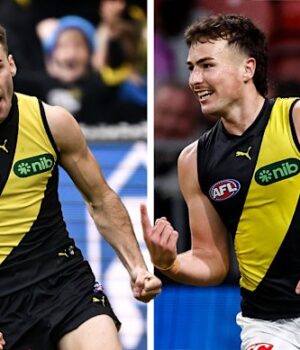
Richmond’s fresh-faced list created problems last year for Hudson. He and Whateley both need to be at the top of their game to distinguish between Seth Campbell and Steely Green.
“I don’t know if it’s the pattern of their name, physical characteristics or where they are in the vicinity,” Whateley said. “It took a bit of concentration to separate them.”
Hard to tell apart: Richmond’s Seth Campbell (left) and Steely Green.Credit: Getty
Richmond’s gun cub Sam Lalor caused issues last year for Whateley, who confused him with the Tigers’ retired premiership forward Josh Caddy. Both had similar builds and wore 22. Richmond have solved Whateley’s problem. Lalor now has Dustin Martin’s old No.4.
Russell finds the Brisbane Lions’ Ashcroft brothers, Will and Levi, hard to differentiate with their flowing blond locks. Both wore the same coloured boots in last year’s grand final.
The mind can also play tricks.
Whateley still associates Carlton’s No.44 with former midfielder Andrew Carrazzo, even though four Blues have worn the number since that player’s retirement in 2015.
“You can get funny little tics that you have to be careful with – that your brain gives you the right thing at the right time,” Whateley said.
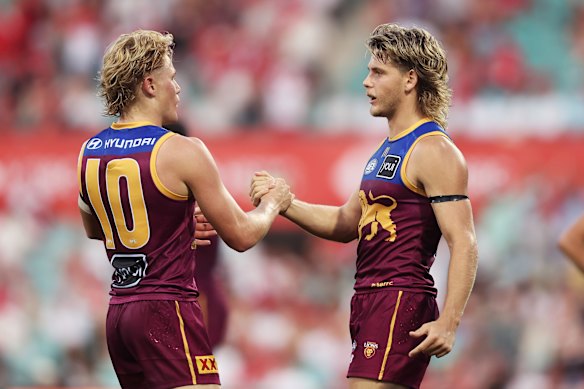
Levi and Will Ashcroft, of the Brisbane Lions, can confuse commentators with their similar appearance.Credit: AFL Photos
Adding value
Almost all callers agree there is no such thing as too much preparation. Seven’s Hamish McLachlan began his study for this year’s season-opener about three weeks ago. He’s watched practice games, attended training, and spoken to figures from each club. He’s even reached out to “super fans” for the insight only a devoted supporter can give.
Each player has a backstory, be it about their family, their junior club or a childhood idol who is now a teammate. Titbits bits like these endear a player to the neutral viewer, which form the majority of an audience.
“A former boss at Seven said, ‘Give the viewer a reason to barrack’,” McLachlan said.
Only a fraction of the research is used.
“Bruce [McAvaney] has always been a mentor, he said, ‘Do this much preparation’, and held his arms out as far as he could, ‘but you’ll only use this much’,” McLachlan said. “You don’t know which bit, so you’ve got to do it all.”
Heverin, a newcomer for Seven this season, has notes next to each player on the team sheet, and another book in which he keeps their relevant stats. Some take it further with colour codes.
“You’ve got to be able to find what you need really quickly,” Heverin said. “And if it’s too complicated, it’s too hard to find.”
Russell is conscious of not saying too much lest the listeners become tired of his voice, and to give the experts the chance to analyse the play.
“When it comes to talking about what happened, it’s not my job to talk about the guy who should have punched or how he used his body,” Russell said. “It’s about letting Jason Dunstall and Garry Lyon, who are the best at their craft, to get enough time to be great.”
The Dwayne Russell bingo card
When callers review their games, usually not from an infrared sauna, they listen for traits such as speed, volume, turn of phrase and repetition.
Nick Daicos on the burst from stoppage towards goal demands an energetic call, but what if his kick ends up with a hanger from Jamie Elliott?
“You’ve got to still have somewhere to go if something better happens,” Hudson said. “That’s the craft. I’m still trying to work it out all these years later. It is trying to call the excitement of the moment.”
Everyone has go-to expressions in everyday speech. Broadcasters are the same, except theirs are more widely known. Russell is aware of a “Dwayne Russell bingo card”, designed by a listener, featuring his favourite lines like “that’s as good as it gets”, “shake and bake” and “crazy good”.
“I have tried to get a few of those things out, but sometimes the default mechanism has me say this is the last roll of the dice, then after I say it and go back and watch it and think ‘what could I have said that’s better?’” Russell said.
“But sometimes it fits the moment and it works, but in my mind I shouldn’t have defaulted to it.”
The best lines
Cometti, with his smooth voice, dry humour and impeccable timing, was without peer. As much as callers never aspire to be the story, Cometti, as his great friend Bruce McAvaney said, made footballers famous.
“Dennis was always able to find the right words to say at the right moment to make it better,” McLachlan said.
Preparation is important, but this is where too much can be a curse. Spontaneity reigns over the rehearsed.
Quartermain’s famous Leo Barry line from the 2005 grand final, when Sydney broke a 72-year premiership drought, “just came out”.
“There was nothing planned, it was a very tense situation at the end,” Quartermain, calling for SEN this year, said. “It’s not terminology I’d used before, and probably never used after.”
The origins of Hudson’s “Thirteen. THIRTEEN!” does not match the enthusiasm with which the call is remembered.
“That’s a number, I just said it,” Hudson explained. “When I said it, I had no concept it would still be remembered and quoted back to me by people on the street. It was more about how people latched on to it as a bit of fun. All it is is just a number.”
Pop culture plays a part. A Taylor Swift fan, Russell often weaves the megastar’s song lyrics into his call. Hudson had watched a YouTube clip about the USA’s 1980 ice hockey win over the Soviet Union, dubbed the “Miracle on Ice”, in the days before he described the Brisbane Lions’ after-the-siren win over Geelong in 2013 as the “miracle on grass”.
The inspiration to Whateley’s call on SEN of Collingwood’s epic comeback win over the Blues in 2022 came from Steven Spielberg’s 1984 box-office hit Indiana Jones and the Temple of Doom.
“I’m not sure I’d thought of that for many a year but that was the image that popped into my head and that’s what you go with,” Whateley said.
“The Grim Reaper had occurred to me in the minutes leading up to it, and the imagery just arrived in the moment it happened as to how ruthless and savage it was to Carlton.”
Calling your team
Commentators often stand accused of being biased when calling matches involving their club.
When Whateley is behind the microphone in games involving his team, as he was in Geelong’s grand final defeats in 2008, 2020 and 2025, he reminds himself of his responsibility to the audience.
“To Hawthorn people, Richmond people, to Brisbane people, this is their moment,” Whateley said. “You have no right to intrude on that. I don’t have any trouble on that front, and I’d stand behind those calls.”
Hudson’s famous call of Nick Davis’ match-winning goal for Sydney – “I see it, but I don’t believe it” – came against his beloved Cats.
His heartbreak at his team going a 42nd season without a flag did not taint the call. If anything, it enhanced the moment by reflecting the disbelief of all who watched the game.
“Geelong just found a way to just not win those big games,” Hudson said.
“I was lucky to call a close final with an unbelievable bit of play from Nick Davis. It was going to be something that would be remembered. You hope you don’t stuff it up.
“The thing with TV, your voice is the soundtrack to that piece of play.”
The perfect call?
If there is the perfect call, none of the seven commentators interviewed said they have delivered it. Some have light-bulb moments long after the event as to what they should have said, but there is a long-lasting sense of satisfaction and professional pride at finding the right words at the right time.
In Australia’s 2023 tour of India, Whateley was approached by a young boy who delivered a word-perfect recital of his “shot of an emperor” call of Virat Kohli’s back-to-back sixes against Pakistan in the 2022 T20 World Cup.
“It’s one of the more beautiful moments that I’ve experienced,” Whateley said.
Two decades on from the 2005 grand final, Quartermain still gets approached for his call of Barry’s flag-saving mark, most recently at the races last month.
“I reckon about half a dozen blokes were yelling it out as I was going to the TAB,” Quartermain said. “I get it every week without fail. To be honest, it’s lovely. It could be worse. I could have stuffed it up.”
Keep up to date with the best AFL coverage in the country. Sign up for the Real Footy newsletter.