
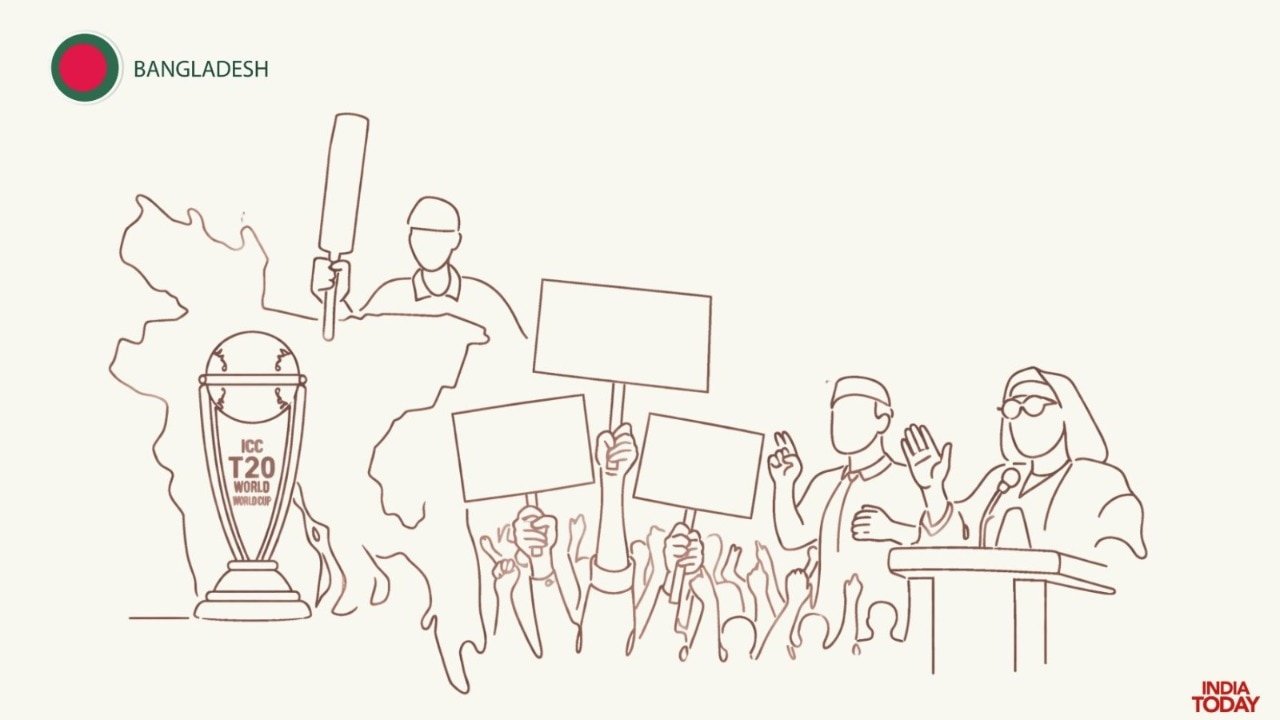
Source : INDIA TODAY NEWS
Bangladesh heads to the polls on Thursday in what is shaping up as a direct contest between the Bangladesh Nationalist Party and a Jamaat-led alliance. While on-the-ground campaigning has drawn to a close, the real battle has been unfolding online for months.
India Today’s Open Source Intelligence (OSINT) team analysed social media platforms, examined party manifestos and reviewed speeches by political leaders to assess the dominant narratives shaping the upcoming election.
advertisement
Posts online reveal a clear pattern: parties are vowing to bring the World Cup to Dhaka this time by exploiting anti-India sentiment and the use of AI-made videos to spread misinformation.
PARTIES USING CRICKET AS A ‘TOOL’
Cricket has emerged as one of the loudest talking points in Bangladesh’s election season, not as a sport but as politics by other means. In rallies and on social media, party supporters are reframing Bangladesh’s T20 World Cup disappointment as a question of national dignity and foreign interference, turning the bat and ball into campaign tools.
The India Today team scanned Facebook and X handles of leaders, cadres, and supporters of different parties and found that supporters of Jamaat-e-Islami have framed Bangladesh’s World Cup setback as an injustice, urging voters to prioritise national dignity over sporting heartbreak.
Supporters of the party assert that a Jamaat-led government would restore Bangladesh’s pride on the global stage, even promising future World Cup success as part of that political vision.
The NCP organised the “Rally for Bangladesh” to protest against India’s dominance in the International Cricket Council. The protest also targeted what the party described as Delhi’s sheltering of those accused in the killing of student leader Sharif Osman bin Hadi, alleged interference in the last four national elections, and an Indian “conspiracy” surrounding the upcoming 13th national polls, according to Bangladeshi media reports.
Videos and images from the rally circulated on social platforms, where some users went further, calling for a boycott of Indian matches, while others urged broadcasters to stop airing World Cup coverage.
In such a situation, the BNP appears to have maintained a strategic silence, at least on social media.
ANTI-INDIA RHETORIC IN BANGLADESH ELECTIONS
With the banning of the Awami League, long viewed as the ‘pro-India’ force and the dominant party in Dhaka, the upcoming Bangladesh elections have turned into a political arena where anti-India positioning carries clear electoral value. The central question now is which party will extract maximum leverage from this sentiment.
The National Citizen Party (NCP), born out of the student protests that led to Sheikh Hasina’s ouster, has been the most explicit. Its manifesto names India directly, citing border killings, unequal agreements, disputes over transboundary rivers, and alleged interference in Bangladesh’s internal affairs.
The party states that if bilateral dialogue fails, Dhaka would pursue legal and multilateral routes through international courts and organisations to bring Sheikh Hasina to justice.
On the campaign trail, NCP leaders have openly mocked Awami League figures now based in Delhi, at times branding them terrorists, militants, and thieves, reinforcing a narrative of Indian patronage and political shelter.
The BNP, while avoiding direct references to India in its manifesto and speeches, continues to rely on a long-standing sovereignty-first discourse. Its chairman Tarique Rehman’s remarks, including the proposal to construct a Padma Barrage as an alternative to the so-called death trap Farakka Barrage, however, signal a harder line beneath carefully calibrated language.
But this restrained posture has not insulated the BNP from criticism. Hardliners in Dhaka appear unwilling to tolerate any party perceived as taking a rational stance towards India. The trend has deepened to the point where sections of social media have accused the BNP of being aligned with India.
Jamaat-e-Islami, long marginal in Bangladeshi politics, has gained renewed relevance following the Awami League’s ban and its tactical alignment with the NCP.
While its senior leadership avoids overt anti-India rhetoric, for now, and officially pledges friendly relations with neighbours, its manifesto prioritises uncompromising sovereignty and closer ties with Muslim countries. Meanwhile, Jamaat and NCP-aligned online networks continue to amplify anti-India sentiment.
Awami League, a party known for liberating Bangladesh and ruling Dhaka for years, the longest among all political forces, has been banned from contesting elections. Sheikh Hasina, following her ouster, is now sheltering in Delhi and faces a death sentence in Bangladesh.
Reports by the South Asia Terrorism Portal (SATP) suggest that from a secure and undisclosed location in the Indian capital, Hasina spends much of her time holding party meetings and speaking with supporters inside Bangladesh.
At times, certain factions of the Awami League have launched digital campaigns such as #NoBoatNoVote, alleging that the elections being held under the Muhammad Yunus-led interim government are a farce and not inclusive. These campaigns are also calling on voters to boycott the February 12 elections.
So the question is not ‘if’ but ‘how much’ effect this ‘anti-India’ posture will have for the political parties participating in one of the most consequential elections of Bangladesh.
AI-GENERATED CONTENT IN BANGLADESH ELECTIONS
Bangladesh’s social media landscape has been flooded with AI-generated content. India Today found that party supporters and online influencers are increasingly spreading misinformation through AI-made videos.
India Today identified at least seven social media channels spreading false narratives through AI-generated content. A previous investigation by Bangladesh-based fact-checking group Dismislab found 21 pages circulating AI-made material, most of it posted without any disclosure or labelling.
Both Jamaat-e-Islami and the Bangladesh Nationalist Party are deploying AI-generated videos to discredit their rivals. Content aligned with Jamaat frequently depicts the BNP as extortionists and deceivers, while targeting the party’s proposed “Family Card” programme as an inducement or a deceptive trap.
Anti-Jamaat campaigns, meanwhile, seek to brand the party as anti-state, portraying its ideology as incompatible with Bangladesh’s founding principles. For example, in a podcast-style video, an AI character asserts that Jamaat is loyal not to Bangladesh, but to Pakistan. Another video claims that after failing to turn Bangladesh into Pakistan in 1971, Jamaat is now attempting to turn it into Afghanistan, an effort the public will resist.
What is striking about these videos is how realistic many of them appear. Circulated alongside genuine, real-life testimonials, the AI-generated clips blur the line between fact and fabrication.
In one conspiracy narrative, a Jamaat supporter claimed that BNP leaders had met officials from India’s Research and Analysis Wing (R&AW) in New Delhi. Subsequent verification using Google’s SynthID, a DeepMind tool designed to identify AI-generated content, showed that the images circulating with the claim were artificially generated. India Today independently verified several such fake testimonials and conspiracy claims using the same tool.
– Ends
Tune In
Must Watch
SOURCE :- TIMES OF INDIA


