
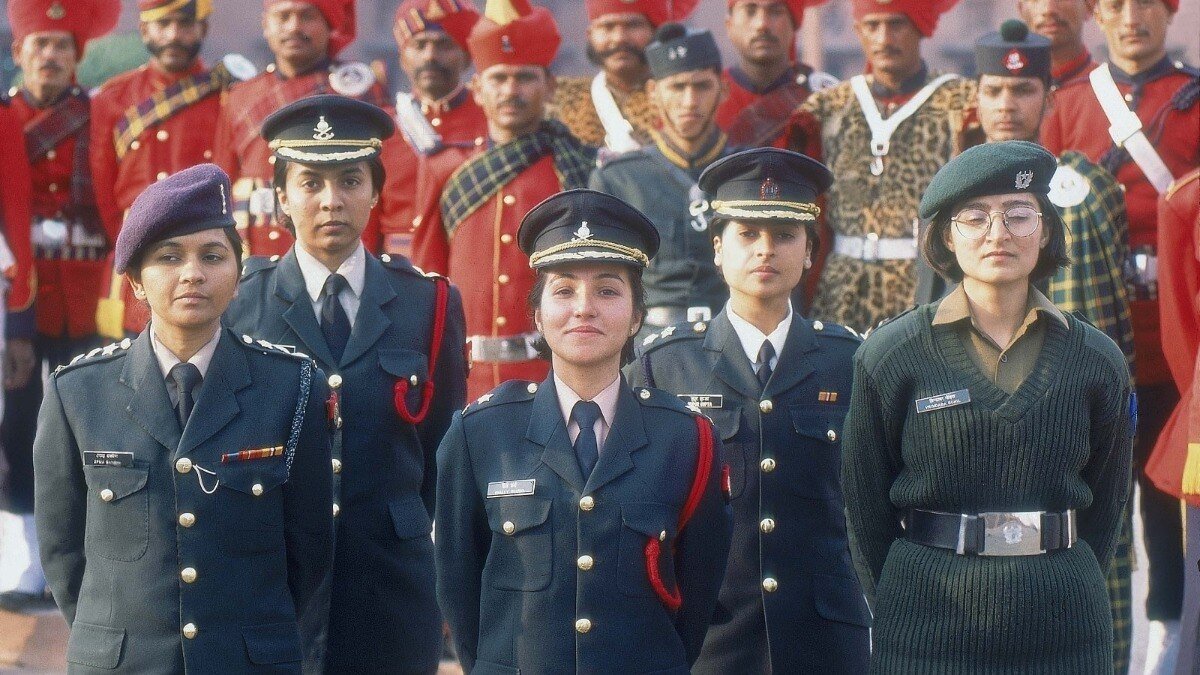
Source : INDIA TODAY NEWS
The Supreme Court has recognised long-standing barriers faced by women officers in the Indian Armed Forces in securing permanent commissions and promotions. After nearly 15 years of legal battles, the Court acknowledged systemic biases that affected Short Service Commission Women Officers (SSCWOs) in the Army, Navy, and Air Force.
The Court delivered three key rulings on Tuesday, highlighting how women officers were disadvantaged despite earlier court orders and policy changes aimed at gender parity. Around 100 women officers across the three services have been seeking justice against these obstacles.
BIAS BUILT INTO THE SYSTEM
advertisement
The Court noted that Annual Confidential Reports (ACRs), which form most of the evaluation for permanent commission, were prepared when women were not eligible for such promotions. This led to consistently lower ratings for women officers, limiting their chances despite their merit.
Women officers were often excluded from important training courses and appointments that helped career growth. For example, they were denied the Junior Command Course, which was available to men and critical for promotion, simply because of their initial ineligibility for permanent commission.
POLICY CHANGES AND LIMITATIONS
Although the Armed Forces introduced anonymous and computerised evaluations in 2012, the Court observed this could not undo the impact of earlier biased assessments. The Court compared this to trying to fix an old photograph by adjusting the camera lens after the picture was taken.
The government’s argument about a yearly cap of 250 permanent commission vacancies was also challenged. The Court pointed out that this limit had been exceeded before and said rigidly applying it now would worsen inequality.
COURT STEPS IN WITH RELIEF ACROSS FORCES
Using its constitutional powers, the Supreme Court ordered that women officers who met earlier selection criteria should be granted permanent commission and pension benefits. It also recommended reviewing evaluation methods to prevent future bias against women officers.
For Navy officers, the Court noted problems with transparency in vacancy calculations and evaluation criteria. It directed granting permanent commissions to eligible officers as a one-time measure to avoid further litigation.
In the Air Force case, the Court provided relief to women officers considered in selection boards between 2019 and 2021. However, it rejected requests for retroactive promotions, citing concerns about the service’s hierarchical structure.
These rulings mark a significant step towards addressing historical inequalities faced by women in the Armed Forces, recognising that policy changes alone were insufficient without correcting deep-rooted systemic issues.
– Ends
Tune In
Must Watch
SOURCE :- TIMES OF INDIA