

source : the age
Major infrastructure projects funded by the Albanese and Allan governments hosted drug trafficking, systemic corruption and bribery, bikie gangs and the shocking sexual exploitation of women at an estimated cost to the taxpayers of $15 billion, according to a landmark report into CFMEU corruption.
The public airing of the explosive Rotting From The Top inquiry report, written by corruption-busting lawyer Geoffrey Watson, SC, comes amid revelations that explosive conclusions reached by Watson that were highly critical of Labor were secretly stripped from the report’s pages shortly before its release.
On Wednesday morning, this masthead revealed how Albanese government-appointed CFMEU administrator Mark Irving, KC, directed Watson to remove explosive findings from Watson’s 18-month investigation. The deleted chapters concluded that Victoria’s Labor government enabled CFMEU graft and organised crime on state and federally funded major road and rail projects.
The deleted material estimated the cost of this inaction to Australian taxpayers who unwittingly funded union corruption, bikie infiltration and organised crime rackets, at $15 billion.
Irving released the sections on Tuesday evening after this masthead asked if he had whitewashed the report. Irving said he sought the removal of the material because he “was not satisfied that they were well-founded or properly tested”.
In his sworn testimony before the Queensland Commission of Inquiry into the CFMEU on Wednesday morning, Watson revealed he was “quite angry” at Irving’s order to to remove the politically sensitive material and believed Irving’s criticism of the deleted chapters was baseless. Watson said he “absolutely” believed the deleted chapters needed to remain in the report.
The removed “government inaction” section includes Watson’s conclusion that Victoria’s Labor government both “knew and had a duty to know” that corrupt union and underworld forces had infiltrated its signature Big Build infrastructure scheme, but chose to do “nothing about it”.
That finding directly contradicts the denials of Premier Jacinta Allan, the minister previously responsible for the Big Build, that she had any knowledge of the CFMEU scandalous conduct until it was revealed by this masthead and 60 Minutes in 2024.
It also raises major questions for the Albanese government given it appointed Irving to clean up the union and spent billions funding the projects Watson has concluded were corrupted.
Even with the stripping of the politically embarrassing material, Watson’s report – which was uploaded to the Queensland’s Commission of Inquiry’s website today – contains an extraordinarily damning exposé of the Big Build.
The report finds the $100 billion program hosted and enabled not only systemic corruption but bikie activity, the sexual exploitation of women and drug trafficking.
While two of the examples uncovered or cited by Watson have led to minor criminal charges and other case studies have prompted regulatory action to cancel the licences of three labour hire firms, his report repeatedly calls for a more sweeping and powerful inquiry than the existing police effort, under Taskforce Hawk.
No such inquiry exists nationally or in Victoria but multiple times, Watson’s report concludes that “an investigation supported with coercive powers” is needed to probe the corrupting of the Big Build and the vast amount of improper conduct that has gone unchecked.
The Queensland commission of inquiry is equipped with coercive powers, but state and federal police do not have equivalent tools that Watson found were necessary to fully expose Big Build corruption.
For instance, Watson concludes that intelligence suggesting drug-trafficking bikie gangs hijacked government sites is “an especially serious matter which cannot be addressed in a report like this – it requires the immediate attention of an investigative body with a full suite of coercive powers”.
The CFMEU’s descent from militant blue-collar union to a lawless enabler of corruption and organised crime, according to Watson, was underpinned by two factors: “The leadership of John Setka and his team and the role of the Big Build.”
“Things went badly downhill when the Big Build really got going in 2015,” the report states.
“The big money generated by the Big Build was at the root of the problem in Victoria. The temptation created by the big money proved too great.
“The flood of government money… made the Big Build ripe for corruption – ad hoc corruption on the part of former organisers and delegates, as well as a more organised or systemic corruption involving collaboration by some elements in the CFMEU with outlaw motorcycle gangs (OMCGs) and other crime outfits.”
Watson reveals that insiders told him that some of the large Big Build sites “were converted by OMCGs into drug distribution centres”.
“Picture 200 or more men aged between 18 and 30, each earning well over $100,000, confined within the area of a single building site – that is a drug dealer’s dream. Rival bikie gangs were fighting to get control over the individual sites.”
Watson uncovered information that rival bikie gangs connected with warring union factions ended up fighting for control of parts of the Hurstbridge Rail Line Upgrade because of its value as a drug-dealing hub as well as an employer for bikies wanting lucrative taxpayer-funded jobs.
“Approximately 1000 workers were on the Hurstbridge site – 540 on day shift, approximately the same on the night shift. That many workers, placed into a confined area, made Hurstbridge a desirable place from which to distribute drugs,” Watson said in his report, describing the $530 million project to duplicate the line and build new stations.
“Because the rates of earnings at Hurstbridge were unusually high, it was also a desirable place to work. Those two factors meant that there were two struggles for control: one was between individual organisers and delegates at the CFMEU; the other was between rival bikie gangs.”
Witnesses told Watson of a stand-off at a Hurstbridge rail line site between Comancheros and Rebels or Bandidos bikies.
“There were about eight Comancheros who arrived in full colours, riding large and noisy motorcycles. The Comancheros continued their ‘ride’ for the rest of the day, rolling in a continuous loop around the site and making it plain they were making a territorial demand.
“One witness spoke about his knowledge that members of the rival Rebels were also involved and that the gangs were staring each other down,” Watson said.
“Several witnesses spoke of their knowledge that the real fight between the bikies was over which gang should be permitted to control drug distribution on and from the Hurstbridge site.
“Several sources, including high-placed officials, have recounted that the working theory of the intelligence agencies is that the OMCGs used the building sites for drug-distribution purposes.”
Watson noted the theory was consistent with bikies being the state’s largest manufacturers and distributors of methamphetamines.
Watson’s report describes how workers routinely paid bribes to get lucrative jobs on Big Build sites with the help of union officials.
“A market was created where corrupt organisers and delegates bought and sold the jobs. There are plenty of stories of people who were willing to pay to get an unskilled job paying well over $100,000 a year,” he said.
“Several witnesses gave accounts of those who previously held the power (ie organisers, delegates and contractors) selling Big Build jobs for an upfront cash payment. A few witnesses described how a powerful delegate, Joel Leavitt, required potential workers to pay him a sum to get a job in the first place and an occasional payment to keep it.”
Leavitt is a violent senior member of the Rebels bikie gang who worked across multiple Big Build sites as a union delegate, wielding huge control over who was hired and which subcontractors were used by government contractors.
On one occasion, Leavitt directed the Labor government’s Southern Project Alliance to hire 18 workers, including several members of the Rebels bikie gang and his relatives or those of other CFMEU officials.
Watson also describes how he was told by an informant that in return for securing well-paying shifts on the Melbourne Metro Tunnel project, up to 100 workers had to donate $100 to a “concocted” CFMEU charity for the right to work a weekend night shift.
On the Hurstbridge upgrade, Watson notes “several accounts [were] given that former CFMEU organisers and delegates were actually charging a fee to people who wished to work” on the most lucrative shifts.
“Because there was so much money to be earned, the fees charged by the delegates or the others were sums like $500 or even $1000.”
Bigger bribes were probably paid too, Watson concludes. When a large labour hire business won a traffic management contract on the Eastern Freeway job, its owner told “his workforce that ‘I’ve paid [redacted] 800 grand to get this job, so don’t stuff it up’.”
Union delegates and health and safety officials on Big Build projects also rorted the public purse by devising a “ghost” shift scheme involving getting paid by two Big Build firms simultaneously. This rort, too, was “eventually paid by the Victorian taxpayers”.
Watson said that when the ghost shift scandal first emerged in 2023, then-premier Dan Andrews, stated that he had “zero tolerance” for ghosting.
Despite Andrews’ public objections, Watson concludes the rorting “happened again. And again and again”. Among the recent examples Watson cites is a ghost shift scandal involving major Metro Tunnel contractor MC Labour – a company Watson’s report also notes has deep ties to organised criminals.
“The truth is that MC Labour was not the only labour hire company charging for ghost workers on government projects – others were at it as well.”
While ordinary workers had to pay kickbacks to win jobs on the Big Build, Watson concluded that bikie gangs and the friends and relatives of certain union bosses – who were sometimes also in bikie gangs or the underworld – got their pick of lucrative Big Build work.
Watson’s report also describes how the CFMEU, rather than Labor government contractors, controlled which subcontractors won work on the Big Build.
One mechanism of this system of “extortion” involved the union and underworld figures operating a black market where bribes were paid by select labour hire firms to secure the union’s formal Enterprise Bargaining Agreement endorsement, which was needed to win Big Build contracts.
“There were many accounts to suggest that a labour hire EBA will cost $500,000, there was one account… where the asking price was $1 million. There was hard evidence that eager contractors paid $250,000 to obtain a civil construction EBA and that $250,000 had been agreed for a demolition EBA.”
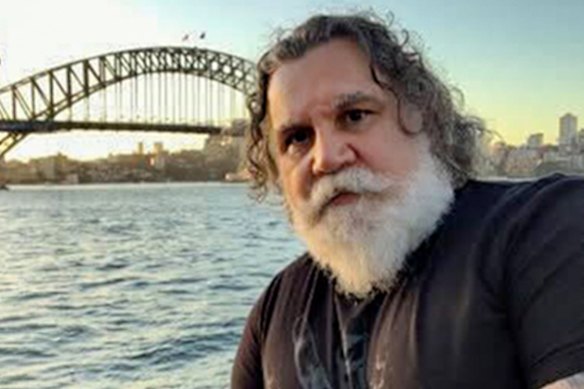
One case study recounted in the Watson report involves underworld figure Billy Mitris demanding payments from a company employing veterans on the North East Link in return for the required union support.
Another case study described by Watson involves an infrastructure company caving to CFMEU demands to replace traffic management companies aligned to the rival Australian Workers Union with the CFMEU’s pick, despite them being 30 per cent more expensive.
One contractor told Watson they had to let the CFMEU keep “controlling these contracts” or face site shutdowns, and that the union’s unlawful demand “cost the Victorian taxpayer $50 million to $60 million on the North East Link alone”.
An executive from another Labor government major contractor told Watson that pressure from the CFMEU to hire its favoured contractors on a major rail and level crossing removal project cost “the taxpayer another $50 million plus”.
Watson’s report singles out now-ex union boss Joe Myles as a key facilitator of Big Build rorting, from placing bikies into jobs, to demanding major contractors use more expensive subcontractors.
One example involved Myles telling a principal contractor to hire a North East Link subcontractor despite being $4 million more expensive than a rival.
“Joe Myles inserted himself into negotiations to tell the principal that it must select the highest quote or the rest of the job would be shut down. There was no choice – $4 million would be the money lost in a week-long delay. The grateful subcontractor gave the principal’s superintendents (an unwanted, unsolicited) bottle of Grange Hermitage. It is inconceivable that rewards were not given to the CFMEU officials involved.”
Watson also details “criminal” figure Mick Gatto’s infiltration of the Big Build, both as a highly paid “fixer” for subcontractors such as Rangedale and LTE and as a hidden owner of labour hire firm and traffic management company, the M-Group.
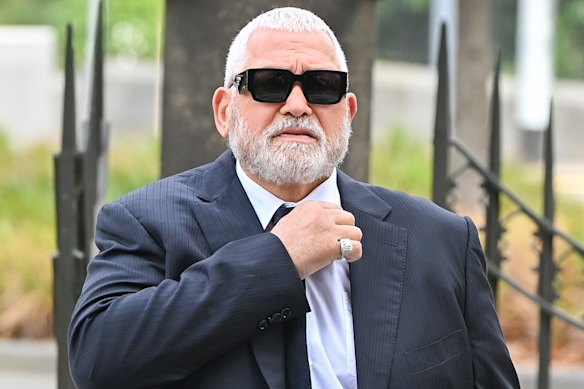
Watson criticised Gatto for running a “racket” as an industry fixer, making “well over” $5 million a year. The figure doesn’t include any funds Gatto earned as a silent shareholder in building companies.
“Given that most of it is taking place on Big Build jobs, eventually it is the taxpayer who is paying for this kind of extortion,” Watson’s report states while also criticising how M-Group subsidiaries have managed to keep winning government work despite other M Group entities having collapsed, owing huge debts to the tax office.
“There has been no dent in Gatto’s work,” Watson concludes, observing that another firm partly owned by Gatto has exploited the state’s social procurement policy on the Big Build.
“Perhaps the most remarkable feature of this is that it is occurring on Victorian government sites funded by Victorian taxpayers.”
Female workers have also been grossly exploited on the government scheme, Watson found. One informant told Watson that on one Big Build site, “the men would pay cash” to have female workers strip “in the site shed”.
A health and safety manager from a Labor government contractor described the “treatment of women as “incredibly awful”, “toxic” and “dangerous for women”.
Other informants told Watson that a now former manager at a labour hire subcontractor, which specialised in finding employment for women, required prospective female employees “to offer sexual services” to secure a Big Build job.
“That man is no longer involved in the business and, to its credit, the CFMEU assisted in getting rid of him. The allegations are so serious it is not appropriate to provide further details without further investigation”.
Watson’s conclusions about the corrupting of the CFMEU’s most powerful and influential branch in Victoria under the reign of now-former leader John Setka are scathing.
Under Setka’s leadership, Watson describes the union’s transformation from “champion of the working class” to an organisation “that turned to looking after gangsters, standover men, bikies, heroin traffickers, and even killers”.
“It is clear that Setka’s ‘leadership’ dragged the CFMEU down from a position of esteem and into a pit of crime and corruption,” Watson’s report states.
“There were so many criminals involved, and so many instances of the conferral of inexplicable benefits, that it can confidently be said that the leadership of the CFMEU was a participant in a larger criminal design.
“During the Setka era the CFMEU was forcing contractors to employ patched bikies, meth abusers, violent standover men, killers, boxers and cage fighters.”
Violence became omnipresent, Watson’s report said. “The threat of violence in the building industry was pervasive: it sat behind every demand, every request. The only certain way to avoid violence was by capitulating to demands, or by making payments to underworld figures and standover men. There are instances of hired assassins, death threats, bashings, firebombings – it goes on.
“By the end of this investigation I have been left with the empty feeling that the Setka-led Victorian branch of the CFMEU was no longer a trade union, it was a crime syndicate.”
Up until his resignation in mid-2024, Watson found that Setka led a small leadership team that “had little regard or respect for the general membership” and which “ran the CFMEU for their own profit and their own benefit. Several of them were deeply corrupt”.
The ex-union bosses Watson identifies as corrupt are Derek Christopher, who received secret benefits from large building companies; Elias Spernovasilis, who was party to the blackmarket trading of union EBAs; and John Perkovic, who received up to three million dollars in secret benefits from building firm owners, including property and luxury cars.
“The problem with this was that these men were corrupt, known to be corrupt, and were promoted and protected by Setka.”
Watson also claims that Setka was involved in highly suspect property developments with criminals and building companies bosses.
Watson’s report is also scathing of Myles, finding he managed a “crew” of underworld “cronies” who in turn “introduced their own cronies into the union – more bikies, more drug dealers, more violence”.
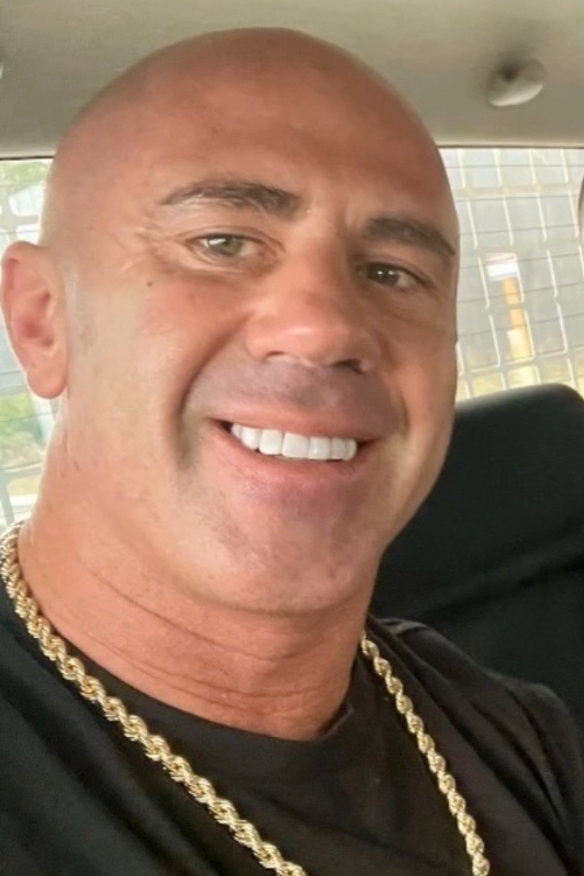
One case study cited by Watson involves Myles and another now-former union official, Gerry McRudden, recruiting violent ex-Hells Angels boss Luke Moloney into the union. McRudden claimed that he recruited Moloney as a CFMEU delegate after bumping into him at a noodle shop.
Watson finds that McCrudden and Myles’ description of Moloney’s recruitment is unbelievable and “the only available inference is that Moloney corrupted the process or that McCrudden and Myles were paid or were performing a favour for a third party”.
Watson’s report also takes aim at organised crime-linked figures, including Nick Maric, the owner of federal and state government project subcontractor LTE.
But his most pointed criticism of any underworld figure is reserved for Gatto.
Watson finds that “Gatto has damaged the building industry and damaged the Victorian economy – maybe permanently. Everybody knows what he has been doing. Repeated inquiries, including royal commissions, have singled out Gatto as a criminal. Yet he seems to survive.”
The Gatto extortion model involved demanding money from contractors under the threat that, unless a payment is made, the CFMEU would raise an industrial issue and close a building site.
“It seems all of the old CFMEU executive were willing to bend the knee to Gatto,” Watson said.
“Now is the time for change. Now is the time finally to break Gatto’s malignant influence over the CFMEU and the Victorian building industry. Now is the time to get rid of Gatto once and for all.”
Setka, Gatto, Myles and Maric have previously denied all wrongdoing.
Start the day with a summary of the day’s most important and interesting stories, analysis and insights. Sign up for our Morning Edition newsletter.


