Source :- THE AGE NEWS
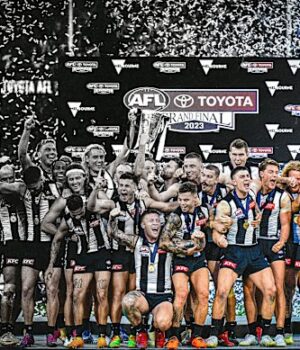
The AFL’s Victorian era of the early 21st century lasted from 2007, when the Geelong juggernaut was unleashed, until grand final afternoon, 2023, when Collingwood’s veterans marshalled a storied victory over the coming power, the Brisbane Lions.
Victorian heavyweights Geelong, Hawthorn, Richmond and Collingwood claimed 13 premierships over those 17 seasons, the Cats and Hawks taking four each. Geelong reached an astounding 13 preliminary finals, the Magpies made 10.
Collingwood’s 2023 premiership was the most recent by a Victorian team.Credit: Eddie Jim/Aresna Villanueva
Melbourne’s flag in exile during the pandemic was hailed – especially by the Demons in the giddy aftermath – as the beginning of a red and blue empire, but that flag, as with West Coast’s outstanding 2018 and Sydney’s 2012 takedown of Hawthorn, were outliers.
Old acquaintances Christian Petracca and Clayton Oliver haven’t been forgotten, but their moves to expansion clubs confirmed the end of any Demon dynasty. Even more against the grain than Melbourne’s premiership was the stirring Bulldogs’ 2016 miracle from seventh on the home-and-away ladder.
In 2026, the Victorian clubs’ prospects aren’t bleak or bereft of hope. A premiership for one of them can’t be discounted in a competition of small margins and injury-driven outcomes. As 10 of 18 teams, the Victorians have baked-in advantages on the fatigue/travel front.
What is evident, however, is that the cycle is turning in favour of teams beyond Victorian borders, especially clubs north of the Murray, whose heavily resented academies are reaping talent for the Suns, Brisbane and the Swans (less lately).
Consider the 2026 prospects of the Melbourne clubs, large or small.
Collingwood, who were lengths ahead at round 16 last year, couldn’t maintain that rage and while they were respectable in the finals, the defeat by the Lions was an accurate reflection of Brisbane’s deeper, younger list. It is difficult to envisage the Pies holding, much less graining ground, considering the vanishing veterans and their scant elite young talent.
Richmond’s rebuild of their list is among the more uncompromising yet undertaken. It will be years before they compete for the flag again, a scenario their fans accept.
Carlton, by losing Charlie Curnow and Tom De Koning, have accepted a withdrawal from contention mode to refresh with elite kids (father-sons and Jagga Smith). The Blues have assessed their position astutely. They can aspire to the top 10, not to the top six.
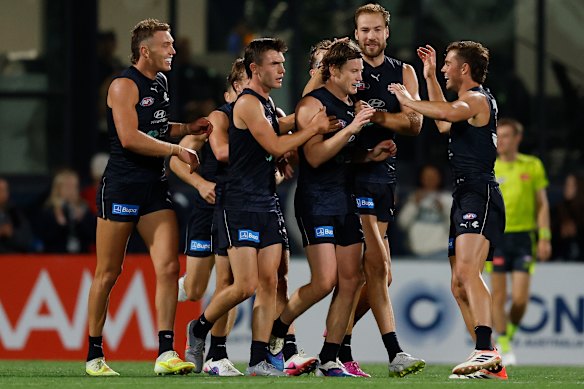
New Blues: Carlton are in a regroup phase after losing some big names in the off-season.Credit: AFL Photos via Getty Images
Essendon’s road has been bumpy under Brad Scott, who is attempting a cultural rebuild in the face of Zach Merrett’s failed defection. It is a slow process for the Baby-step Bombers. Even if they surprisingly rose to a wildcard final, they’re not upending the best.
Melbourne have put the post 2021 premiership Demons to bed, as Max Gawn acknowledged. Petracca and Oliver’s exits, and new coach Steven King’s pressing of the reset button means they are in a position much like Carlton, ie, regrouping and not contenders.
The Bulldogs are harder to read than James Joyce’s Ulysses. They smash the weak. They haven’t beaten the strong, despite Marcus Bontempelli and Tom Liberatore’s heroics, Ed Richards’ rise and Sam Darcy’s freakish gifts. Until they defend successfully, they won’t see late September.
But the Dogs at least have the raw material to challenge.
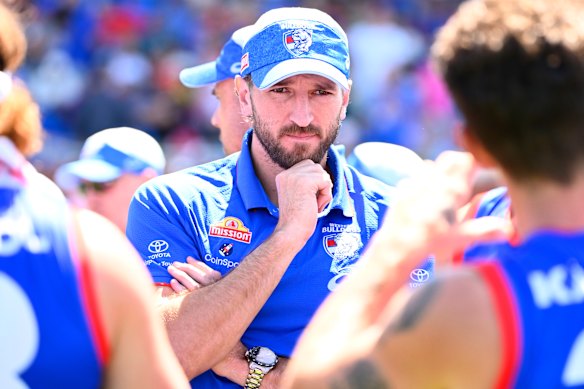
Ready to challenge: Marcus Bontempelli’s Western Bulldogs.Credit: AFL Photos via Getty Images
Hawthorn, fresh from consecutive finals series under Sam Mitchell, seemed ripe to press for their 14th flag. Will Day’s continued foot and shoulder ailments, alas, is a major impediment to a preliminary or grand final berth. Had they somehow landed Merrett – harder than landing on Mars, in retrospect – they would have coverage in the middle, where Jai Newcombe is the sole A grader, sans Day.
By dint of their risqué recruiting, when Tom De Koning, Sam Flanders, Liam Ryan and Jack Silvagni landed for near enough to $4 million, the Saints have, unexpectedly, become the most compelling storyline of the Victorian contingent. They have quietly accumulated young talent, and should make the second week of the wildcard system (ie, top eight).
In the 60th anniversary of that solitary premiership, it would be asking too much for the Saints to take the grail. They’re not ready.
North Melbourne’s progress has been so laboured that the natives – and some of the 1990s crew – are losing patience. This year, the story is about Alastair Clarkson, as he runs out of runway.
Of the Victorian 10, that leaves the team that has defied the draft’s gravity for so long that we take for granted they’ll hang around: Geelong.
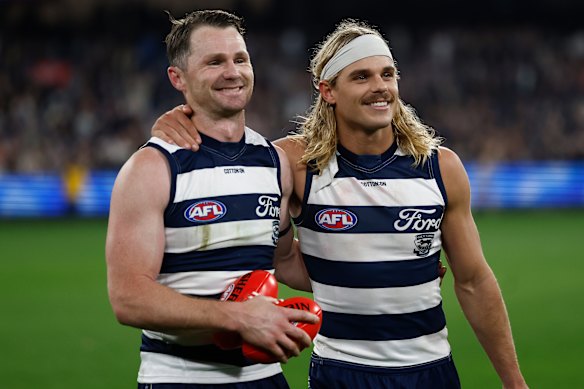
Cats captain Patrick Dangerfield with Bailey Smith.Credit: AFL Photos via Getty Images
The Cats can remain thereabouts, having steadily infused an ageing list with younger players. The difficulty for Chris Scott is that they can’t extract more from Patrick Dangerfield, Jeremy Cameron or Tom Stewart. Bailey Smith’s career season might not be repeated. The growth will need to come from others.
Compare the Victorian prospectus to what we once called, with unconscious bias, as “the interstate clubs”.
Brisbane’s abundance of talent, maturity and scope for improvement – aided by recruits Oscar Allen, Sam Draper and Daniel Annable – puts the Lions in the best spot on the grid. Will Lachie Neale’s personal issues drag them down? Unlikely. They won the grand final and navigated the first half without him.
Behind the Lions are two other northern state clubs, Sydney and Damien Hardwick’s Suns.
Sydney are poised for a rebound in Dean Cox’s second year, having returned to the proven playbook of purloining a key forward from the Melbourne fishbowl. Charlie Curnow will provide the avenue the Swans have not had since Lance Franklin’s final season. Tom Papley and Callum Mills were injured for much of 2025, and will be de facto recruits, too.
The Gold Coast midfield of Matt Rowell, Noah Anderson, Touk Miller and the luxury item of Petracca shapes as the competition’s most formidable when Rowell is back after the early rounds. Hardwick has serious talent at his disposal, much of it generated by the academy. An all-Queensland grand final, a fantasy two years ago, is well within the bounds of possibilities.
Fremantle have set the table for success, too. They have a core of players moving into their prime, headed by Victorian trio Caleb Serong, Hayden Young and Andrew Brayshaw. They should be inside the top six in ’26.
Adelaide’s minor premiership was unwound by dismal finals performances. Yet, they, too, should be a finals team. Midfield quality, outside of Jordan Dawson and (sometimes) Izak Rankine, was their undoing last September.
GWS have a list with enough quality to compete for the flag. Their pre-season, alas, has included a worrisome toll of injury, headed by Tom Green’s season-ending knee and Sam Taylor’s bothersome hamstring.
Port Adelaide are another club that has bought time to regenerate by changing coaches. They aren’t in the premiership window. West Coast are perhaps the furthest away of any club.
The overriding point is that the Victorian teams are either rebuilding (Richmond, Essendon), regrouping (Melbourne, Carlton), overripe (Collingwood), unreliable (the Bulldogs) or have been beset with a critical injury (Hawthorn). Or, as in St Kilda’s case, they’re not as talented yet as the Lions, Suns, Swans or Dockers.
The fixturing in the final rounds will be a signpost to September, and it would be surprising if Thursday and Friday night slots were again allocated to clubs with fan bases far more powerful than their on-field personnel.
Keep up to date with the best AFL coverage in the country. Sign up for the Real Footy newsletter.