Source : the age
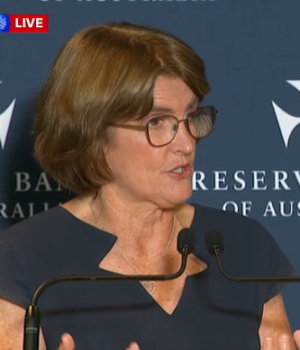
Reserve Bank of Australia governor Michele Bullock is speaking after the bank’s board raised interest rates for the second time this year.
The Reserve Bank has lifted official interest rates by a quarter of a percentage point, in a decision that will add about $100 a month to the repayments on a $600,000 mortgage.
Inflation in the economy was too high before the conflict in the Middle East rose petrol prices, Reserve Bank governor Michele Bullock has said.
“Higher petrol prices will add to inflation, but they’re not the reason for today’s decision. Inflation was already too high, reflecting the fact that demand is outstripping supply, higher fuel costs will not slow demand enough on their own to address this,” Bullock said after the bank raised interest rates this afternoon.
“If we do not act, these price pressures will spread and the eventual adjustment would be harder,” she said.
“ The Board concluded that the cash rate was not at a level consistent with returning inflation to target within a reasonable time frame. If the Middle East conflicts get worse or are not resolved soon, higher fuel costs will push inflation here even higher.”
Shadow treasurer Tim Wilson has accused Labor of denying the impact that government spending is having on inflation, saying that Treasurer Jim Chalmers needed to show “some humility” in the face of rising inflation.
“What we need from the government, and from Jim Chalmers particularly, is some humility and acknowledgement of the responsibility the government has in causing this inflation crisis and the increase in interest rates,” Wilson said.
“What we’ve heard from the treasurer today in his press conference is that he is in a complete state of denial of the contribution that the federal government is having to increase interest rates. They continue to pour debt petrol on the inflation fire. There is denial about the contribution the federal government is making.”
Chalmers said during his press conference this afternoon that the Reserve Bank had not pointed to public spending as a major cause of inflation.
Reserve Bank of Australia governor Michele Bullock is speaking after the bank’s board raised interest rates for the second time this year.
The government is not anticipating a need for fuel rationing, Treasurer Jim Chalmers says, noting that the consumer watchdog received confident feedback from fuel suppliers at a meeting today about the state of fuel supply moving forward.
“Now, obviously there’s a lot of volatility and unpredictability and how this plays out through the coming weeks and months, but that outcome [fuel rationing] is not something that we’re anticipating,” Chalmers told reporters this afternoon.
“Ships are arriving. We’ve got very substantial stockpiles. We’ve released more into the system. We’ve relaxed the fuel standards, and so there is a level of confidence that we will avoid that situation that you are describing.”
Chalmers said a meeting between fuel suppliers and the Australian Competition and Consumer Commission this morning offered a positive outlook for national fuel supply.
Treasurer Jim Chalmers has said that shadow treasurer Tim Wilson will “tell all kinds of lies” in the coming days about the impact of government spending on inflation, as the Coalition accuses the government of poor economic management.
“Obviously, my opposite member will tell all kinds of lies about this in the course of the rest of the day. But I refer you to the [Reserve Bank’s] statement,” Chalmers said.
“The statement, when it comes to government spending, says growth in private demand strengthened substantially more than was expected in mid-2025, and that, in the statement, is why they attribute the higher capacity pressures towards the end of last year. That’s the way that I’ve described it as well.”
Chalmers also said the RBA had made the decision based on both inflation that was already in the economy, and the impact of conflict in the Middle East.
“Clearly the bank is responding to both, and not just one or other – not just the pre-Iran situation, but the pre- and post-Iran situation – including what’s happening in petrol markets.”
Jim Chalmers has backed the government’s cost of living measures while being questioned on the difficulty of increased mortgage payments that many Australians will face following today’s announcement.
“For every $500,000 that people owe, it means about $79 a month. And so that is substantial additional pressure on household budgets, which are already stretched. I acknowledge that,” Chalmers told journalists.
“What we’ve tried to do as a government, and what we’ve done as a government really over the course of the last three-and-a-half years, is not just to recognise these pressures that people are under, but to act on them, to respond to them in a number of different ways,” he said.
“Whether it’s cheaper medicines or more bulk billing or student debt relief, or most particularly, the tax cuts, which, when you add the three tax cuts together, they’re about $50 a week for the average worker. We’ve tried to do what we can to anticipate and respond to these cost of living pressures, which are real.”
Treasurer Jim Chalmers says the conflict in the Middle East is having a negative impact on an Australian economy already struggling with inflation.
“These global risks are very substantial. We’re not immune from them, but we are better placed than most to deal with them. And I’ll have a bit more to say about that in the main pre-budget speech that I’m giving on Thursday in Melbourne,” Chalmers said as he addressed the media following this afternoon’s rate rise.
“But the main point from this decision is that we know we had an inflation challenge already in our economy. Developments in the Middle East are already making that challenge harder, rather than easier.
“The Reserve Bank board has taken this decision independently today to increase interest rates in the face of those pressures, but also [this] very substantial global economic volatility and uncertainty.”
Treasurer Jim Chalmers is holding a press conference Parliament House in Canberra after the Reserve Bank of Australia raised interest rates by a quarter of a percentage point.
The Australian sharemarket bounced back after the Reserve Bank moved to hike interest rates as the fuel shock from the Iran war adds to inflation pressures.
Though widely anticipated, today’s rate rise was a split decision, with four of the central bank’s nine board members in favour of keeping rates steady.
The S&P/ASX 200 added 18.20 points, or 0.2 per cent, to 8601.60 as of 2.45pm AEDT, with seven of its 11 sectors in the red. Interest rate-sensitive stocks such as retailers and tech companies were lower, while the Big Four banks advanced.
The Australian dollar was trading at US70.51¢.
Investors are looking to comments by RBA governor Michele Bullock at 3.30pm AEDT for clues on a potential further rate hike in May.
Shadow treasurer Tim Wilson has blamed today’s interest rate rise on the government’s “active inflation agenda”, saying Treasurer Jim Chalmers was taking the country in the opposite direction of the rest of the world.
“Twelve months ago the treasurer said Australia had turned the corner on inflation and
interest rates, but [Australian Bureau of Statistics] data shows that the treasurer doesn’t understand that by pouring debt petrol on the inflation fire he is stoking it,” Wilson said in a statement.
“The treasurer will blame international factors, but Australia’s inflation problem was reported in the December data from Canberra, not March in Tehran,” the Liberal frontbencher said, referencing the ongoing conflict between the US, Israel and Iran.
“Australians are living the consequences of the treasurer’s inflation denial. When Australians pay their mortgage or go to the supermarket, they feel the consequences of Jim Chalmers’ active inflation agenda whether he acknowledges it or not”.