
Source : THE AGE NEWS
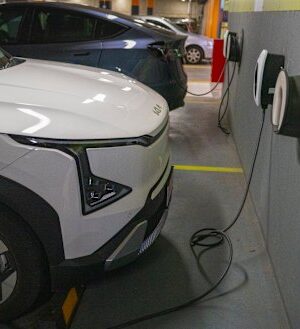
A line of electric vehicles (EVs) plugged into rechargers as their drivers wait patiently for their batteries to be topped up has become a familiar sight at many service stations. While some of the latest EVs can recharge in 20 minutes or so, many take much longer. Yet some EV drivers could soon be back on the road much more quickly. Companies are developing ultra-fast charging systems which can refill a battery in almost the same amount of time as it takes to top up a fossil-fuel car. Rapid recharging could dispel the last remaining obstacles to widespread EV adoption.
One such system will be unveiled in Paris on April 8th by China’s BYD, the world’s biggest EV maker. It consists of a powerful 1,500 kilowatt (kW) drive-through charger, which looks like a large overhead gantry from which recharging cables descend. When plugged into a Denza Z9GT, BYD’s new premium model, the car’s 122 kilowatt-hour (kWh) “Blade Battery” can be boosted from 10 per cent capacity to 70 per cent in five minutes. The car can be fully charged in nine minutes.
Topping up an EV battery requires a charger to convert alternating current, as delivered from the mains, into a direct current, which is the type used by batteries. A charger contained in the cars themselves can handle slow overnight charging when plugged into a household supply. For quick top-ups, much beefier kit is required. This is contained in public fast-chargers, which convert power directly from the grid, bypassing the charger in the car. This allows more power to be pumped into the battery more quickly.
There is, though, a limit to how fast a lithium-ion battery, the type commonly used in EVs, can be recharged. When the battery is plugged in, charged particles called lithium ions migrate from the cathode to the anode, where they are squirrelled away and stored. When the battery is discharged, the ions migrate back. The difficulty is that as the charge rate increases, bottlenecks can build up in the flow of ions, particularly into the anode. This creates resistance which produces damaging heat.
BYD says its Blade Battery uses cathodes and anodes that have been engineered at the molecular level to allow ions to flow more readily. In part this is done using thin battery components, which reduce internal resistance. For these batteries to live up to their potential, BYD will need to install its mighty 1500kW chargers at service stations, where most existing fast-chargers operate at 100-350kW. BYD aims to install its big chargers globally and expects to have 20,000 operational in China by the end of the year.
Nyobolt, an energy-storage company spun out of the University of Cambridge, in Britain, has taken a less daunting approach to the same problem. The 35 kWh battery it has installed in a lightweight sports car can, when plugged into an existing 350kW fast-charger, be boosted from 10 per cent capacity to 80 per cent in under five minutes. Although the battery has a small capacity by today’s standards, the light weight of the car means it can still provide a range of around 250km. The company can also produce bigger versions.
Like BYD, Nyobolt overcomes the internal resistance problem by redesigning the electrodes. Its anodes are built out of a proprietary form of niobium-tungsten oxide, which allows ions to enter and leave much faster, increasing the charge rate.
Nyobolt already supplies batteries equipped with these anodes for use in data centres, which require fast-charging batteries to smooth out huge swings in power demand. The company also recently signed a deal with Symbotic, an American firm, to equip its warehouse robots with fast-charging batteries, allowing the bots to spend more time working. Nyobolt is talking to a number of vehicle manufacturers about using its batteries.
These increases in speed come with a cost. One consequence of fast charging is that the added strain on batteries can lead them to lose their capacity more quickly than with regular charging. Engineers are also getting on top of that problem. Sai Shivareddy, Nyobolt’s boss and co-founder, says its batteries have been tested with more than 4,000 fast-charging cycles, equivalent to a car travelling around one million kilometres, while retaining more than 80 per cent of its capacity. BYD says its battery will also have enhanced durability. However it comes about, the opportunity to relax with a coffee or take a nap while your EV recharges may soon be a thing of the past.
The Economist
The Business Briefing newsletter delivers major stories, exclusive coverage and expert opinion. Sign up to get it every weekday morning.


