
Source : INDIA TODAY NEWS
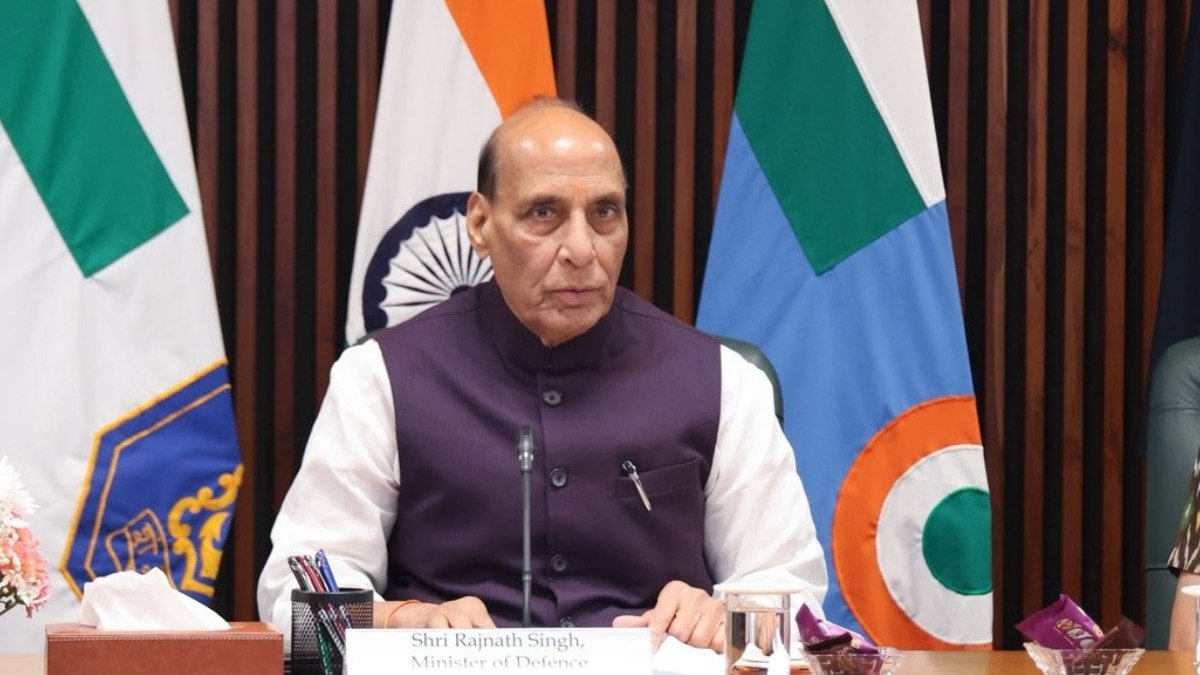
Defence Minister Rajnath Singh on Friday hinted at the impending launch of INS Aridhaman, India’s third indigenously built nuclear-powered submarine, in a post on X, writing: “Its not a word, its power, ‘Aridhaman’!” Equipped with longer-range missile capability, INS Aridhaman is expected to bolster India’s sea-based nuclear deterrence, enhancing both strike potential and survivability in line with the country’s nuclear doctrine.
advertisement
INS Aridhaman has successfully completed its final phase of sea trials and is set to join the Strategic Forces Command, following in the footsteps of its predecessors INS Arihant (commissioned in 2016) and INS Arighaat (commissioned in August 2024).
The announcement coincides with Singh’s visit to Visakhapatnam, home to India’s nuclear submarines, where he is scheduled to commission the indigenously built advanced stealth frigate Taragiri today. Visakhapatnam serves as both the construction hub and current home port for India’s SSBN fleet.
ALL ABOUT INS ARIDHAMAN’S CAPABILITIES
Displacing around 7,000 tonnes, Aridhaman is slightly larger than its predecessors and features a more streamlined hull for improved stealth and acoustic performance. The submarine is powered by an upgraded 83 MW pressurised water reactor (PWR) developed by the Bhabha Atomic Research Centre (BARC).
Unlike its predecessors, Aridhaman is equipped with eight vertical launch tubes, double the capacity of INS Arihant, enabling it to carry either eight K-4 long-range missiles with a 3,500 km range or up to 24 K-15 missiles with a 750 km range.
The induction of INS Aridhaman will allow India to maintain “continuous at-sea deterrence,” ensuring that at least one nuclear-armed submarine is on patrol at all times.
SSBNs (Ship, Submersible, Ballistic, Nuclear vessels) provide India with assured second-strike capability: even in the event of a devastating first strike on land-based silos and airbases, an SSBN lurking deep underwater can deliver a retaliatory nuclear strike, making any first strike against India suicidal for an aggressor.
Currently, India operates two SSBNs, INS Arihant and INS Arighaat, with Aridhaman poised to be the third. A fourth, still unnamed SSBN, is planned to follow soon after.
With a fleet of four, the Indian Navy would achieve true second-strike capability, allowing one submarine to remain on patrol at all times while others undergo maintenance, transit, or serve as reserve vessels.
Earlier last year, Navy Chief Admiral Dinesh K Tripathi had also indicated that the submarine would be commissioned between April and May, confirming in December 2025 that it had entered the final stages of trials.
TARAGIRI SET TO JOIN INDIAN NAVY’S FRONTLINE
Powered by a Combined Diesel or Gas (CODOG) propulsion system, the Taragiri offers high-speed, long-endurance performance suitable for multi-dimensional maritime operations.
Taragiri represents a generational leap in design, featuring a sleek hull and a significantly reduced Radar Cross-Section that allows it to operate with enhanced stealth.
Its armament includes supersonic Surface-to-Surface Missiles, Medium-Range Surface-to-Air Missiles, and an advanced Anti-Submarine Warfare suite, all integrated via a state-of-the-art Combat Management System for rapid threat response.
Beyond combat readiness, Taragiri is designed for versatility, capable of undertaking high-intensity operations as well as humanitarian assistance and disaster relief (HADR) missions.
The vessel reinforces the Indian Navy’s position as a combat-ready, self-reliant force, safeguarding the nation’s maritime interests. As a symbol of India’s rising maritime power, Taragiri stands as a testament to ships designed, built, and operated entirely by Indians.
– Ends
With inputs from Manjeet Singh Negi
Must Watch
SOURCE :- TIMES OF INDIA