
SOURCE :- THE AGE NEWS
Big Fords and Chevrolets idled like junkies hanging out for a fix.
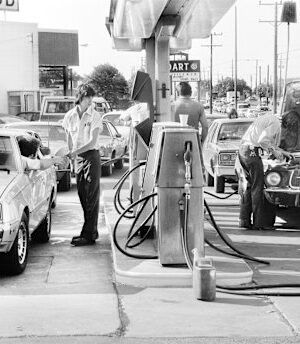
Opportunist students offered to jockey cars through endless gasoline-station queues for a few dollars, freeing frustrated drivers to line up at phone booths to cancel business appointments.
More kids turned up on roller skates hawking drinks to drivers fuming in the queues.
An odds and evens rationing system prevailed: cars with number plates ending in odd numbers lined up for fuel on the odd days of the month, and vice versa.
The dreaded word ‘Iran’ was on everyone’s lips.
Someone called an ayatollah had turned the world and its fuel supply upside down.
How easily the past slots into the present.
How easily we forget.
It was 47 years ago.
Ever since then, US presidents – with the notable exception of George W. Bush and his adventure in Iraq – have observed some caution in the knowledge that various countries in the Middle East, and Iran in particular, if pressed, could seek to shred the West’s economies by simply turning off the crude oil supply.
Every president, that is, before Donald Trump.
Every military strategist since the lessons of the 1970s worried that if Iran was really hunted into a corner, it could, and probably would, close the Strait of Hormuz to ensure ships carrying oil to a fuel-hungry US and its allies would lie becalmed.
Every military chief, that is, before Fox News entertainer Pete Hegseth named himself secretary of war, thus requiring an actual war to justify his conceit.
I was living in Los Angeles in 1979 when Iran gave the world – and the US in particular – its second oil shock in six years, causing those exotic lines at gasoline stations. Both periods proved economically disastrous for Western countries.
Neither, however, was as crippling as the current mess, as Australian motorists, farmers and businesspeople are beginning to recognise.
Never before has Iran so thoroughly closed the Strait of Hormuz, effectively tying up almost one-fifth of the world’s crude oil supply.
That took the combined efforts of Trump’s unbridled ego, Hegseth’s negligence and Iran’s maddened mullahs to achieve.
And limited memories.
The first of the oil shocks came in 1973 when members of the Organisation of Arab Petroleum Exporting Countries (OAPEC) placed an embargo on the US and other countries that supported Israel in the Yom Kippur War against an Arab coalition led by Egypt and Syria.
Australia under Gough Whitlam, it happened, adopted a policy of strict neutrality during that war, causing howls of protest from Israel and Australian Jewish leaders. It didn’t save Australians – as always captive to US circumstances – from their own fuel shortages and lines at the pumps, naturally.
Oil prices quadrupled from $US3 a barrel to $US12, plunged the Western world into a deep recession combined with high inflation and shifted the globe’s strategic balance from overwhelming Western economic power to the rise of oil-producing states.
The 1973 crisis also prompted much of Europe and Scandinavia to begin a profound transition from oil-dependency towards sustainable energy.
Denmark, for instance, whose king and queen visited Australia this week, relied almost completely on oil in 1973. Now, it produces almost 90 per cent of its energy from renewable sources, from biomass to wind and solar and hydro.
America chose Band-Aid measures.
The speed limit was reduced to 55mph, US oil producers were encouraged to pump more oil, and American carmakers began trimming the size of their vehicles.
By 1979, however, it felt in the streets of Los Angeles that the lessons had been all but forgotten, except the urge to panic buy.
Middle America was rich again – and the cars were big guzzlers.
Why, even as those gas-station lines snaked around the block, their motors continued running to keep drivers air-conditioned.
It was estimated later that each of those cars used around two to three litres for every hour they idled, squandering up to 150,000 barrels of oil a day.
I learnt something of America’s abiding love for big motors when I insisted on renting a smallish car for a trip along the coast between Los Angeles and San Francisco. A fellow customer, a large American, snorted as if I were spitting on the American dream. Little cars, he sneered, were for little people. I felt smug a few days later when the oil crisis hit.
The 1979 shock followed the Iranian Revolution after the US-supported Shah Mohammad Reza Pahlavi fled. With Iran’s monarchy gone, the Islamic cleric Ayatollah Ruhollah Khomeini assumed leadership.
Turmoil accompanying the revolution disrupted Iran’s oil production, causing the loss of about 4.8 million barrels of crude a day, or 7 per cent of the world’s supply.
The Strait of Hormuz, however, remained open, and extra sources of oil from elsewhere in the world soon reduced the global shortage to just 4 per cent.
Nevertheless, amid panic buying and hoarding of inventories by crude-oil buyers, oil prices rose from $US13 a barrel in mid-1979 to $US34 a barrel 12 months later.
Energy anxiety sank deeper into American hearts when, just as the oil shortage began, the Three Mile Island nuclear plant in Pennsylvania suffered a partial meltdown.
By the end of 1979, when Iranian revolutionaries seized the American embassy and took hostages, US president Jimmy Carter imposed an embargo on Iranian oil.
The result? Another deep recession. And Jimmy Carter lost the presidency.
Many Americans went into denial.
About the time those queues at fuel stations were longest, Associated Press and NBC News polled 1600 Americans and found 54 per cent of them thought energy shortages were a hoax.
All these decades later, a US president who ordered an all-out attack on Iran for reasons that keep changing is incandescent with rage that Iran went rogue and blocked the Strait of Hormuz.
After a year insulting allies and hitting them with tariffs, Trump is indignant that those former friends are reluctant to help him out of his jam.
Meanwhile, American motorists in their giant trucks and SUVs, having ignored the past, and Australians who fear our meagre stocks are running out, grow angrier by the day.
The world can be pretty sure, if history is any guide, that a recession or worse is on the way.
Start the day with a summary of the day’s most important and interesting stories, analysis and insights. Sign up for our Morning Edition newsletter.
 Tony Wright is an associate editor and special writer for The Age and The Sydney Morning Herald.Connect via email.