Source : ABC NEWS
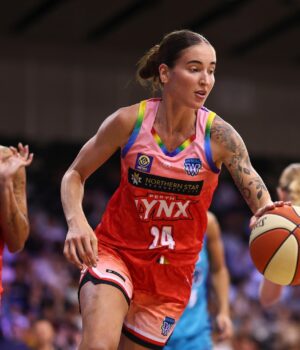
Anneli Maley has always felt like basketball provides a space she can be her full self.
“Women for the longest time have had to fight to be seen and so we know what it’s like to not be welcome in a space,” she said.
“Women’s basketball does a great job with inclusion, not just on the court but in the stadium.
“And I think that’s something the men’s sports can take from what we do.”
The celebration of the queer community has become a fixture in many women’s sporting competitions, with a large number of openly gay, bisexual, and non-binary athletes.

The Hobart Hurricanes hosted their own WBBL Pride game late last year. (Getty Images: Steve Bell)
“Fans of and participants in women’s sports are rightly proud of the inclusive environments they have created,” Pride Cup CEO Hayley Conway said.
“Leagues and clubs should be doing more to learn from and expand these inclusive practices rather than sticking to the way things have traditionally been done.”
She also warns that spirit of inclusion needs to be retained in the face of increased investment and attention.
“When sport is a big brand and a big industry it can start to push women or people of colour back into a frame where they are less welcome to be themselves,” she said.
“What they want from them is to shut up and kick the ball … rather than to be their whole selves, which is something that women and non binary people have been able to do in sport for decades now.”
Need for visible role models
A national survey from Pride Cup, Pride in Sport and PwC Australia found half of LGBTQ+ athletes felt more comfortable with their sexuality thanks to their involvement in women’s sport.
And close to half felt more comfortable with their gender.
But it also highlighted challenges, with 31 per cent of respondents saying they have experienced bullying, harassment, or offensive behaviour because of their sexuality or gender.
The participants came from all levels, with the majority from community sport, followed by the representative level.
Similarly, ABC’s Elite Athletes in Australian Women’s Sport Survey, which polled 152 elite athletes across 47 sports, found 34 per cent have been discriminated against due to their sexuality or gender identity, and 63 per cent had witnessed it.
While not representative of all athletes, it echoes other research in this space.
Nikki Ayers won a gold medal with partner Jed Altschwager at the Paris 2024 Paralympics, but has since taken a break from sport.
“As a disabled queer woman, my experience has been that I haven’t always felt safe and a reason for that is there hasn’t always been a visible role model or a visible representation within the sporting community,” she said.
Nikki Ayers teamed up with Jed Altschwager at the Paris 2024 Paralympics to win Australia’s first ever rowing gold medal. (Getty Images)
Ayers described times where she let people assume her ex-wife was a man, for fear of revealing her sexuality.
“There was unfortunately some homophobia that I’ve experienced and that didn’t make me safe enough to be who I was,” she said.
An anonymous respondent to ABC’s survey shared that the discrimination can often extend beyond the playing field.
“Pride rounds are important rounds to promote visibility and the power of storytelling. However, when these stories or content around this round goes out online, it allows people to post harmful or derogatory comments on the specific posts. Seeing people write comments attacking myself and other girls for our sexuality can hurt sometimes. Comments like these proves why these rounds are still so important for the LGBTIQA+ community.” – Aussie Rules player
Conway says while men may typically experience more overt displays of discrimination, it can be more insidious for women.
Pride Cup CEO Hayley Conway (left) alongside Adelaide United captain Ella Tonkin during this year’s A-Leagues Pride celebration. (Getty Images: Photo by Maya Thompson)
“We hear women players often talking about being scared of being outed or being scared of being told that they are a lesbian, whether they are or aren’t, because they haven’t figured that out about themselves yet,” she said.
“Homophobia looks different for women, but it is equally damaging and really difficult and challenging for them.”
Ayers has been proactive in creating change, including as an AIS Thrive with Pride ambassador, working with organisations to form inclusive policies, and provide education to other athletes.
Ayers wants to be a role model for others. (ABC News: Tony Hill)
“It brought a real sense of purpose for me in being able to advocate for myself, for my community … that you can be your true authentic self and you can be successful at the elite level in sport.“
Transgender women’s inclusion
The debate around transgender women’s inclusion in sport continues to rage in public forums, despite overall low levels of participation.
The IOC is expected to release new guidelines soon, tipped to ban their participation at the Olympics, while the Australian Sports Commission’s guidelines advocate for an inclusion-first approach.
The athletes who responded to our survey had mixed responses when it comes to non-binary people and trans women’s inclusion.
An anonymous respondent from a smaller sport said their organisation is trying to form a policy for non-binary and trans athletes, but “there is very little education for new coaches surrounding this topic”.
Several respondents suggested the creation of a separate category for trans women at the elite level, and some raised concerns over perceived biological advantages.
“I think that it is an unfair position for both parties to be in and I can’t imagine being excluded from competing in my sport because of my gender identity,” an athlete wrote.
“But I also would feel very discouraged by losing potential opportunities to someone who was born male.”
Another respondent said they have witnessed athletes in their sport experience transphobia with the “most disgusting things said about them”.
“Those women have always been the kindest most respectful players and I consider some of them like family now. They understand there are biological physical differences but they have never used that to leverage themselves against less experienced players. They play smart, they play fair but they also understand that in the current climate it is not realistic for them to compete beyond regional level teams.” – Volleyball player
The Pride Cup/Pride in Sport survey found over half of gender diverse respondents felt their club was completely supportive of trans people participating at their level.
Although many shared that this support didn’t extend to the sport more broadly.
“Being specifically recognised and treated as a woman, rather than just tolerated, has made such a positive impact on my life and mental health. I am more comfortable in my gender because the people in my sport treat me with comfort.” – Hockey player
“It’s honestly perplexing just how much focus there is on this handful of people playing community sport and just hanging out with their friends,” Conway said.
“For most community clubs who either have trans women in the group or who play against trans women, they have absolutely no reason to be opposed to them.”
Maley is supportive of their participation at the elite level too, and says more time should be spent addressing other issues in women’s sport.
Loading Instagram content
“The biggest threats to women’s sport is not trans women. It’s actually men thinking that it’s trans women,” she said.
“Because can you name five WNBL players? Have you been to a WNBL game? Have you bought a WNBL membership? Do you go watch local women’s sporting clubs?
“That is the biggest area that we need to grow.
“Trans women have a space in women’s sports, 100 per cent.“
Why Pride Rounds matter
Pride rounds and games are increasingly common across many sports from the grassroots through to the elite level.
Conway says previous research they have conducted with Monash University shows just how impactful they can be.
“Homophobic behaviour in a club is reduced by 50 per cent after the playing of one pride game,” she said.
The Australian Open has celebrated Pride Day for the past eight years. (Getty Images: James D. Morgan)
“And that’s the combination of inclusion, education and the choosing to wear a rainbow jersey or something that represents what your team stands for and your shared values of inclusion for everyone.
“When they happen in elite environments, they’re also an opportunity for players and for fans to say this is actually what we stand for as an entire community.
“Every club, every performance environment is made better when people feel more able to be themselves.
“So when clubs don’t invest in pride rounds, in other inclusion initiatives, they’re taking away something that could actually really help their players perform to another level.”
The AFLW has hosted six league-wide Pride Rounds. (Getty Images: Mark Metcalfe)
That strikes a chord with Ayers.
“For me it’s about being visible and being out there and sharing my story and experience, so kids don’t have to grow up and have the experience that I had, thinking that it wasn’t OK to be different,” she said.
“Instead they can look up and say ‘hey, here’s Nikki, she’s a person with a disability, she’s a queer person and she won a gold medal. That could be me, it is OK to be me.'”
This story is part of the ABC Elite Athletes in Women’s Sport Survey.