
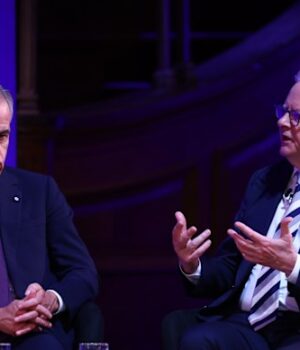
source : the age
March 1, 2026 — 1:30pm
When Canadian Prime Minister Mark Carney addresses a joint sitting of parliament in Canberra on Thursday, he will, no doubt, make a plea for middle powers such as Canada and Australia to work more closely together in the face of disruptions to the world order. He can be expected to reprise some of the themes of his instantly famous speech at the World Economic Forum at Davos in January.
Leaders of other important democracies (notably, Donald Trump) also spoke at Davos, but it was Canada’s prime minister who grabbed the world’s attention – not just by the erudition of his remarks, but by their unsparing candour. While European leaders hedged their words with careful euphemisms about threats and challenges to the rules-based global order, Carney dismissed such diplomatic legerdemain as “a pleasant fiction”.
Criticising the “strong tendency for countries to go along to get along, to accommodate, to avoid trouble, to hope that compliance will buy safety”, he bluntly warned his fellow leaders: “Well. It won’t.” Rather, he declared, the world faced “the beginning of a brutal reality, where geopolitics among the great powers is subject to no limits, no constraints … Let me be direct. We are in the midst of a rupture, not a transition.”
In years to come, the speech may come to be seen as a defining moment. (It certainly reads as if it were written with one eye on the history books.) Its impact was, to a degree, attributable to Carney’s gravitas and prestige. He is unusual among world leaders in being at once a political neophyte – he was shoe-horned into the prime ministership from outside parliament by Canada’s Liberal Party – and a well-established member of the so-called global elite.
It is unimaginable that Anthony Albanese could have made such an impression: someone whose biggest job before he was an MP was assistant secretary of the NSW branch of the Labor Party is never going to speak with the authority of a former governor of not one but two of the world’s leading central banks (the Bank of Canada and the Bank of England).
Whatever one may think of Carney’s analysis, the powerful impression it made typified the significant influence, disproportionate to its size, which Canada has on shaping the dialogue of global politics. It is the smallest member of the G7 in both population (42 million) and by GDP. Its armed forces (68,000 full-time personnel) are only slightly larger than Australia’s (61,000). Canada’s contribution of intelligence product to the Five Eyes is roughly the same as ours. According to the latest World University Rankings, it is home to only three of the world’s 100 highest-rated universities. (Australia has six.)
Canada’s outsized influence in global politics is largely due to its soft power: its reputation as a good global citizen, with a deep-seated commitment to internationalism. Only last week, the UK’s leading conservative magazine, The Spectator, described Canada as “the moral leader of the middle powers”. For instance, by one of the few empirically reliable measures of soft power – foreign aid – Canada’s contribution is one of the world’s largest in per capita terms, almost double that of Australia (0.33 per cent of gross national income versus 0.18 per cent).
In the decades after World War II, Canada was also important because geopolitics had a largely Atlantic focus. The division of Europe between NATO states and the nations of the Warsaw Pact was the frontline of the Cold War. Although they fought proxy wars in Asia and elsewhere, Washington and Moscow glowered at each other across the Atlantic Ocean. Canada, as a significant NATO nation – both Anglophone and Francophone – was in every important conversation.
We no longer live in a predominantly Atlanticist world. Canada’s own National Security Strategy, launched in 2024, recognised: “The Indo-Pacific is rapidly becoming the global centre of economic dynamism and strategic challenge. Every issue that matters to Canadians … will be shaped by the relationships Canada and its allies and partners have with Indo-Pacific countries.”
In the era when the main fault line of geopolitics lay through the Western hemisphere, Canada’s leaders projected global influence – as they still do. In the 21st century, however, it is Australia – situated at the inverse apex of the Indo-Pacific – that finds itself in the most contested and strategically fragile region of the world.
Yet too many Australians – and an alarming number of politicians – still indulge the happy complacency inherited from the days when ours seemed a sequestered part of the globe, where crises happened on the other side of the world, and international politics were somebody else’s problem. In a sense, we still live in the long shadow of Donald Horne’s assessment of Australia as a mediocre, insular, unimportant nation. “Australians are anonymous, featureless, nothing-men,” he sourly wrote.
The Lucky Country was published in 1964. White Australia was still a bipartisan policy (until Harold Holt began to dismantle it in 1966), the word “multiculturalism” did not exist, and hardly any of the people Horne was describing are still alive. But there is one thing Horne said that remains as true today as it was two generations ago. Speaking of our engagement with Asia (although in very different circumstances), he wrote: “Australia’s problem is that it now exists in a new and dangerous power situation and its people and policies are not properly re-orientated towards this fact.”
Canada has, for decades, been an exemplar of how a middle power can also be a global leader – if it appreciates that its interests are international, not just regional, and addresses global issues with the authority that comes from seeing itself as an important player in the great game of geopolitics. There has never been a time when it was more important for Australia to do the same – and for our foreign policy to reflect that realisation.
George Brandis is a former high commissioner to the UK, and a former Liberal senator and federal attorney-general. He is a professor at the ANU’s National Security College.
 George Brandis is a former high commissioner to the UK, and a former Liberal senator and federal attorney-general. He is now a professor at the ANU’s National Security College.