
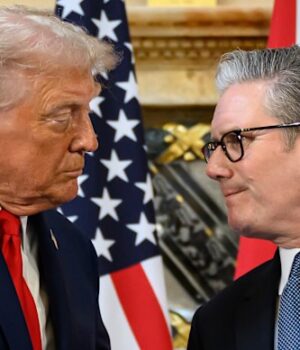
SOURCE :- THE AGE NEWS
London: Telling the truth to Donald Trump is a risk for any American ally who has a good relationship with the US president.
And it is even riskier when that ally is Keir Starmer, the British prime minister who is deeply unpopular with voters and may be gone by the middle of the year.
Starmer is being ridiculed in the British media over his stance on the Iran war after he refused to allow the Pentagon to use UK military airfields for its attacks. He is also being publicly rebuked by the president himself, who said “this is not Winston Churchill we are dealing with” and described the British as being “very, very un-cooperative” with the US attacks.
It is true that Starmer is no Churchill. And Trump is no Franklin Delano Roosevelt. Any parallel with the lions of the Second World War falls apart at a quick glance. Churchill did not blindly follow the US president. He persuaded the American president to change course.
The problem for Starmer is that he looks weak against the tyrants in Tehran because he refused to give Trump a blank cheque.
This is a familiar dynamic in any national debate about the alliance. Australia knows it. Canada experienced it when it chose not to join the US in the war in Iraq in 2003. France had the same debate the same year.
There is usually a relentless pressure to sign up to a president’s cause to save the alliance. The toughest thing to do is to offer some unwelcome common sense.
Starmer has landed in a tortured position on the war. He blocked the use of two bases on Saturday – Fairford in England and Diego Garcia in the Indian Ocean – but then saw the Iranian regime fire drones at civilian targets. On Sunday, he allowed the bases to be used for defensive purposes. This was legal casuistry because he cannot control what an American aircraft does once it takes off from an airfield.
Even so, his core argument about the war needs to be reported fairly and remembered in full context. So here is some of what he said in the House of Commons on Monday.
“The United Kingdom was not involved in the initial strikes on Iran by the US and Israel. That decision was deliberate,” he said. “President Trump has expressed his disagreement with our decision not to get involved in the initial strikes, but it is my duty to judge what is in Britain’s national interest. That is what I have done, and I stand by it.”
Starmer argued that it would have been better to keep negotiating with Iran. It is too soon to judge this argument because, so far, we only have conflicting messages from Trump and his top people about why the attacks were launched on Saturday. Were they justified? The answer may depend on how much you trust Trump. Clearly, Starmer does not trust him that much.
The most important thing Starmer said on Monday was that he was learning from history.
“We all remember the mistakes of Iraq, and we have learnt those lessons. Any UK actions must always have a lawful basis and a viable, thought-through plan,” he said. The implication was that Trump did not have a viable and thought-through plan. No wonder the president turned on the prime minister.
Later in the debate, when asked a question, Starmer made another key point: “This government does not believe in regime change from the skies.”
Long shadow of Iraq
The Iraq war of 2003 was a fiasco. It was founded on false claims that Iraq had weapons of mass destruction, it was encouraged by commentators who spread the falsehood, and it was framed by a central remark from US president George W. Bush in September 2001: “Either you are with us, or you are with the terrorists.” This made scepticism sound like treason.
Starmer is utterly lacking in political cunning and stumbles from one backflip to another. But he is not alone in his caution about this war. French President Emmanuel Macron, German Chancellor Friedrich Merz, European Commission President Ursula von der Leyen and others carefully avoid endorsing Trump’s decision to launch the strikes on Saturday, at the same time they condemn the Iranian leadership.
After the past two decades, the case for caution is overwhelming. Trump has sent mixed messages for days about how long the war will last and what his ultimate goal will be. He talks about regime change but later suggests he will stop destroying nuclear capabilities. After years of criticising the Iraq war, he now seems open to putting boots on the ground. He does not have a serious answer for the proposition – proven by recent history – that you cannot get regime change through an air war alone.
The Iranian regime deserves to fall. It slaughtered thousands of its own people in the protests in January. It enabled terror through its proxies for decades and spread instability throughout the Middle East. It is intent on the destruction of Israel, a mad violence that brings misery to its own people and the region.
Trump may gain a form of victory by weakening the Iranian regime to the point where it poses no threat to neighbours. But does he have a clear strategy that justifies the risks? The dangers include chaos and death inside Iran under a crumbling regime, a flood of asylum seekers into neighbouring countries, an energy crisis from the disruption of oil supplies, a curb on global economic growth and a surge in prices.
Anyone watching the US president in the White House on Monday learnt that he knows exactly what he wants in drapes. Nobody heard what, precisely, he wants in Iran.
Starmer may be dumped within months if his Labour colleagues finally agree on the candidate to replace him, so he is already being dismissed as a weak leader on his way to the political exit. But his reminder about Iraq was necessary. It was the hard, but smart, thing to say. The case for caution was shouted down in 2003. Two decades later, too many want to silence it again.
Get a note directly from our foreign correspondents on what’s making headlines around the world. Sign up for our weekly What in the World newsletter.
 David Crowe is Europe correspondent for The Sydney Morning Herald and The Age.Connect via X or email.

