Source : the age
By Billie Eder
Every Event. Every Medal in 4K.
Watch live & on demand.
Livigno: Ukrainian foreign minister Andrii Sybiha has slammed the International Olympic Committee, saying they intimidated and disrespected Ukrainian skeleton athlete Vladyslav Heraskevych before disqualifying him from competition on Thursday.
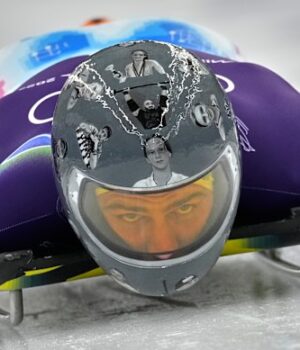
Heraskevych was disqualified after he vowed to ignore a ban that prohibited him from competing in a helmet that depicts more than 20 athletes who have been killed during the war with Russia.
Ukrainian athlete Vladyslav Heraskevych in a training sessionCredit: AP
“The IOC has banned not the Ukrainian athlete, but its own reputation,” Sybiha said on social media site X.
“Future generations will recall this as a moment of shame. He simply wanted to commemorate fellow athletes killed in war. There is nothing wrong with that under any rules or ethics.”
Rule 50 of the Olympic charter prohibits any kind of political, religious or racial demonstration at Olympic sites and venues.
“The IOC intimidated, disrespected, and even lectured our athlete and other Ukrainians on how they should keep quiet about ‘one of 130 conflicts in the world’,” Sybiha said.
“The IOC has also systemically failed to confront the greatest abuser of international sports and the Olympic Charter — Russia.
“A country that started three invasions during the Olympic Truce in the past three decades, implemented the largest state-funded doping program, killed 650 Ukrainian athletes and coaches, and damaged 800 sports facilities in Ukraine. These are Russians who must be banned, not the commemoration of their victims. None of them are ‘neutral’.”
The IOC said it had multiple in-person meetings with Heraskevych, and a final one with IOC president Kirsty Coventry on Thursday morning, but he would not back down.
Ukrainian President Volodymyr Zelensky said the ban did not adhere to Olympic values of fairness and peace.
“Sport shouldn’t mean amnesia, and the Olympic movement should help stop wars, not play into the hands of aggressors,” Zelensky wrote on X.
“Unfortunately, the decision of the International Olympic Committee to disqualify Ukrainian skeleton racer Vladyslav Heraskevych says otherwise… I thank our athlete for his clear stance. His helmet, bearing the portraits of fallen Ukrainian athletes, is about honour and remembrance.”
Heraskevych took to social media after the ban was announced with a short message: “This is [the] price of our dignity”.
“In time of full-scale war, some things are really more important than medals,” he said.
“I would say that a medal is worthless in comparison to people’s lives and, I believe, in comparison to the memory of these athletes.”
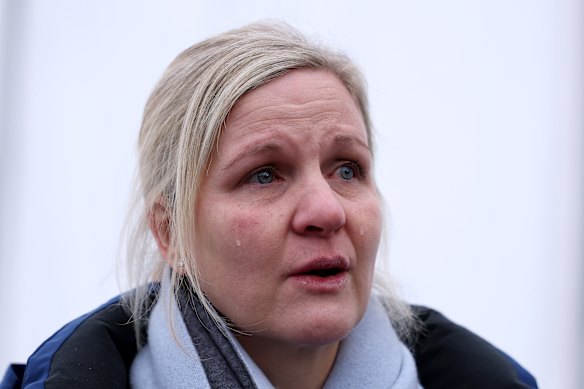
IOC president Kirsty Coventry in Cortina on Thursday morning.Credit: Getty Images
Coventry thanked Heraskevych and his father Mykhailo for meeting her on Thursday morning, but said rule 50 had been initiated by athletes to keep the field of play neutral.
“As you’ve all seen over the last few days, we’ve allowed for Vladyslav to use his helmet in training. No one, no one, especially me, is disagreeing with the messaging,” she said.
“The messaging is a powerful message of remembrance, it’s a message of memory, and no one is disagreeing with that. The challenge that we are facing is that we wanted to come up with a solution for just the field of play. I know he’s very quick, so for just two minutes to not wear the helmet on the field of play.”
Coventry said she would work with Heraskevych and ask leaders and governments for more help with generators (for power in Ukraine).
The IOC has continuously said that there are more than 130 conflicts in the world and that they can’t all be featured on the field of play.
At the IOC’s daily briefing, spokesperson Mark Adams was asked why the IOC wouldn’t allow demonstrations against Russia, when it was the only nation that had been banned from competition at the Olympics.
“Our actions against suspending the Russian NOC [National Olympic Committee] are for sporting reasons and for contravention of the Olympic charter. It’s clear that we have had, in the past, many issues with the Russian government, that’s for sure, in terms of Sochi and so on,” he said.
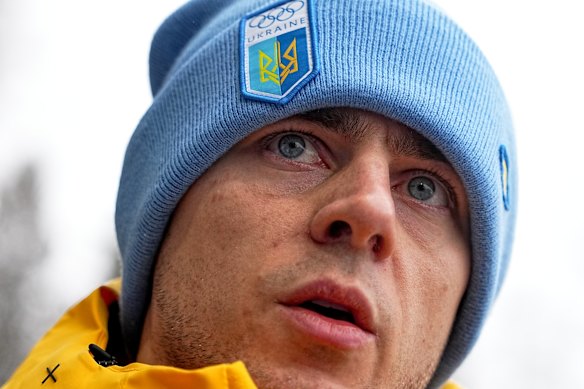
Ukrainian athlete Vladyslav Heraskevych in Cortina on Thursday.Credit: AP
Russia was banned from the Olympics after a years-long doping scandal was revealed, which stripped the country of 30 medals since 2008.
“But this particular issue, the suspension of the NOC is not a protest against the war,” Adams said.
“If we were starting to protest against wars, you would have maybe five NOCs here today. And in the Summer, probably even less.
“Because as a sporting organisation, once you start taking stands against wars and conflicts, there is no end.”
Adams said that nations were reminded of the rules regularly, and athletes were given space for remembrance and mourning.
“We would agree, remembrance is not a crime, and there’s even a place for remembrance in the athletes village…The difference here is that it was a deliberate act after many attempts of compromise,” Adams said.
“And in the end, sport without rules cannot function.”
The Winter Olympic Games is broadcast on the 9Network, 9Now and Stan Sport.
News, results and expert analysis from the weekend of sport sent every Monday. Sign up for our Sport newsletter.