Source : INDIA TODAY NEWS
As we saw, the chair in Delhi had already begun to wobble because of Tamil Nadu’s weather. But 1998 did not merely extend that story; it electrified it. In a neat coincidence of cinema and politics, Hollywood released Mercury Rising that year. India, meanwhile, was watching its own version unfold — with a mercurial Amma in Poes Garden, her temper, impatience and tactical volatility rising faster than Delhi’s comfort levels.
advertisement
The Northern Stair Shakes
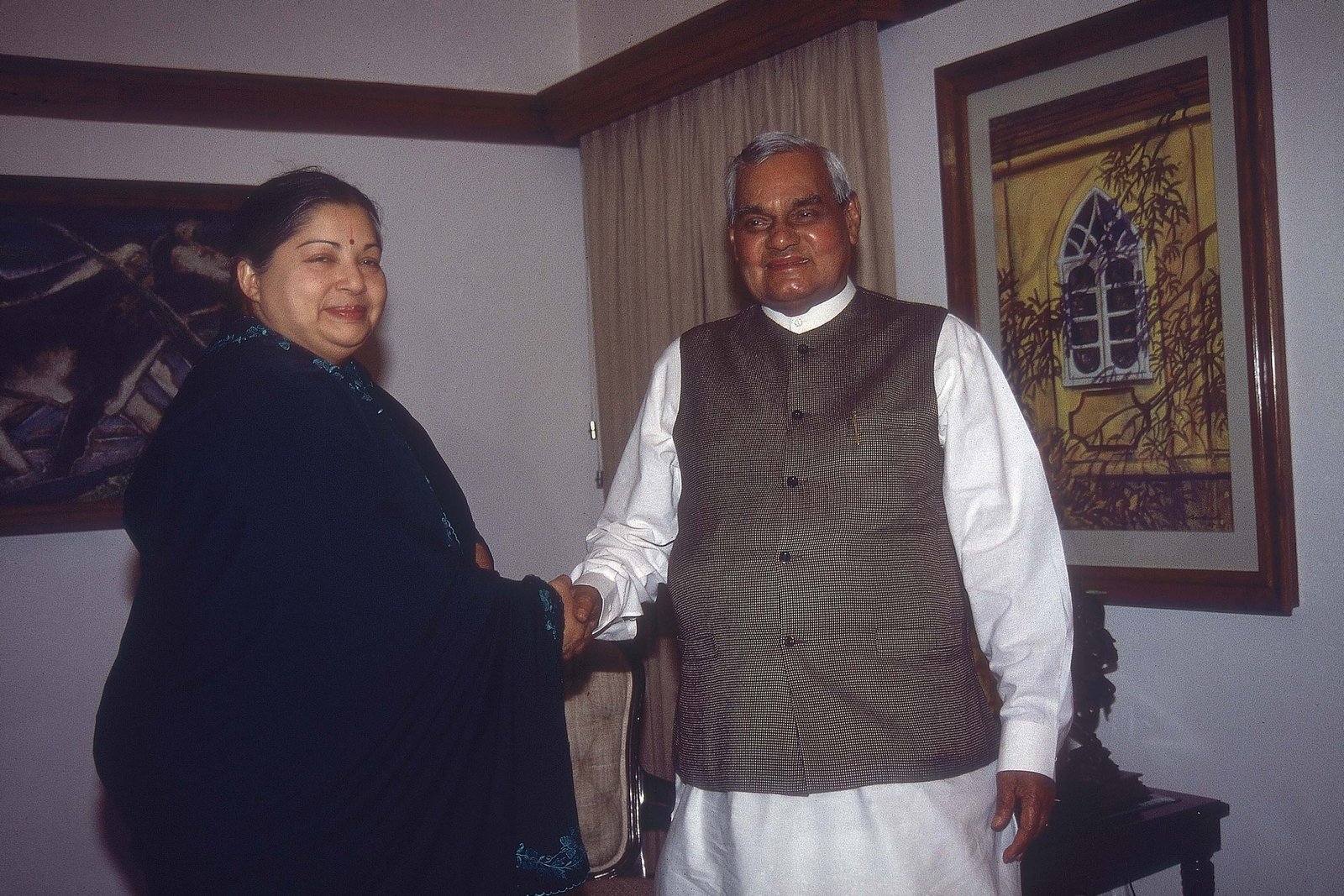
File photo of Jayalalithaa and Atal Bihari Vajpayee from Getty Images.
The 1998 Lok Sabha verdict did more than restore Jayalalithaa to relevance; it lifted her back into the national frame with decisive force. Reduced to political debris in 1996 and battered through 1997, she now re-entered Delhi not as a supplicant seeking rehabilitation, but as a pivotal ally in a fragile arrangement. Atal Bihari Vajpayee returned as prime minister in March 1998, but his government rested on arithmetic that required constant counting and tense tending.
Jayalalithaa understood the value of her position with instinctive clarity. This was not a partnership of equals nor even one of convenience alone. It was a structure in which her support was essential, and therefore negotiable at every step. She had climbed the northern staircase not to admire the architecture, but to test its load-bearing capacity.
For her, this was not merely a comeback. It was revenge via relevance. The woman whom Delhi’s political and legal establishment had watched being dragged through a season of disgrace was now back at the very table where power was portioned out. And she intended to make sure nobody in the capital forgot that fact.
Support with Teeth
The earliest signals made that intent unmistakable. Even before the coalition could settle into rhythm, the matter of formal support became an instrument of messaging. Compliance would not be automatic; it would be calibrated. This was not alliance etiquette. It was a warning.
From the outset, Jayalalithaa positioned herself not as a junior partner, but as a conditional guarantor. Her approach to the NDA was shaped less by ideological alignment than by transactional clarity. Support would flow, but only so long as expectations were met — and expectations, in this case, were expansive, layered and often deeply personal.
This was the season in which Delhi discovered that support from Tamil Nadu could arrive with velvet, but rarely without claws.
Power as Protection
Those expectations were not about national policy: Jayalalithaa rarely agitated herself on such profound matters. Delhi, for her, was a space where political power could alter legal weather. The cases that had dogged her through 1997 had not disappeared. The disproportionate assets proceedings, income-tax troubles and related matters continued to cast long shadows. But coalition participation offered something less visible and yet deeply valuable: proximity to power.
AIADMK ministers in the union government, including key positions like MoS finance, access to central corridors, and the presence of Tamil Nadu-linked administrative channels created an ecosystem in which pressure could be diffused, timing influenced, and atmospherics adjusted. This was not always about direct intervention. It was often subtler than that — the politics of climate, not command. Power was not merely to govern; it was to buffer, soften and occasionally delay.
Moopanar and Chidambaram
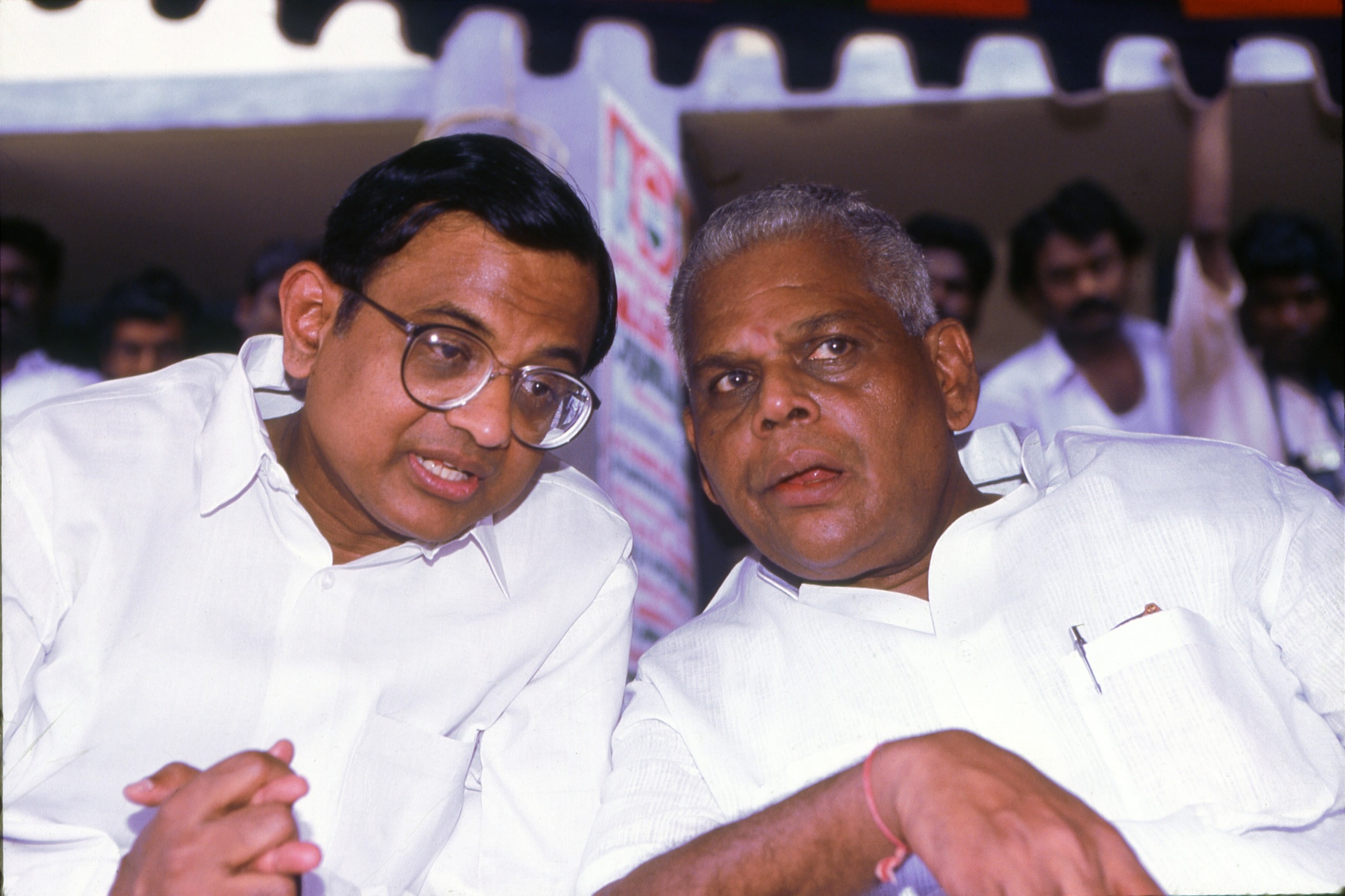
P. Chidambaram and G.K. Moopanar (Photo: India Today Archives)
At the same time, Jayalalithaa’s anger still burned against those she believed had helped engineer her humiliation. She remained deeply hostile to G.K. Moopanar and P. Chidambaram, whose 1996 split from Congress and alignment with the DMK had transformed anti-Jaya sentiment into electoral annihilation. She wanted not just rehabilitation, but retribution. The legal and political tracks were, in her mind, never entirely separate.
In that sense, Delhi became not just a site of national politics, but an extension of Jayalalithaa’s political survival strategy and settling of scores.
Dismiss Fort, Save Face
At the centre of her demands lay a familiar insistence: the dismissal of the Karunanidhi government in Tamil Nadu. The argument was framed through law-and-order concerns, through the lingering shadow of LTTE links, Coimbatore blasts and through the language of national security. But beneath the formal reasoning lay a deeper political objective — to remove a rival government that stood both as adversary and obstacle.
Here, however, she collided with a changed constitutional landscape. The Bommai judgment had altered the ground rules. Arbitrary dismissal was no longer easily defensible. The BJP, leading a coalition dependent on regional partners, could not afford to appear cavalier with federal norms. Nor could it lightly dismiss an elected government without inviting both legal scrutiny and political backlash.
Thus began a structural tension. Jayalalithaa was seeking to use Delhi’s power in a manner that belonged to an earlier era. Vajpayee’s government, constrained by law and coalition logic, could not fully oblige. The demand did not disappear. It hardened.
The irony was exquisite. The same Tamil Nadu that had benefited from Bommai’s shield was now producing a leader impatient with the very restraint it had helped constitutionalise.
The Desert Flash, The Chennai Pause
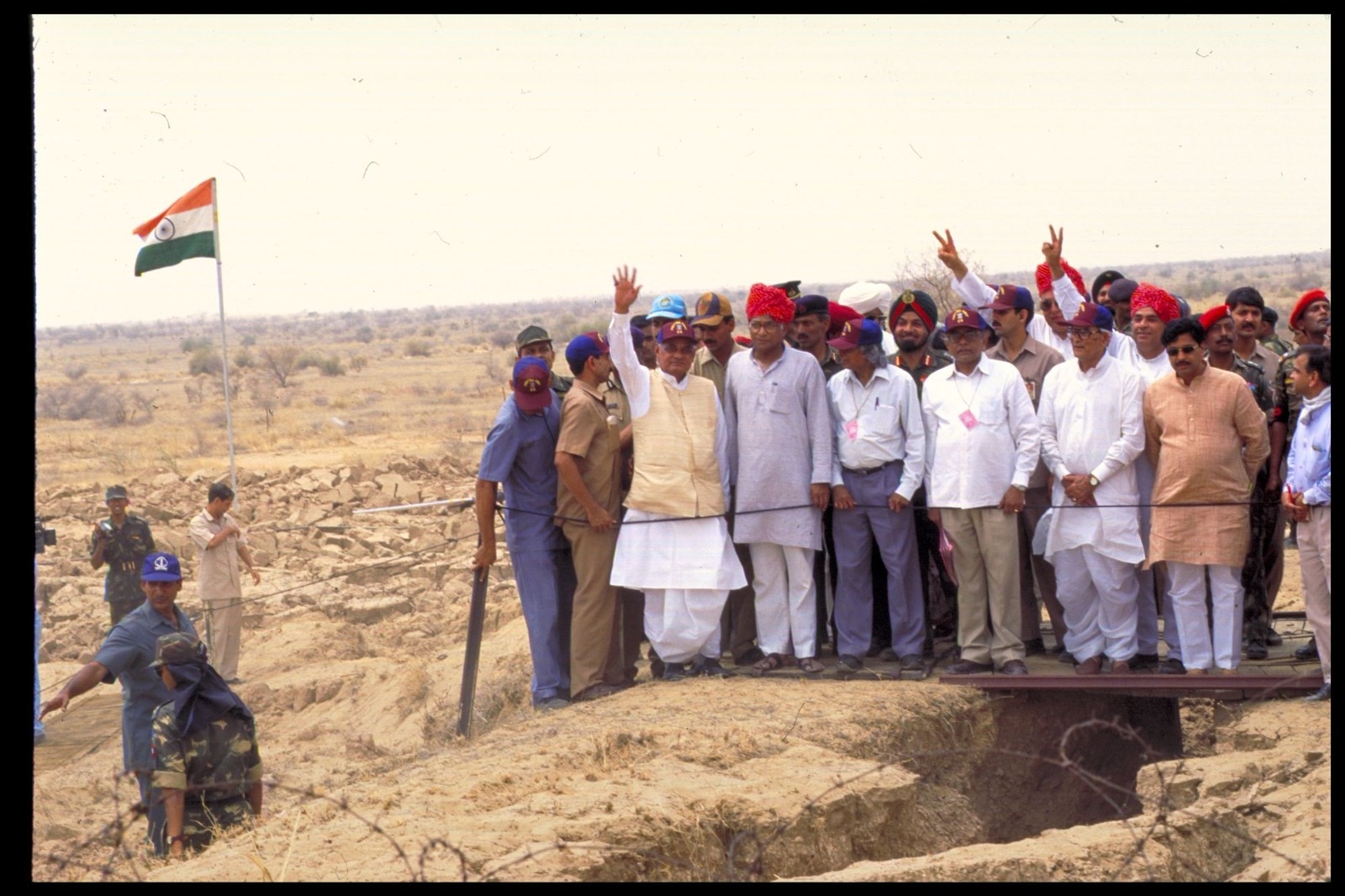
Atal Bihari Vajpayee and others at the site of Pokhran II after India went nuclear (Photo: India Today Archives)
In May 1998, the nuclear tests at Pokhran briefly altered the political mood. National pride surged, and Vajpayee’s stature rose sharply. For a moment, the fractures within the coalition were softened by a larger narrative of strategic assertion. The prime minister appeared less as a manager of numbers and more as a statesman of consequence.
But this pause was temporary. National grandeur briefly masked coalition fracture: it did not heal it. Once the patriotic dust settled, Delhi returned to its daily chore of placating allies — and none needed more placating than the one in Chennai.
Letters, Lists & Lobbying Flights
As the months passed, Jayalalithaa’s pressure on the government grew more pointed. Lists of demands, dissatisfaction with specific ministers, and an expanding catalogue of grievances became part of the coalition’s daily rhythm. Communication was not merely administrative; it was performative. Each letter, each signal, reinforced the message that support could not be taken for granted.
This was also the period when Delhi began dispatching emissaries to Chennai with the regularity of temple processions. George Fernandes and Pramod Mahajan were among the more prominent political messengers who found themselves flying south to please, persuade, reassure or simply survive an audience. Their visits became a genre in themselves.
And then there was the choreography of waiting. One of the more enduring images of the period was that of senior national leaders cooling their heels in Poes Garden’s reception spaces, sometimes for hours, while the hostess of the moment decided when — and in what mood — they might be received. This was not mere discourtesy. It was a deliberate drama. Delay itself had become a political instrument.
Delhi’s ministers, who were accustomed to being power brokers, often found themselves reduced to petitioners in starched shirts, waiting outside a Chennai Durbar for the next signal. Just as well for Jayalalithaa, for the BJP’s northern Ji’s are known only to look down on Madrasi South, not up to it. The role reversal brought cheeky cheers. The haughty saffron got little sympathy here.
The Foe Who Became a Fuse
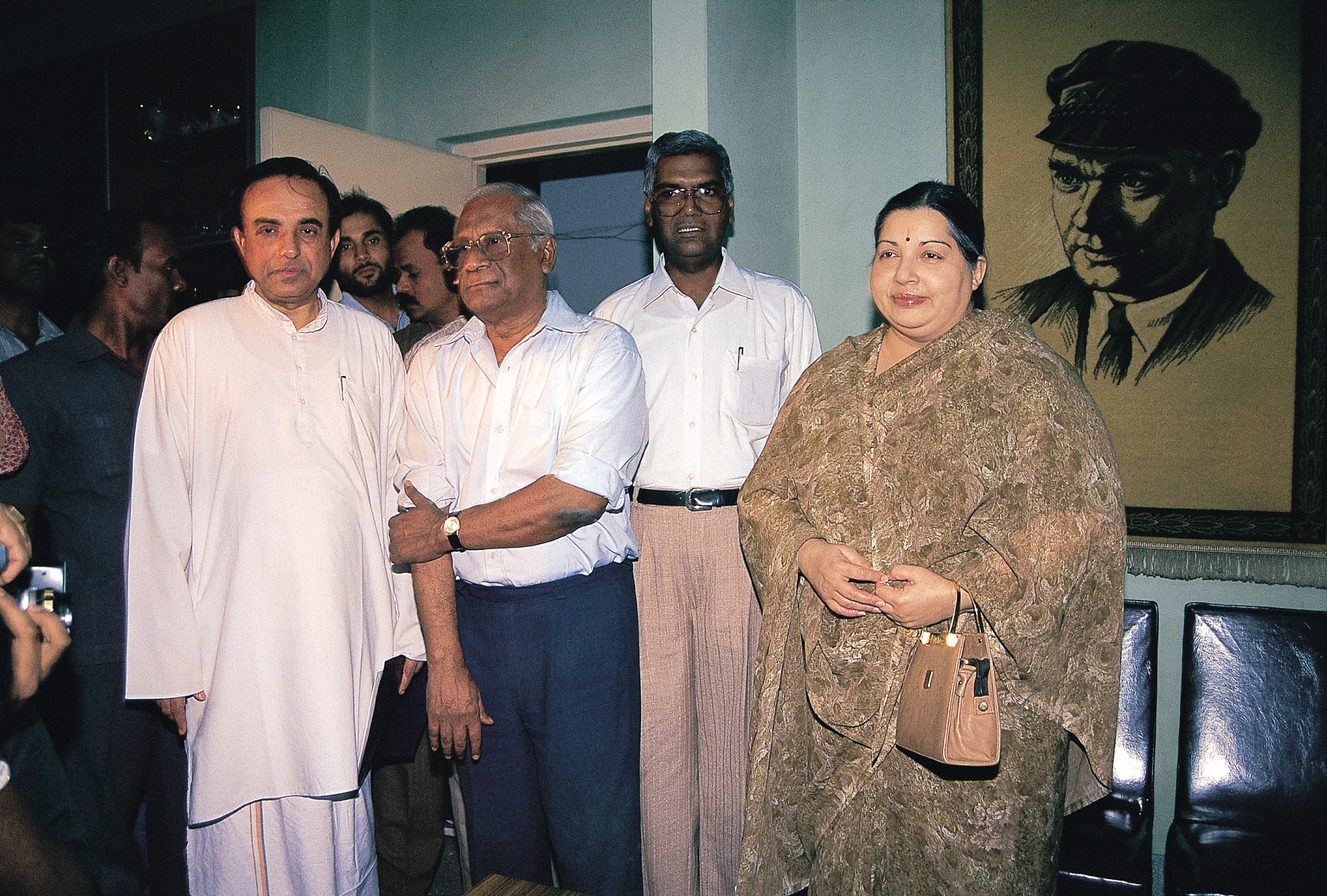
Jayalalithaa and Subramanian Swamy, once fierce rivals, shared a fraught political history marked by sharp criticism and legal battles.
Into this already volatile mix stepped a familiar and unpredictable figure: Dr. Subramanian Swamy. For years, he had been one of Jayalalithaa’s fiercest critics and legal adversaries. Yet Tamil Nadu politics has long had a way of turning enmity into utility.
In this phase, Swamy’s role became less that of an opponent and more that of a catalytic, rather catastrophic, intermediary. His political instincts, honed through decades of disruption, found new relevance in a Delhi increasingly susceptible to intrigue. Old hostilities were not erased, but they were rearranged. In the theatre of coalition politics, even a long-time adversary could become a useful conduit — or a fuse.
Few figures in Indian politics have performed the role of Narada with such consistency and such self-belief. Swamy’s genius lay not merely in entering a room, but in ensuring that no room remained stable after he left it.
The New Face in 10, Janpath
At the same time, another figure was entering the national stage with growing clarity: Sonia Gandhi. What had begun as a ‘reluctant’ political association was steadily evolving into active leadership of the Congress, first family’s prime property. The party, still searching for coherence after its electoral decline, found in her both a symbol and a centre of gravity. For the Indian-made foreign leader, it was a chance to attempt a grab for the gaddi.
Her presence altered the arithmetic of opposition. The anti-BJP space, which had until then been fragmented and tentative, now had a focal point. For Jayalalithaa, this opened new possibilities. Delhi’s alignments were no longer fixed; they were fluid.
The return of the Gandhi surname changed the room temperature in Delhi. It also revived old Congress instincts — among them the belief that power, if numerically possible, was morally due.
Tea, Sugar and a Brewing Cup
It was in this charged environment that one of the most memorable political moments of the period unfolded: the now-famous tea party hosted by Subramanian Swamy in Delhi on March 29, 1999. What might have passed as a social gathering acquired political significance because of who attended — and who was seen together.
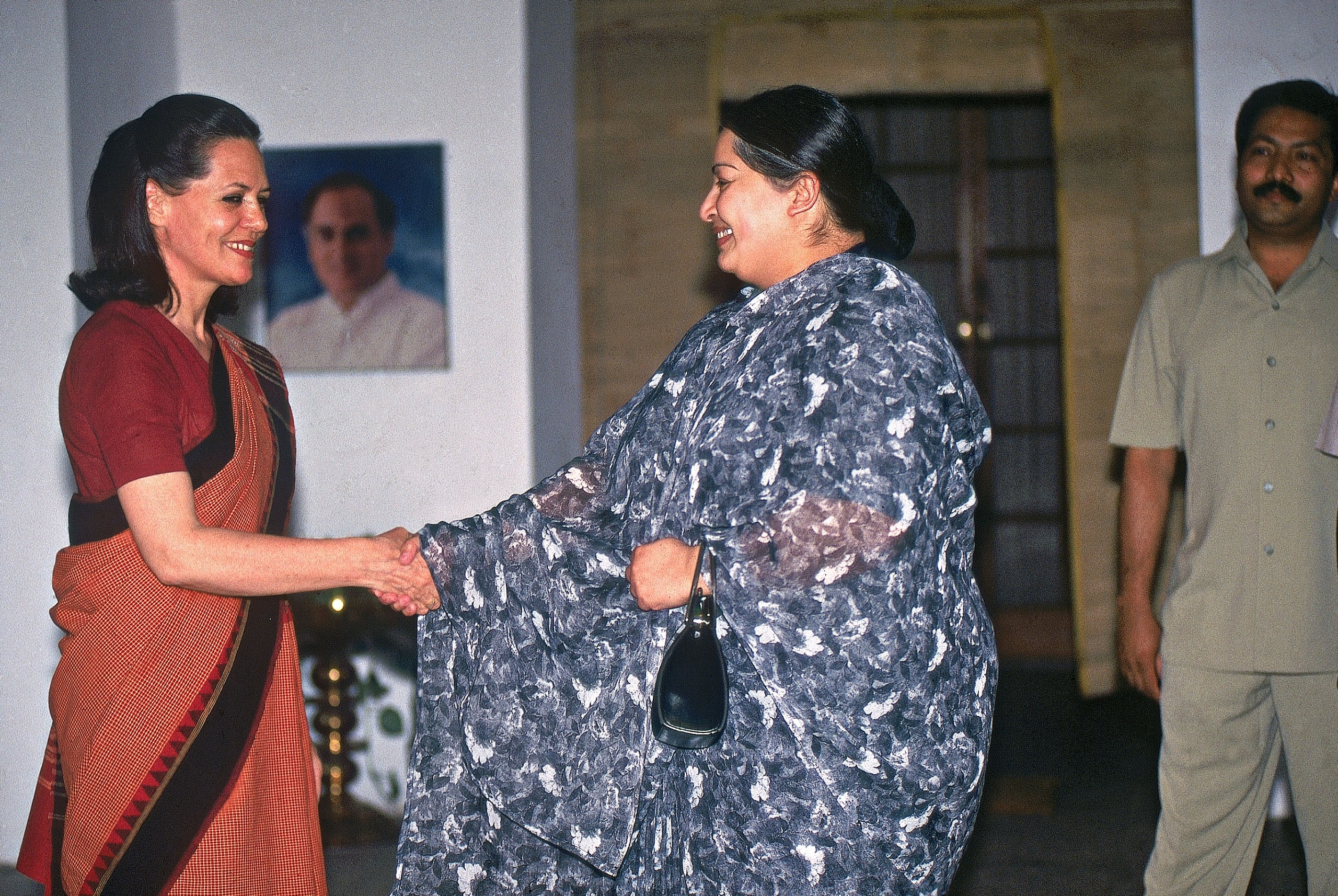
Sonia Gandhi and Jayalalithaa were allies of circumstance, not affinity (Photo: India Today Archives)
Jayalalithaa and Sonia Gandhi, representing two very different political trajectories, found themselves in the same room. The symbolism was unmistakable: A potential partnership against the Vajpayee government was being previewed, not announced.
The image lingered. In coalition politics, optics often precede outcomes. That twilight tea was less Darjeeling than detonator.
Yet even at that moment of apparent convergence, the chemistry was awkward. Jayalalithaa and Sonia Gandhi were allies of circumstance, not affinity. One represented theatrical command, southern hauteur and tactical impatience; the other carried inherited legitimacy, Congress reserve and a different political idiom altogether. It was not so much a friendship as a frost-covered truce.
Swamy, having performed his Narada act with maximum flourish, would soon recede from centre-stage, as though satisfied that the fire had been lit and the smoke would now look after itself.
The Pull of the Plug
The tensions that had been building for months had now reached their logical conclusion. Jayalalithaa withdrew support from the Vajpayee government in April 1999. The reasons were layered — unmet demands, unresolved grievances, dissatisfaction with the handling of key issues, the refusal to sack the DMK government in Tamil Nadu, and a growing sense that continued association was yielding diminishing returns.
But the withdrawal was not a sudden rupture. It was the culmination of a sustained strategy of pressure. The coalition had been tested repeatedly. It now snapped.
There was, however, a fatal flaw in the move. Jayalalithaa had calibrated disruption, but not fully calculated aftermath. She seemed to imagine that once Vajpayee fell, Delhi’s brokers and backroom tacticians would reward her with a more favourable dispensation. That hope would prove expensive.
One Vote, One Wound
The confidence motion that followed on April 17, 1999 remains one of the most dramatic episodes in India’s parliamentary history. The Vajpayee government fell — not by a sweeping rejection, but by the narrowest of margins. One vote.
The numbers told the story: 269 to 270. Absences, cross-voting, last-minute shifts — every element of parliamentary arithmetic came into play. Saifuddin Soz’s decision to vote against his party line, the complexities around participation, and the razor-thin margin combined to produce a result that was both procedural and profound.
Governments in Delhi had fallen before. But rarely had one fallen with such surgical precision. It was not a collapse driven by waves or an uprising. It was an outcome decided at the edge of a ledger.
For Tamil Nadu, the symbolism was striking. A state once vulnerable to Delhi’s axe had now become central to the fall of a government in the capital. Delhi, which had once dismissed Tamil Nadu’s governments with the ease of a file note, was now once again felled by a storm emanating from Tamil Nadu.
The Queen’s Misfire
And yet, the immediate aftermath raised an uncomfortable question: had Jayalalithaa overplayed her hand?
In withdrawing support, she had succeeded in bringing down a government. But what followed did not unfold as she might have anticipated. The attempt to construct an alternative arrangement proved more complicated than the act of dismantling the existing one. Arithmetic, once rearranged, does not always settle into new coherence.
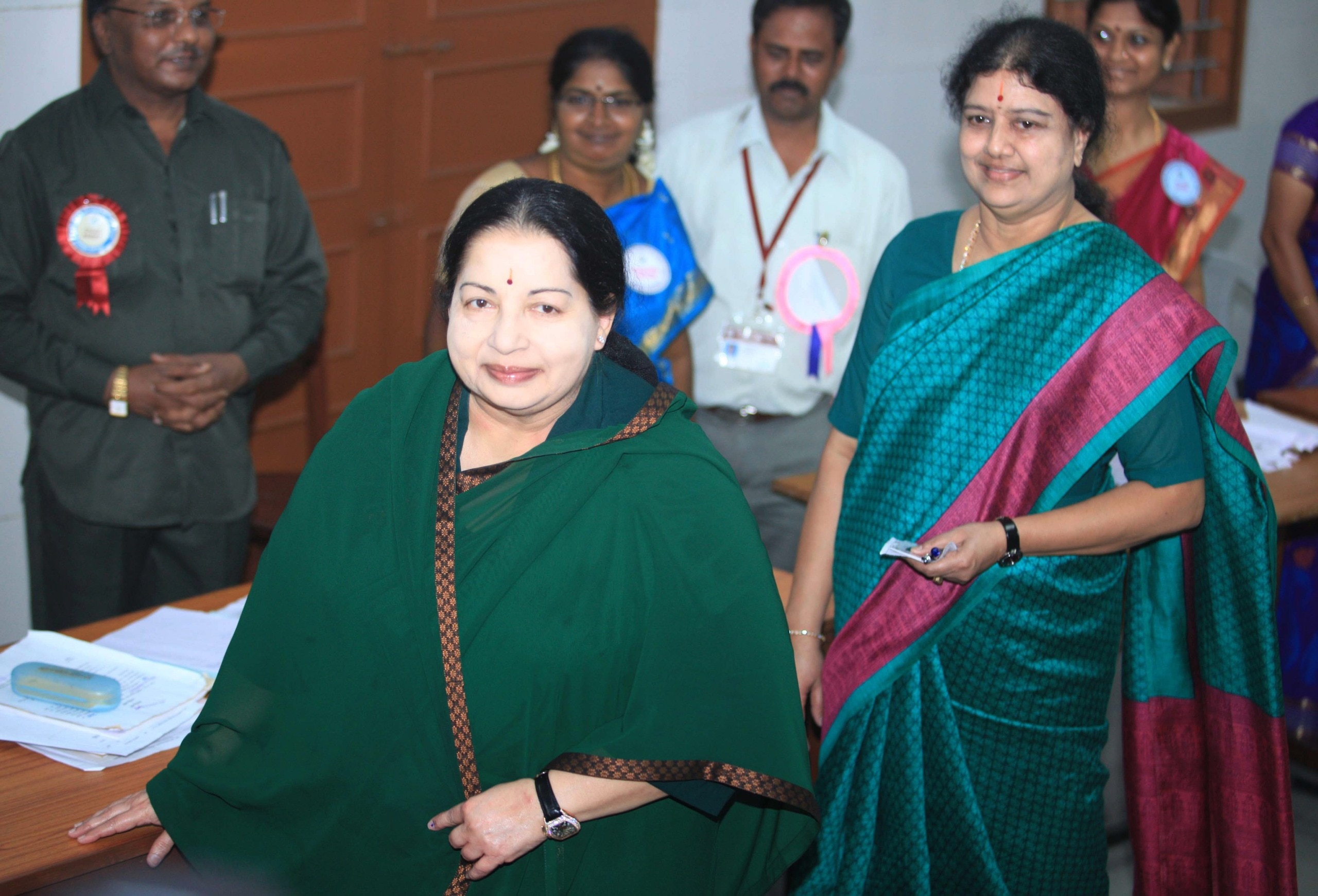
Jayalalithaa and Sasikala, bound by loyalty, controversy, and a deeply entwined political journey (Photo: India Today Archives)
Jayalalithaa arrived in Delhi in April 1999, accompanied by Sasikala, with the aura of a gamechanger and, by many accounts, the expectation that a post-Vajpayee arrangement might not merely accommodate her but elevate her. There were rumours, hopes and Lutyens-fed fantasies that she might occupy an even more substantial place in a new order — perhaps even as a union minister with a heavyweight portfolio. Delhi’s professional whisperers, who survive by selling tomorrow before it exists, had clearly done brisk business.
But once the deed was done, the northern brokers who had encouraged the move proved notably less committed to carrying its consequences. She had been useful in the unseating. She was dispensable in the fluctuating fortunes that followed. She had landed in Delhi greeted by showers of flowers; no one knew when she left!
This was the real wound of the episode. Jayalalithaa had not merely lost leverage; she had inadvertently created space for Karunanidhi.
We Have 272… Or Do We?
The Congress, under Sonia Gandhi, moved to stake its claim. The now-famous assertion that the numbers were in place — “we have 272” — captured both the ambition and the uncertainty of the moment. Negotiations intensified, alignments were explored, and possibilities were tested.
But the numbers did not hold. The attempt to form an alternative government faltered. Delhi, having witnessed the fall of one arrangement, could not immediately produce another.
This was the familiar comedy of coalition India: governments could be brought down with astonishing precision but assembled only with great improvisation and very little shame.
Karunanidhi Waits, Watches, Switches
Amid this turbulence, Karunanidhi adopted a markedly different approach. Where Jayalalithaa had pressed for immediate outcomes, he chose patience. The DMK recalibrated its position, moving towards alignment with the BJP-led formation.
This was not ideological conversion so much as strategic repositioning. Karunanidhi recognised that durability in coalition politics often required adaptability. If the earlier phase had seen the DMK in a different configuration, the new phase demanded a different alignment. That the DMK was the antithesis of all that the BJP believed in was of little consequence for both.
And here lay the most delicious irony of all. By toppling Vajpayee in a fit of adamance, Jayalalithaa ended up helping create the very Delhi space that would soon be occupied by her rivals. The DMK, not the AIADMK, would now move closer to the Centre. Murasoli Maran and other DMK figures would find themselves in ministerial relevance while Jayalalithaa, who had arrived imagining herself the decisive national pivot, found the floor shifting beneath her.
It was a political self-goal of rare elegance.
War, Wind and Reset
The Kargil conflict of mid-1999 introduced a new dimension to the political landscape. National attention turned outward, and the question of security overshadowed internal intrigue. Vajpayee’s leadership during the crisis enhanced his stature, and the electorate’s appetite for prolonged instability diminished.
War did not erase the memory of coalition fragility. But it altered the tone of the impending election. Public opinion now leaned more naturally toward stability than spectacle.
The Bellwether Ballot
When the country returned to the polls in September-October 1999, Tamil Nadu once again offered a masterclass in the speed with which alliances in this state can mutate from conviction to convenience and from convenience to discomfort.
The DMK and BJP entered the election as relatively cohesive partners in the NDA framework. Jayalalithaa, by contrast, found herself in a more awkward formation — aligned with Congress and, most notably, with the Tamil Maanila Congress of GK Moopanar, the very formation born in 1996 just to destroy her. Politics, as ever, had a wicked memory and a flexible spine.
For Moopanar, this was not exactly a triumphant embrace. It was a moment of visible embarrassment, if not outright mortification. The TMC, which had once stood as a vehicle of anti-Jaya moral clarity, now found itself sharing political space with the very leader whose excesses had helped justify its birth. The alliance may have been electorally explicable, but it was emotionally untidy.
Nor did the Congress-AIADMK relationship ever really gel. The frostiness between Sonia and Jayalalithaa remained palpable. Even on the campaign trail, they never seemed to move with the warmth or coherence of natural allies, never even campaigning together. In Tamil Nadu, where chemistry often matters as much as arithmetic, this rift was glaring.
When the votes were counted, the reply was unmistakable. The DMK-BJP combine and its allies performed strongly in Tamil Nadu, while Jayalalithaa’s front failed to convert intrigue into victory. Nationally too, the NDA returned with greater stability, giving Vajpayee a more secure footing than before.
The voter, it seemed, had not merely judged ideology or arithmetic but also punished disruption.
The Decade’s Fastest Revolving Door
This period, compressed into less than two years, redrew the relationship between Tamil Nadu and the centre. It demonstrated that regional parties could decisively influence national outcomes. It also revealed the limits of that influence.
Jayalalithaa had arrived in Delhi in 1998 with the aura of a game changer. By 1999, she found herself at the losing end of a sequence she had helped initiate. The space she vacated was quickly occupied by the DMK, whose leaders now held positions in the union government, shaping policy from within rather than pressing from without.
The contrast was instructive. Leverage, used with precision, could secure influence. Leverage, pushed to rupture, could dissolve it.
The nineties had, after all, become India’s great prime-ministerial parade — VP Singh, Chandra Shekhar, PV Narasimha Rao, Deve Gowda, Gujral and Vajpayee, twice — a turbulent ten years in which Delhi seemed perpetually one ally away from collapse. Tamil Nadu had played through this era not merely as theatre or spectator, but as participant, provocateur, pressure point, conductor, catalyst, instigator and, occasionally, demolition contractor.
And thus, by the end of the year, the decade, the century and the millennium, one truth had become impossible to ignore: Post-1996, Tamil Nadu was no longer merely reacting to national politics. It had become one of the forces redrawing it.
But if Delhi had been shaken enough, the larger duel was now ready to return home. The drama would move back to Tamil Nadu itself — to legal clouds, electoral audacity, a comeback that defied ordinary logic, and a leader who would soon prove that in this state, disqualification and defeat are often only the prelude to return.
Next: Centre Stable, Chennai Countdown, Law & Outlaw, Amma’s Comeback
SOURCE :- TIMES OF INDIA