
Source : THE AGE NEWS
March 4, 2026 — 12:00pm
The US-Israeli assault on Iran could have been expected to produce shockwaves throughout financial markets. Instead, while markets are down, the reaction has been relatively subdued.
While the oil price has spiked from about $US70 a barrel ahead of the attacks to more than $US81 a barrel, the move is roughly the same order of magnitude as the oil market’s response to last year’s bombing of Iran’s nuclear facilities.
That limited conflict didn’t close the Strait of Hormuz, through which about 20 per cent of the world’s oil and gas flows. This one has.
The gold price has actually fallen back from the record levels it was experiencing, and the US sharemarket has see-sawed before seeing its big early moves moderate to end down 0.9 per cent – hardly an investor stampede.
The US dollar has strengthened a little relative to America’s major trading partners’ currencies and bond yields have risen – the two-year yield by 13 basis points and the 10-year by 9 basis points – in a combination of a flight to safety and a response to expectations of energy-driven inflation.
What hasn’t happened is the dramatic surge in oil prices experienced in 2022, when Russia invaded Ukraine, when the price topped $US122 a barrel. European gas prices, responding to the shutting of Qatar’s giant LNG facilities, have soared about 70 per cent, but that also pales against the more than 160 per cent rise in European Union prices in response to the Ukrainian conflict.
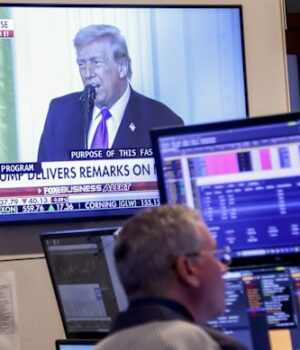
Investors don’t seem to believe that the conflict will be protracted, even if Donald Trump has said it might take four or five weeks before it ends.
Past conflicts in the Middle East have seen oil price rise between 150 per cent and more than 250 per cent, with unpleasant flow-on effects for the global economy. The rule of thumb is that a 10 per cent rise in oil prices reduces global growth by about 0.15 percentage points and increases global inflation by about 0.4 percentage points.
So why, given that the Strait of Hormuz is closed, haven’t markets reacted more violently?
The obvious answer is that investors don’t seem to believe that the conflict will be protracted, even if Donald Trump has said it might take four or five weeks before it ends.
A secondary strand might be that they believe that Trump, facing midterm elections this year in which prices and inflation could influence the result, will do whatever it takes to ensure the impact on oil prices – and US petrol prices – is limited.
They got that bit right. On Tuesday, via (as usual) a social media post, Trump said he had ordered the US Development Finance Corp to provide, “at a very reasonable price”, political risk assurance and guarantees for the financial security of all maritime trade, particularly energy, travelling through the Persian Gulf region.
“This will be available to all Shipping Lines. If necessary, the United States Navy will begin escorting tankers through the Strait of Hormuz, as soon as possible. No matter what, the United States will ensure the FREE FLOW of ENERGY to the WORLD,” he wrote.
While the Iranians have threatened to attack ships travelling through the strait, they have yet to do so. The vital passage has, however, effectively been closed to the oil trade because tanker owners and, in particular insurers, have made the cost of chartering ships and providing insurance cover for them prohibitive.
The US has provided naval protection for tankers passing through the strait during past regional conflicts and, with Trump providing insurance his intervention might see some resumption of shipping movements.
Reopening the strait is vital if oil prices aren’t to soar and the impact on global inflation and growth isn’t to be magnified.
The oil and gas that is being produced, but not shipped, in Saudi Arabia, the United Arab Emirates, Kuwait, Iraq and Iran has to be stored if it isn’t being transported.
While the Saudis and the UAE do have some pipelines that reduce their reliance on the strait, their capacity is limited – the Saudi pipeline can carry about 5 million barrels a day and the UAE’s about 1.5 million barrels a day – and is already being utilised.
There is considerable storage capacity in the region – the Saudis have about 64 million barrels of spare capacity, the UAE about 50 million barrels and Kuwait about 40 million – but, at the rate they produce, that capacity could be used up within a couple of weeks at best.
Unless Trump can get the oil shipments flowing through the strait again, in a prolonged shutdown of production in the Middle East – the source of about a third of all oil exports and closer to 40 per cent of all oil products – the damage to oil supplies will be greater and more lasting, and the impact on prices (and therefore the global economy) far more significant than the markets have currently priced in.
The apparent calm within financial markets might also relate to the changing nature of the structure of global energy markets, compared to previous oil crises.
The shale oil revolution has turned the US from an oil importer into the world’s largest energy exporter, giving it energy self-sufficiency and the rest of the world an alternate supplier to the Middle East-dominated OPEC cartel that once could dictate global supply and prices.
It is the US that has helped fill the vacuum in European Union energy imports created by the EU’s reduced reliance on Russian energy. The US is now the world’s largest LNG exporter, with more terminals under construction, overtaking the former leading exporters Qatar and, before it, Australia.
With Qatar shutting its major facility, American LNG producers are scrambling to ramp up supply to take advantage of the big spike in spot prices, a spike that will also benefit Australian producers.
The US production, combined with the energy market’s oil glut before the conflict started – 3 or 4 million barrels a day of supply were surplus to demand – and global inventories of about 2 billion barrels (roughly half of them in China) mean there is more of a buffer to an interruption of Middle Eastern supply than there has been in the past.
That only helps insulate the market to a degree, of course. If the war in Iran stretches out into weeks or months, investors will pay a lot more attention to the aftershocks that could create.
The US is already experiencing some tariff-induced inflationary pressures. Its core inflation rate (excluding food and energy prices) keeps edging up, and the most recent survey of manufacturers showed an 11.5 per cent increase in January in the index that tracks their input costs.
Oil-related petrol price rises (as is the case here, US domestic energy prices reflect global prices) would, as Trump now appears to recognise, add to the inflation rate and decrease the already-receding likelihood of an interest rate cut in the US anytime soon.
For the moment, investors are sanguine, betting on a short and sharp conflict with only temporary secondary effects and then a resumption of business as usual (for those outside Iran).
If the hostilities drag on, or the Strait of Hormuz doesn’t fully reopen, or energy infrastructure in the region is significantly damaged by Iran’s scatter gun retaliation, that complacency would be shattered – with threatening implications for the markets, economies and investors.
Read more on the US-Israel-Iran war:
The Market Recap newsletter is a wrap of the day’s trading. Get it each weekday afternoon.
 Stephen Bartholomeusz is one of Australia’s most respected business journalists. He was most recently co-founder and associate editor of the Business Spectator website and an associate editor and senior columnist at The Australian.Connect via email.

