
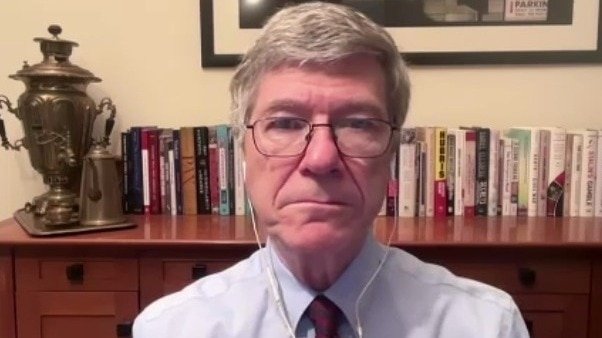
Source : INDIA TODAY NEWS
In a blistering assessment of the escalating crisis in the Middle East, noted economist and Columbia University professor Jeffrey Sachs has characterized the recent military strikes by the United States and Israel on Iran as a “premeditated” campaign for regional and global dominance.
In an interview with India Today TV, Sachs said the latest US strikes were “premeditated” and dangerous to the world order. He dismissed official justifications from the US and Israel as “a lie,” suggesting the conflict is far from a defensive necessity.
advertisement
“There was no imminent threat whatsoever,” Sachs said, disputing US President Donald Trump’s claim that military action was necessary to stop Iran’s nuclear ambitions. According to him, negotiations to revive the 2015 nuclear agreement were underway when the strikes occurred.
‘PLAN FOR HEGEMONY’
Professor Jeffrey Sachs argued the conflict reflects broader power ambitions. “This is a plan for US control over the Middle East and for Israeli hegemony militarily in the Middle East,” he said.
Warning of serious escalation risks, Sachs added that the situation “could become World War III,” accusing Israeli Prime Minister Benjamin Netanyahu of pushing Washington toward open war.
“Israel wants hegemony in the Middle East. The United States wants global hegemony. So that’s what the partnership is about,” he said.
He also described the war as “premeditated, dangerous for everybody — dangerous for India, dangerous for the world.”
AMERICANS AGAINST IRAN WAR
On domestic sentiment in America, Sachs claimed there is strong public resistance to the conflict.
“The disconnect is between our military security state which runs the United States and the American people,” he said, adding that “roughly three quarters of the American people are against it.”
He suggested the war had been in the works for years, noting the scale of military mobilisation in the region. “This is not something that just happens in a day or two. This is long planned,” Sachs said.
Sachs further predicted political fallout for the US president if the conflict drags on.
“If this is prolonged, Trump’s approval ratings, in my view, will plummet further,” he said, noting the president was already unpopular when the war began.
‘BOOTS ON GROUND’ UNLIKELY
Despite fears of a prolonged conflict similar to Iraq or Afghanistan, Sachs said he does not expect US ground troops to be deployed.
“I don’t think the American society will accept boots on the ground,” he said, calling Trump “deeply unpopular” and arguing that Americans “see through these lies.”
However, he cautioned that near-term developments will depend on battlefield dynamics, including missile defences and Iran’s capacity to sustain retaliation.
HORMUZ THREAT AND GLOBAL ECONOMY
Jeffrey Sachs warned that any disruption in the Strait of Hormuz could deliver a major economic shock, particularly to energy-importing countries.
He said oil prices could rise above $100 per barrel and predicted that insurers and shipping companies may avoid the narrow waterway if tensions persist.
“If it lasts many weeks or even months, it will have a very significant effect on the world economy… and it will be Europe, India and China that will pay the highest price,” he said.
REGIME CHANGE IN IRAN?
Sachs dismissed suggestions that bombing Iran could trigger an internal uprising.
“The idea that people will take to the streets and replace the regime seems to me an utter fantasy,” he said, adding that a few weeks of air strikes are unlikely to bring a large, mountainous country “to its knees.”
He also characterised Iran’s regional strikes as primarily targeting US military installations rather than civilian sites, though he acknowledged the situation is “extraordinarily complicated.”
CALL FOR BRICS ROLE
He urged countries outside the Western alliance system to take a more active diplomatic role.
“I think that the BRICS should play the leading role in this,” Sachs said, while advising New Delhi to maintain strategic autonomy.
“My advice to India is do not join the Quad… India is an independent country,” he said, arguing that Washington is pursuing a classic “divide and conquer” strategy globally.
EUROPE ‘POORLY LED’
The economist was equally critical of European governments, calling the continent “very poorly led” and overly dependent on Washington.
“Everything that happens is adverse to Europe,” Sachs said, claiming most European governments backed the US strikes due to their security dependence.
Despite his grim assessment, Sachs said the conflict could still be halted if Washington changes course.
“The glimmer of hope is the United States says this does not work… We go home. The fighting will stop,” he said.
– Ends
Must Watch
SOURCE :- TIMES OF INDIA